.png) 3 months ago
72
3 months ago
72
You could be forgiven for thinking Friedrich Merz would rather be anywhere but Germany of late.
But hopes that his stop in Washington this week would provide the chancellor even a brief respite from woes at home were dashed by Donald Trump’s risky Iran gamble.
Only just back from high-stakes trade talks in China, the unpopular Merz boarded the Konrad Adenauer, the government’s jet, bound for the US after the weekend’s seismic events.
The US-Israeli military attack on the Middle East has left European leaders looking once again like spectators in the unsettling new landscape of great power politics. But the fact is the war will have incalculable economic, political and security implications for Europe too.
As the first European leader to be granted an audience in the gold-adorned Oval Office since the war started, Merz was under pressure to perform what observers called a “high-wire act” – of defending European interests without antagonising the increasingly erratic Trump.
During his brief perch in the White House hot seat, Merz was at pains to identify common ground while impressing upon his often distracted interlocutor the stakes of his actions. It also kept him from stepping in – at least in public – when Trump went on the attack against allies Spain and the UK for purported failings. It also stopped him from mentioning international law.
“We are on the same page in terms of getting this terrible regime in Tehran away. And we will talk about the day after,” Merz said in response to one of the many open questions of what comes next in Iran.
But the chancellor did not mince words about the knock-on effects of Operation Epic Fury, which has sent stock markets reeling and energy prices soaring.
“This is, of course, damaging our economies,” he said. “So that’s the reason why we all hope that this war will come to an end as soon as possible.”
Although Trump was fixated on Iran, Merz repeatedly attempted to steer the conversation back toward Europe’s top concerns: the US’s on-again, off-again tariff policies and Ukraine.
German-American political scientist Cathryn Clüver Ashbrook, who has just published a book on this fraught period in transatlantic ties, The American Wake-up Call, said the Europeans had precious few options for keeping Trump onside.
“Merz is in a terrible situation, as are any European leaders at this point. They have very few areas of influence,” she told me. “We’re in a world where all areas are now weaponised.”
One limited course of action with Trump, she suggested, was stressing how Europe makes itself useful to the US, even as it’s had to endure stinging rebukes from the Trump administration on everything from defence and free speech to trade and immigration.
This strategy includes making major strides toward rearmament and taking on more responsibility for Ukraine. Flexing Europe’s concerted economic muscle could also come in handy down the road – with an American domestic economy, which according to Ashbrook may be vulnerable to pressures down the line, contrary to Trump’s bullish take on US growth last week.
The Europeans should “consider their economic influence as strategic influence” and maintain a united front against the US on industrial policy and in trade disputes going forward, she said.
Trouble at home?
Trump and Merz are both facing economic headwinds with pivotal elections looming this year. The US midterms could be a disastrous referendum on his lame-duck presidency.
And Merz’s conservative Christian Democratic Union is facing five tough state polls between this Sunday and September, with the far-right Alternative für Deutschland party (AfD) surging in several races.
Merz is often seen as more sure-footed on the international stage than at home. In terms of Iran, he knows many are celebrating the death of supreme leader Ali Khamenei who had the blood of so many of his compatriots on his hands.
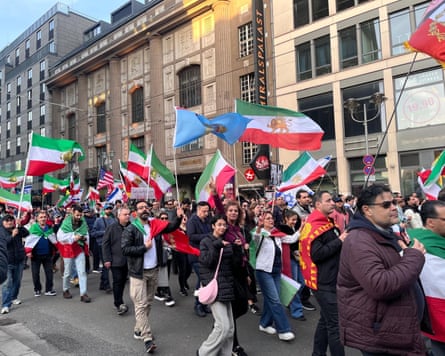
Last weekend, jubilant members of the large Iranian diaspora marched down Berlin’s Friedrichstraße, their Iranian, US and Israeli flags whipping in the spring sunshine. But the word Flächenbrand, or wildfire – a regional conflagration – is now on many lips in Berlin’s government quarter as the conflict spreads to neighbouring countries.
German officials are troubled at the US decision to attack: pushing back at the notion advanced by the Trump team that they never took the threat posed by Iran seriously. Diplomats in Berlin, which calls itself Israel’s staunchest ally in Europe, point to the countless hours it invested in hammering out the 2015 accord curbing Iran’s nuclear activities.
Trump pulled the US out of the deal during his first term and disparaged it again at Tuesday’s meeting, saying military action was long overdue. Merz at the weekend ceded that the deal had failed to snuff out Tehran’s nuclear ambitions.
But the German electorate is clamouring for an economic recovery already under threat by Trump’s latest tariff threats and now imperilled by the Iran war. German shipping, insurance and tourism giants are on edge.
Meanwhile the AfD, despite cosying up to the Trump administration, has criticised the Iran action and warned the Middle East turmoil could trigger another massive refugee influx.
Merz may see a rare glimmer of good news out of Europe this week. After months of bilateral tensions undermining EU cohesion, France and Germany agreed a landmark accord on nuclear deterrence. In the face of wavering US commitments, Germany will join French nuclear exercises and inspections of strategic sites, just as Paris announced an expansion of its nuclear arsenal, marking a significant stride toward Merz’s pledge of more security independence on the continent. Perhaps president Trump will take notice.
To receive the complete version of This Is Europe in your inbox every Wednesday, please subscribe here.