.png) 3 months ago
68
3 months ago
68
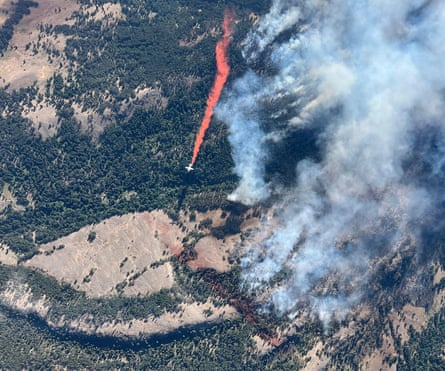
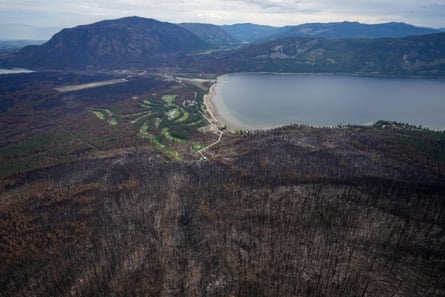
In May 2023, a lightning strike hit the forest in Donnie Creek, British Columbia, and the trees started to burn. It was early in the year for a wildfire, but a dry autumn and warm spring had turned the forest into a tinderbox, and the flames spread rapidly. By mid-June, the fire had become one of largest in the province’s history, burning through an area of boreal forest nearly twice the size of central London. That year, more of Canada burned than ever before.
The return of cold and snow at the close of the year typically signal the end of the wildfire season. But this time, the fire did not stop. Instead, it smouldered in the soil underground, insulated from the freezing conditions by the snowpack. The next spring, it reemerged as a “zombie fire” that continued to burn until August 2024. By then, more than 600,000 hectares (1.5m acres) had been destroyed.
Zombie fires, sometimes betrayed by a plume of steam emerging from the bubbling ground in the frozen forest, were once a rare occurrence in the boreal regions that stretch across the far north through Siberia, Canada and Alaska. But in a rapidly heating world, they are becoming increasingly common. The overwintering burns are small – and often hard to detect – but they are transforming fires into multi-year events and fundamentally altering the soil ecology where they burn, making it harder for forests to regrow.
“It is a massive problem,” says Lori Daniels, a forest and conservation sciences professor at the University of British Columbia. “Zombie fires, also called holdover fires, are fires that move into the organic soil matter and smoulder. It’s a very slow, but hot, combustion through a prolonged period and then they resurface. In December 2023, we had over 100 fires that were still burning, and in the spring of 2024, they continued to burn,” she says.
Current estimates show that only about 15% of the northern hemisphere is underlain by permafrost, yet these frozen soils contain roughly twice as much carbon than is now in the atmosphere. By burning slowly and at a lower temperature, they release vastly more particulate pollution and greenhouse gas emissions than flaming fires.
“These boggy soils take hundreds to thousands of years to accumulate the carbon that is stored in the organic soil layers. In some cases, it’s burning right down to the rock,” says Daniels. “Over a very short period of time, we are combusting all of this ancient carbon into the atmosphere. It becomes a feedback loop with tremendously negative consequences for the ecosystem. It changes the hydrology – you’re losing the substrate and the seed banks within them, you’re changing the soils to some sort of mineral base instead of an organic base,” she says.
The prolonged, intense burns have big consequences for the seed bank in the soils. Low and medium intensity fires – the kind of “ordinary” burns that sweep through forests periodically – provide space for the forest to regenerate quickly. After these fires, the peaty soils are full of seeds, with burned areas typically bursting into life once a blaze is over. But repeated burning and heating from zombie fires can destroy many seed species, making it much harder for ecosystems to regenerate quickly. After intense fires, only mineral soils – mostly made of up sand, clay and silt – are left.
With a lack of easy detection, scientists are working to rapidly develop methods to identify holdover Arctic fires using satellite imagery. Researchers say that while the vast majority of fires are caused by humans and lightning, zombie fires pose a significant challenge to how fire is managed, with many crews working throughout the year to keep blazes contained. Scientists say that similar patterns in Siberia, which has also seen huge fires in recent years, are likely taking place, but are not as well studied due to a lack of international collaboration with Russian researchers.
The problem can also compound itself. Patrick Louchouarn, a professor at the School of Earth Sciences at Ohio State University, says: “This has the potential to become really problematic. The more of the permafrost dries out and some of those organic, rich soils dry out in the Arctic, and the more you increase the temperature, there’s greater possibility for that fuel to be ready to burn.”
In 2025, the fire season started early again in Canada. By mid-September, 8.8m hectares (21m acres) had burned in hundreds of fires across the country. Many of the early blazes were likely zombie fires that carried over from the year before, say researchers, who highlight that the northern parts of Earth are the most rapidly warming areas, increasingly rising by several degrees more than the average.
Communities on the ground are already feeling the shift. Jennifer Baltzer, a professor at Wilfrid Laurier University, says: “In 2023, we had this crazy fire season in the Northwest Territories. Seventy percent of the region was evacuated and it was very traumatic. People were driving through crazy fires to get away from their homes. There were lots of these overwintering fires around communities that had to be evacuated.
“It adds to the stress that people in these ecosystems are facing. Usually the winter is the season where you can feel like you’re safe from fire.”
Find more age of extinction coverage here, and follow the biodiversity reporters Phoebe Weston and Patrick Greenfield in the Guardian app for more nature coverage