.png) 1 month ago
17
1 month ago
17
This wacky futuristic fantasy by Japanese writer-director Hideki Noda aims high. It opens with none other than God observing the Tower of Babel, which creeps up to the heavens in the shape of a skyscraper. Cue an irreverent satirical drama that covers the age of dinosaurs, Cleopatra’s frozen eggs (were they fertilised by Julius Caesar or Mark Antony?) and biotech, all via a plot involving time travel, diseased angels and, well, bone conduction: the present day bones of the protagonist, Help (Sadawo Abe), connect with fossilised ones through vibration.
The Pied Piper of Hamelin (Koji Ohkura) turns up, as do Mephisto (Suzu Hirose) and Faust (Isao Hashizume). Noda performs too, as a researcher in the cutthroat world of gene science. The underlying preoccupation is with the ethics of eradicating disease and the creation of the “ultimate” human. The story was partly inspired by the mass killings at a care home in Sagamihara, outside Tokyo, in 2016, by a former employee who wanted disabled people to “disappear”. Help, who is D/deaf, takes a bumpy Back to the Future-style trip to the past in order to connect with bones that form mankind’s inheritance and further medical discovery.
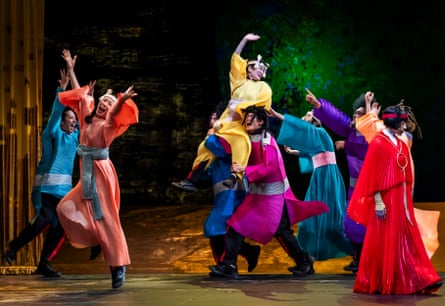
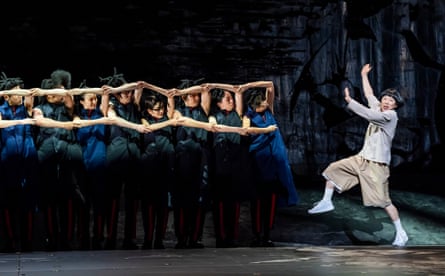
Or something along those lines, because the plot swings between dreams, fantasies, experiments with lab mice (a great comic ensemble), ancient excavations and debates. The turns are so sharp, the satire so adrenalised, it seems on a sugar high. If you can’t keep up, it doesn’t matter because much of it is such a fun ride. Highlights include a set piece with dancing bananas. There is gorgeous choreography by Shigehiro Ide and physical theatre when the ensemble becomes the fossilised bones of a dinosaur. In these moments, it gleams and sparkles.
Yukio Horio’s set design features billowing sheets to make characters disappear or reappear, along with video technology that takes us into a high-rise and gives the illusion of switching frequencies in time. It is a marvel of projection design (by Taiki Ueda), never overplayed, with striking costumes (designed by Kodue Hibino) and vibrant performances.
But the satire and whimsy are hard to sustain for more than two hours performed without an interval. It becomes over-baked into an earnestness that clashes with the earlier anarchic comedy. Yet you still walk away feeling as if you have entered the zany Tardis of Noda’s imagination – and with the motif of a phonebox to boot.
-
At Sadler’s Wells, London, until 11 July