.png) 2 months ago
60
2 months ago
60
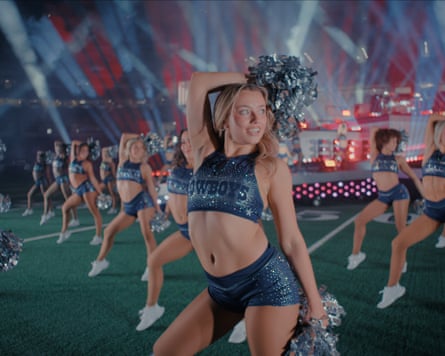
It’s been 30 years since the Dallas Cowboys – who have long billed themselves as America’s Team – won the Super Bowl. But now, thanks to Greg Whiteley’s Netflix docu-series America’s Sweethearts: Dallas Cowboys Cheerleaders, the most reliable and globally recognizable arm of the Cowboys brand may no longer be the men playing football, but the women dancing on the sidelines.
“The footballers are gonna break your heart,” one fan says in the Season 3 finale. “But the cheerleaders are gonna leave you with a smile.”
When its first season debuted in 2024, America’s Sweethearts became a breakout hit, cracking Netflix’s global Top 10 and turning what had long been a distinctly American obsession into a worldwide one. Like the long-running CMT series Dallas Cowboys Cheerleaders: Making the Team, which ended in 2022, it follows the annual process through which the DCC director, Kelli Finglass, and her colleagues whittle a vast pool of talented dancers down to a final roster of 36. But unlike its predecessor, the Netflix series stays with the cheerleaders throughout the football season, tracing the demands the role places on their bodies, relationships, finances and sense of self.
The third series of America’s Sweethearts, which follows the 2025–26 football season and became one of Netflix’s most-watched shows after premiering on 16 June, is the first to confront the show’s own impact on the institution it documents. “As these people have become famous by virtue of the film we’ve been making, we just have to account for that,” Whiteley says on the week of the season’s premiere. “It would be impossible to document Season 3 honestly without acknowledging that they’ve become more famous than they were before we arrived.”
In the DCC, the dream of the American girl comes to life: beautiful, altruistic and disciplined. “It’s like a beauty pageant, but in athletic form,” says Kleine Powell, one of the stars of the series. When she calls me on Zoom from the Netflix office, her hair falls in golden waves, not a single strand out of place, with a DCC track jacket wrapped around her shoulders. She smiles between questions, and her sheer warmth hovers over the rest of my day.
The series complicates the cheerleaders’ pristine image by revealing the work that goes on behind it. The women survive on high stress and very little sleep, often balancing their DCC career with multiple other full-time jobs. Whiteley, whose previous sports documentaries include Cheer, Last Chance U and Wrestlers, is repeatedly drawn to bodies pushed toward their limits. “Why am I interested in that? I don’t know. I think it’d take years of therapy to unpack,” he says.
Whiteley’s series offers a far more subtle and layered portrait of an institution that has long prided itself on its immaculate sheen. “People want more now,” Finglass says, who coaches and mentors the women while maintaining the DCC’s refined brand image. When we speak, she is exactly as she appears on screen; naturally authoritative and effortlessly poised. Wearing a well-tailored blue blazer, she is every bit as presidential as one of her style icons, Kamala Harris. (“I just love her power suits,” she said in Season 2.)
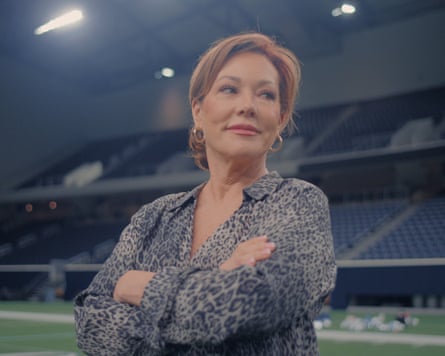
Finglass was a DCC herself from 1984 to 1989, notable as the first cheerleader invited back without re-auditioning, and became director in 1991. But since the show’s debut, she says she’s never seen such a dramatic shift in the organization’s history.
“The real estate that Netflix has provided is huge. People all over the world know our names and know our stories,” she says. “What we’re experiencing now is more individual fame. People recognize the cheerleaders at the grocery store, at the airport. They know their names. Privacy is not really a commodity any of us have any more.”
But the newfound visibility has also introduced new anxieties. In the latest season, Finglass voices concern about “who’s here for the right reason”.
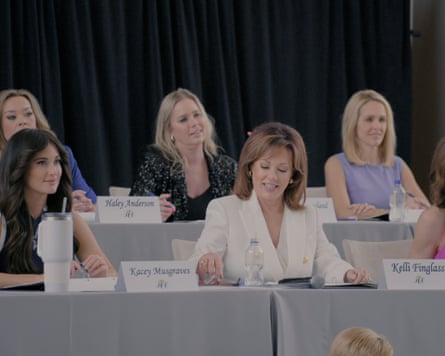
DCC hopefuls are now auditioning not only for one of the most prestigious institutions in sports, but also for a fame engine with a clear influencer pipeline. The show is now big enough to attract celebrities like Kacey Musgraves, who appears as a guest judge. Most DCCs currently have large followings, ranging from hundreds of thousands to millions, and regularly post themselves dancing to trending songs, as well as offering sneak peeks into their lives across Instagram and TikTok.
No one else on the team illustrates the shift toward social media and individual fame more clearly than Powell. The Goldie Hawn of the team – bright, sprightly and a bit cheeky – she is one of the DCC’s loosest and most combustible personalities, and her instinct to test boundaries frustrates Finglass almost as much as it endears her. “Have you poured yourself into your teammates,” Finglass asks during a tense scene, “or are you pouring yourself more into social media?”
Powell maintains a regular presence online, posting YouTube videos of her skincare routines and day-in-the-life vlogs every Thursday. “I think I definitely was the start of this whole big social media thing,” she says. “I had a really big say in how it was being used in the DCC space.” But Powell insists her use of social media extends beyond self-promotion. “I wanted to take care of my teammates, and the only way that I know how is to stand up for them and do what I think is right.”
In 2025, right before Season 3 aired, Powell was one of five Dallas Cowboys Cheerleaders who were instrumental in securing a historic 400% pay rise for the group. Before that, members reportedly earned only $15 an hour, plus appearance fees. Negotiating against a billion-dollar organization was, understandably, daunting. “Without the millions of eyes from the Netflix docu-series, I don’t think we would’ve been hyped up enough to go into those meetings.”
Social media helped her speak up, too. Despite receiving pushback from Finglass, Powell says she “had to explain myself further and keep standing up for the girls, because at the end of the day, it is a financial opportunity, and I know what it feels like not to feel safe financially”.
Powell now performs as an All-Star, contracted to fill in when other DCCs are unavailable. She remains attached to the organization, but is increasingly oriented toward life beyond it, which includes her art, husband and two kittens. Hanging up the uniform – and leaving behind a protected world of girlhood – however, remains difficult for anyone on the team to imagine.
“Putting on the uniform is really surreal every time you do it,” says Powell. “Thinking of hanging it up permanently is kind of a big deal. It symbolizes a loss of this certain part, this era of your life, but I feel like I’ve put myself on the back burner for my entire life. I’m excited to pour into my creativity and figure out who I am.”
Finglass, too, thinks about endings from time to time. After 35 years with the Cowboys, she’ll eventually retire and spend more time with her husband, children and “crazy shih-tzu”. “As painful as it will be to leave, I have this part of my life that I’ve never really gotten to enjoy.”
The DCC demands a beautiful act of self-sublimation, in service of something bordering on religious: a lineup of high-kicking women smiling beneath stadium lights, performing the American Dream. Now, millions from home know a little more about the devotion and struggles behind those smiles.
-
America’s Sweethearts: Dallas Cowboys Cheerleaders is streaming on Netflix