.png) 2 months ago
41
2 months ago
41
I won’t, I promise, refer to Felicity Kendal as Tom Stoppard’s muse. “No,” she says firmly. “Not this week.” Speaking to Stoppard’s former partner and longtime leading lady is delicate in the immediate aftermath of the writer’s death. But she is previewing a revival of his Indian Ink, so he shimmers through the conversation. The way Kendal refers to Stoppard in the present tense tells its own poignant story.
Settling into a squishy brown sofa at Hampstead theatre, Kendal describes revisiting the 1995 work, developed from a 1991 radio play. “It’s a play that I always thought I’d like to go back to.” Previously starring as Flora Crewe, a provocative British poet visiting 1930s India, she now plays Eleanor Swan, Flora’s sister. We meet Eleanor in the 1980s, fending off an intrusive biographer but uncovering her sister’s rapt and nuanced relationships in India.
Kendal claims to have only hazy memories of when she was in the original production: “You wipe a play, you shed things as you go along.” Eleanor was first played by Peggy Ashcroft (in her final radio performance) and Margaret Tyzack. The redoubtable sisters are both “bluestockings”, considers Kendal. “They have very much the same beginning politically – they’re edgy, and they break the rules.” Young Eleanor was a communist, involved with a married politician – but the stern older woman, always with “two kinds of cake on the go”, has become, Kendal suggests, “a little more conservative. Mrs Swan is mourning what has gone. Because she’s lived much longer, there’s a sadness for the past.”

The role of Flora passes to Ruby Ashbourne Serkis, who sits beside Kendal and describes the character as “endlessly ballsy. She’s an adventurer.” The play, she thinks, is about “saying yes to life, taking chances when you get them, and not letting cloudy days get in the way”. Flora has “learned to not take notice of what people think of her – it’s what I want for myself”.
Stoppard is caustic about Britain’s imperial past – “It beats me how we’re getting away with it, darling,” scoffs Flora, “I wouldn’t trust some of them to run the Hackney Empire.” It’s heady material, lightly worn, though the current cast haven’t dug into the background. “It’s all in the play,” Kendal exclaims. “He [Stoppard] has done the digging, don’t mess yourself up with any more.” Even though the play chimes with her own childhood, she brushes aside any personal resonance. “Don’t do all that therapy about it because you’ll fuck up the text,” she declares. “You don’t need it.”
Indian Ink bounces off the page – but is it easy to play? “At first glance, it is effortless but it’s actually super complex,” says Ashbourne Serkis. “A lot of our rehearsal process has been digging to lay those foundations, and then bringing it back to what is there on the surface. It’s such a gift.” For Kendal, the first voice of so many Stoppard roles, you need to “find the style and rhythm. It doesn’t come just by reading it, you’ve got to work out what that music is. Once you get it, you know you’ve got it.”
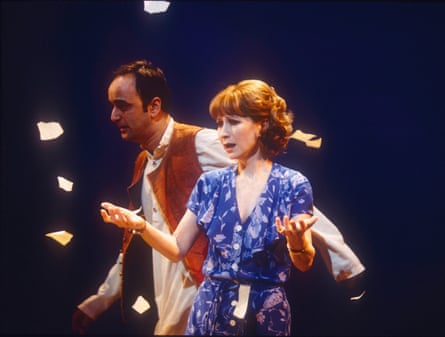
In other Stoppard plays, Kendal has been an academic (in Arcadia), a spy (Hapgood) and an actor (both The Real Thing and Jumpers). Is there a common thread? She thoughtfully fingers the star of David around her neck. “There are always three or four different things going on at the same time,” she says. “He loves complications.” She mentions the 18th-century watchmaker Jean-Marc Vacheron, hailed as “a master of complications” for his intricate timepieces. “That’s what he [Stoppard] is,” she continues, “a master of complications. There’s no story. It’s an idea, so one of your jobs is to translate his ideas through that person.” The writer had, she says, “a genius brain. It’s heavy stuff, but he lightens it with incredible wit.”
Stoppard spent several formative years in India, but insisted: “There’s almost nothing of my experience in [the play], not even indirectly.” Kendal too grew up in India, touring with her parents’ theatre troupe (semi-fictionalised in the film Shakespeare Wallah). Indian Ink is dedicated to her mother, Laura. Her co-star also has actor parents – Lorraine Ashbourne starred in Sally Wainwright’s recent Riot Women and Andy Serkis is famed as Gollum and King Kong. “It was gorgeous being in their dressing rooms, desperately wanting my hair to be done and to be put into big old costumes,” she remembers. “Were they pleased that you were going into the business?” asks Kendal. “It was a bit of an inevitability,” replies the younger actor. And do they often share advice? “The one thing mum says every day is: ‘Just enjoy it, Rubes.’”
This production is directed by Jonathan Kent: “He’s got the romance and passion of it,” Kendal says approvingly. Despite his illness, Stoppard revised the text and was “involved in the production as much as he could be”, says Hampstead theatre. During their relationship, did he ever ask Kendal to test out work-in-progress? “Absolutely not,” she says. “Never.” Although a perfect voice (husky, teasing) for his writing, she refutes the idea that she might have been an inspiration. “I don’t think that’s how it works. He wrote what he wanted.”
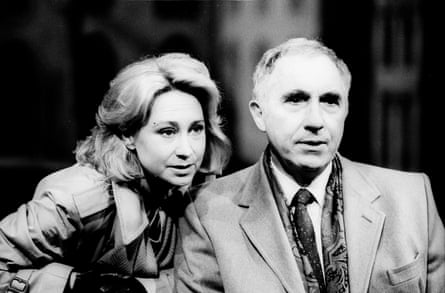
As well as Stoppard, Kendal’s career encompasses new plays by Alan Ayckbourn, Michael Frayn and Simon Gray. Now 79, she has rehearsed with the best. “They’re always very easy,” she says. “They like to be there.” Ashbourne Serkis, who recently premiered David Hare’s Grace Pervades in Bath, says Hare was “like a little boy, because he was so excited. It’s one of my favourite things, watching him laugh at his own lines.” Kendal agrees that playwrights are the best audience for their own jokes – “they love it!”
Hare’s previews were a blizzard of rewrites, says Ashbourne Serkis. Was Stoppard similar? “Tom certainly rewrites as he goes along,” says Kendal. “There would be scenes taken out. Endings would be redone.” This was nothing compared with the premiere of Peter Shaffer’s Amadeus, in which she played Constanze Mozart. “Papers were flying everywhere, until eventually Paul Scofield did this” – a wagging finger, forbidding further tinkering.
Death inevitably shadows our conversation, as it does Indian Ink. “It’s one of his more emotional plays,” says Kendal. She enjoys the way it reminds us of Stoppard’s Indian connection. “He was thought of as an English writer but he wasn’t in any manner or form. The artist isn’t owned by anybody. Flora dies, but goes on because of her writing. It’s a lovely play to be doing now – because the artist goes on.”