.png) 6 hours ago
6
6 hours ago
6
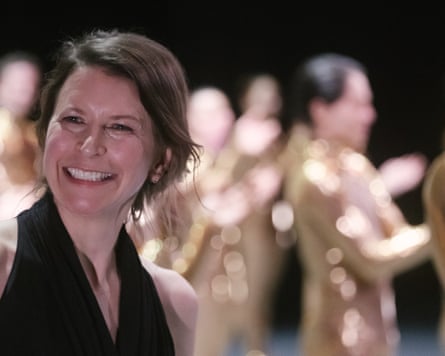
Aszure Barton is taking herself back to the creation of Mere Mortals, remembering the creative buzz of the studio at San Francisco Ballet. “Sam was fiddling around making magic in one corner,” she says – that’s Sam Shepherd, AKA electronic musician Floating Points, who plays live in the show. Digital art duo Hamill Industries were there too, designing visuals for giant LED screens. “I was in a corner with the dancers,” says Barton. “Principals and apprentices, everyone working together. It was a really shared experience, which I loved.” In fact, it’s a “curiosity for real collaboration” that drives the Canadian-American choreographer. “If it was just about me,” she says, “the work wouldn’t be as powerful.”
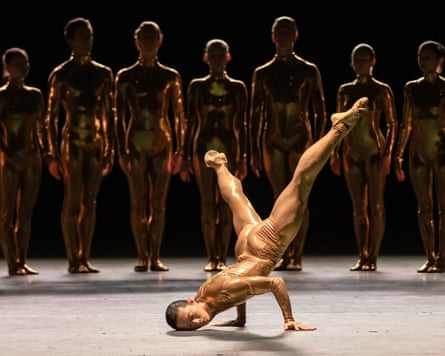
Mere Mortals, which opened in San Francisco in 2024, is finally getting a European premiere, at this year’s Edinburgh international festival. While Barton’s memories of making the show are all about human connection, the subject matter is quite the opposite: artificial intelligence. It’s inspired by the myth of Pandora’s box, but instead of a box unleashing the evils and sorrows of humanity, it is reimagined as a cautionary tale about AI.
The idea came from SF Ballet’s artistic director Tamara Rojo, who took over the company in 2022 after 26 years in the UK, notably as a principal dancer at the Royal Ballet and artistic director of English National Ballet. “She was very hands-off in terms of the work itself,” says Barton, but Rojo assembled a crack international team for her ambitious commission which garnered some rave reviews for the intensity of its scale, score and visual impact.
Barton had worked with Rojo before, when she choreographed Fantastic Beings for English National Ballet in 2016, a dance full of endlessly inventive, quirky movement. Beyond that, the 50-year-old isn’t well known on this side of the Atlantic (Rojo has called her “completely underrated”), although she’s been choreographing for more than two decades with major companies all over the world, as well as for her own, Aszure Barton & Artists. She was mentored by the great Mikhail Baryshnikov at his Baryshnikov Arts Center in New York. What did she learn from him? “On day one, he said, ‘Never ask me for money’ and ‘I like your willingness to work your ass off.’”
In the making of Mere Mortals, it turns out the richest conversations were not about the perils of AI, but the myth of Pandora, or “a myth that had been misconstrued”, says Barton. “A false story spread throughout history of this powerful being who didn’t have any agency and was toxic.”
There’ll always be different tellings of Greek myths, but Pandora does seem to have had a bad rap. She was the first woman, an Eve-like figure, created from clay and given by Zeus to Epimetheus, unbeknownst to him, as a punishment for his brother Prometheus giving humans fire. “One of the things I was really driven by was the fact that she was an agent of change,” says Barton.
As well as looking to a fictional figure from the past, however, Barton also used what was right in front of her in the present: the dancer in the lead role, Jennifer Stahl. “Ab-sol-utely incredible!” she says of Stahl, wide-eyed. “This stunning, powerful, amazing woman that I was getting to create with made my job very sweet.” Stahl, who has danced with SF Ballet for 20 years, will be returning to the Pandora role, having had a baby in between premieres.
In the same way the inspiration for Pandora was right there in the studio, the show’s theme was all around her in San Francisco, the AI centre of the world. “You’re living the reality,” says Barton, “the systems and the chaos and the beauty, and I was really intuitively responding to that moment.” Barton uses lots of tech in her working life, not so much AI, more video, to endlessly document, analyse and deconstruct her way through the creative process. She calls choreography “the most magical Legoland for me”, but it always comes back to bodies. “I love dance because it’s so human and so beautiful. You can do some cool stuff with technology, but there’s nothing like sharing a space with a dancer.”
She’s not anti-AI. Some choreographers use AI as a tool to interrupt their creative habits and find new ideas. “That’s cool,” says Barton, although her own creativity is sparked by interacting with dancers. “You never have choreographer’s block if you’re open to what’s right there in front of you,” she says. “Dancers are heroes. They don’t get credited enough for their input.”
Barton hopes that all the fizzing creativity that went into making Mere Mortals is tangible to the audience. She wants them to be “showered with energy”. She can’t sit in her chair and watch it, she says. “I have to be in the back, bouncing up and down like I’m at a rave.” Between the dancers and the musicians (from the Royal Scottish National Orchestra) there are 87 performers in the show. “Masses of people sharing themselves, sharing this raw beauty,” says Barton. “It’s delicious.”
-
Mere Mortals is at Edinburgh Playhouse, 28-30 August and Sadler’s Wells, London, 9-12 September.