.png) 2 months ago
62
2 months ago
62
Among the slender needles and elegant spires of the Manhattan skyline, a mountainous lump has reared into view. It galumphs its way up above the others, climbing in bulky steps with the look of several towers strapped together, forming a dark, looming mass. From some angles it forms the silhouette of a hulking bar chart. From others, it glowers like a coffin, ready to swallow the dainty Chrysler building that trembles in its shadow. It is New York’s final boss, a brawny, bronzed behemoth that now lords it over the city with a brutish swagger.
Fittingly, this is the new global headquarters of JP Morgan, the world’s biggest bank. The firm enjoys a market capitalisation of $855bn (£645bn), more than Bank of America, Wells Fargo and Citigroup’s combined, and it looks as if it might have swallowed all three inside its tinted glass envelope. Last year, for the first time, it made more than $1bn a week in profits. Chairman and chief executive Jamie Dimon likes to boast of its “fortress balance sheet”, and he now has an actual fortress to go with it – built at a cost, he revealed at the opening, of around $4bn. He has certainly made his mark. It would be hard to design a more menacing building if you tried.
The Brobdingnagian pile is the work of Foster+Partners, led by the 90-year-old Norman Foster, who is no stranger to penning extravagant bank headquarters. His HSBC tower in Hong Kong was the world’s most expensive building when it opened in 1986, standing as a costly essay in structural redundancy, with a stack of steel suspension bridges bolted to its facade. It was described by one former partner as “a sledgehammer to crack a nut”. In comparison, the JP Morgan tower is like using a bronze-plated bulldozer to puree a pea.
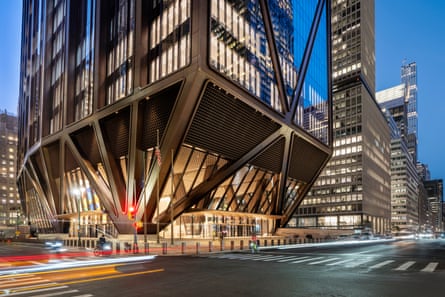
The sheer amount of structural steel – 95,000 tonnes in total – is obscene for a building that contains just 60 storeys in its 423-metre height, half the number of floors you might expect in such a colossus. It uses 60% more steel than the Empire State Building, which is taller and has more square footage. One leading engineer calculated that if the steel was flattened into a belt (30mm wide by 5mm thick), it would wrap the world twice – an apt symbol of the bank’s throttling global domination.
If the building is a bullying affront to the skyline, it is just as domineering at street level. It erupts from the sidewalk with gargantuan bunches of steel columns that fan out at each corner, clutching the base of the tower like Nosferatu fingers. Positioned to dodge train tracks below, the columns splay out to hold the building’s swollen mass ominously above new strips of privately owned “public space”, where shallow steps and planters look designed to deter lingering. To the west, on Madison Avenue, the building greets the street with an incongruous cliff face of carved granite boulders. This, it turns out, is an artwork by Maya Lin, who has achieved the impressive feat of making real stone look like fibreglass scenery from Disney’s Frontierland, complete with morsels of mossy garnish clinging to the cracks.
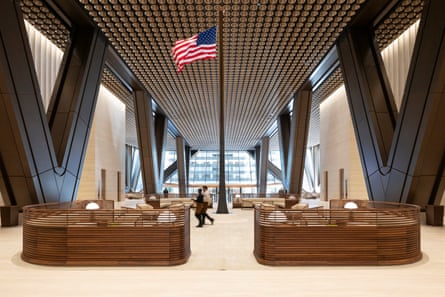
On the other side of the block, along Park Avenue, the security guards will let you peer through the windows to admire a US flag hanging from a 12-metre high bronze flagpole at the top of a staircase in the lobby, which, in another surreal twist, flutters in an artificial indoor breeze. It is a rare artwork by Lord Foster himself, who intended the flag’s movement to reflect the wind conditions outside. On the calm, still day of my visit, it was billowing at a stiff clip. In this “city within a city”, JP Morgan gets to dictate the weather it wants.
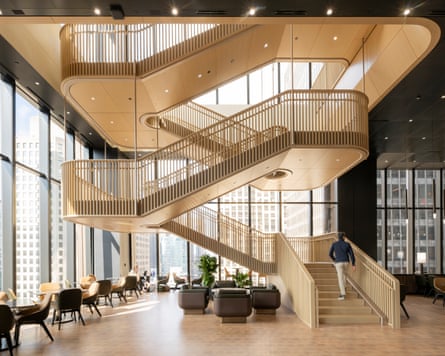
Inside, everything is colossal. Great walls of fluted travertine, sourced from a single quarry in Italy, rise up through the 24-metre-high lobby, flanking a grand travertine staircase framed by a pair of huge Gerhard Richter paintings. Banks of elevators shuttle the 10,000 workers up into a vertical office-wellness universe, complete with a 19-restaurant food court (with kitchen-to-desk delivery), a hair salon, meditation rooms, fitness centre, medical clinic and a pub. The column-free office floors are fitted with circadian rhythm lighting, creating a carefully calibrated environment, detached from the outside world in the manner of a Las Vegas casino, in the hope that employees might never leave their desks. Dimon is serious about getting everyone back to the office full-time, despite the pleas of his staff. This is his machine to crush the hybrid-working movement once and for all.
The ceiling heights may be lofty (adding many more cubic metres of air to heat and cool), but when an image of the new trading floors was posted on social media, condemnation was swift. Comparisons were made to factory-farmed chickens, Chinese sweatshops, and the very 1950s cellular office space that open-plan layouts are intended to avoid. A conspicuous steel truss zigzagging through the space somewhat undermines the “column-free” claims, and raises questions over the building’s structural logic. One engineer who has studied the plans notes that adding a few more columns and reducing the spans by a couple of metres could have reduced the building’s carbon footprint by 20-30%. But then Foster and Dimon wouldn’t have got the heroic, protein-fuelled steelwork they so desired, slicing its way through the building in monumental Vs.
Beyond the structural braggadocio, they were also keen to dial up the theatrics by night. Every evening, for miles around, New Yorkers can now gaze in wonder and horror as the tower’s summit transforms into a glittering crown, bubbling with twinkling lights that rise up the facade like a supersized flute of champagne. It is the work of Leo Villareal, who recently illuminated the Thames bridges. Sometimes, the throbbing diamond shape adds an inescapable Eye of Sauron vibe. At other moments, it appears to shift into a pulsating yonic void.
Vajazzled steeple aside, what makes the tower’s pumped-up extravagance so galling is that it saw a perfectly good office building needlessly bulldozed. The 52-storey Union Carbide headquarters, built in 1960 as the celebrated work of Natalie de Bois at SOM, stood as a sleek, Miesian monolith. It had even undergone a full refurbishment and environmental upgrade in 2012 – trumpeted by JP Morgan at the time as “the largest green renovation of a headquarters building in the world”. Just seven years later, at the hands of the same ruthless bank, it became the tallest building ever to be intentionally demolished. To be replaced by something almost twice the height, but with just eight extra floors.
The reason this happened, beyond ego and greed, can be traced to a 2017 zoning change. There had been a growing fear among landlords in East Midtown that the area was losing its lustre as the world’s pre-eminent business address. Office tenants were flocking west, to the glistening new shafts of Hudson Yards, in what is known, in real estate lingo, as the “flight to quality”. The city’s solution, in a shortsighted act of self-sabotage, was to allow Midtown to shape itself after the soulless corporate wasteland of Hudson Yards. Incentives were introduced to encourage demolition, including allowing the sale of unused “air rights” from landmarked buildings within the 78-block area. This means that historical structures that didn’t fill the maximum bulk allowed on their plots could sell their unused potential to others. JP Morgan acquired 65,000 square metres of air rights from Grand Central station, and 5,000 square metres from St Bartholomew’s church nearby, allowing it to inflate its size far beyond the usual limits.
What few might have predicted is the cumulative effect that unleashing this scale of development might have. The JP Morgan tower is not a one-off, but merely the first of a whole new breed of steroidal supertalls. An even bigger 487-metre high, 62-storey tower was recently granted permission at 350 Park Avenue nearby, also designed by Foster+Partners as another bunch of towers strapped together, with the look of a discount bulk-buy. SOM won permission for a similarly sized monster at 175 Park Avenue, set to pierce the ground with more fans of columns converging to a point. This part of Midtown will soon resemble a huddle of bloated bankers squeezed into stilettos, casting ever longer shadows down the canyons of Manhattan and obliterating views of the city’s cherished peaks, while crushing a generation of handsome, usable buildings beneath them.
From a distance, across the pond, you might care little about the fate of New York. It is a place long shaped by the forces of unbridled capital, where form follows finance and landowners get to build “as of right”, citizens be damned. But Foster’s bronze goliath is a prelude of what might soon come to London, on an even bigger scale. Last week, JP Morgan announced that it will begin work on a 280,000 square metre European headquarters in Canary Wharf – by far the biggest office building in the capital, containing more space than the Shard, Gherkin and Walkie-Talkie combined. The design, also by Foster+Partners, has only been teased with a glimpse of a ground-level corner, showing some curved bronze fins wrapping a bulging glass drum. Brace yourselves for what’s out of shot.