.png) 3 months ago
69
3 months ago
69
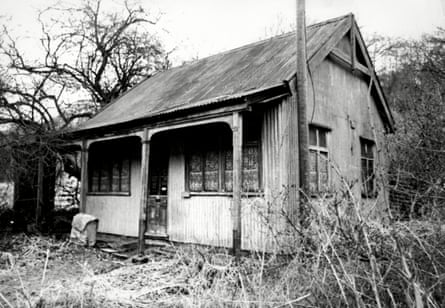
Elizabeth Allen lived at the end of a steep, muddy track in a dilapidated hut with a notice on the door that read: “Knock very loudly.” One day in the winter of 1965, the artist Patrick Heron did just that – and overnight Allen, then in her 80s, became lauded as a luminary of the art world. There were exhibitions across Britain, not to mention in New York, Los Angeles and Barcelona. The Guardian called her “a remarkable colourist”, adding that “Klee and Matisse would undoubtedly have been impressed”.
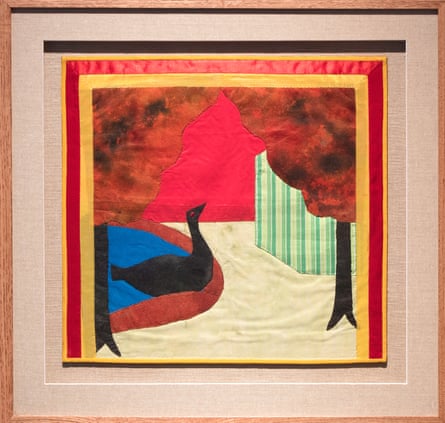
One of Allen’s pieces, 1966’s The Great Swan Song, reflects the surprise she felt at this flurry of fame after a life lived in total obscurity. This textile work features a black bird stitched into a cobalt-blue pond fringed by brown-leafed trees. The bird’s red eyes are gazing up at a vermilion sky, while a patchwork piece of bright green striped cloth seems to represent Allen’s hut.
Allen died in 1967 and her work was swallowed into the twilight as quickly as it had burst on to the scene. But now she has been unearthed anew, this time with a show at Compton Verney in Warwickshire that includes pieces that have been buried in storage or hidden away in private homes for almost half a century. There is also the first-ever public showing of a textile work entitled Autobiraggraphy. Its scenes include the day in 1934 when two helmeted police officers arrived to evict her – “wrongfully,” she has written on the reverse – from the Suffolk cottage where she had until then been living. In this brightly coloured image, we see red furniture rendered in felt, sewn on to an olive green lawn outside a pink house. A policeman leans out of one of its windows. Allen, known to her family as Queen, is gazing up in despair, wearing a floral skirt with a large black shoe peeping out from underneath. She had been born with one leg shorter than the other, and many of her works feature her orthopaedic footwear.
Autobiraggraphy also depicts Allen’s birth: the image shows an angel above a picture-postcard cottage, and a smartly dressed, bonnet-wearing woman arriving with a bunch of flowers. It’s a romanticised take on the truth: she was born above a baker’s shop in Tottenham, London, in 1883, one of 17 children of a German father and an Irish mother, both tailors. From them she learned to sew, and it may have been because she was unable to take part in dances that she devoted herself to needlework. Her parents’ workshop, filled with fabric offcuts and the paraphernalia of clothes-making, was her inspiration and her palette. Late in her life, she said: “A picture dawns as soon as I see a lovely piece of cloth.”
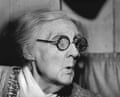
Much of her life story is unknown, but she would have been 51 when she lost her home in Suffolk, later moving into that shack outside Biggin Hill in Bromley, where she lived alone, making patchwork pictures using old clothes. She used a tailor’s thimble without a top, allowing for quicker stitching. When she read in a newspaper about a bankrupt textile business off-loading stock, she quickly sent off for ribbons, braids and trimmings.
Despite her reclusive lifestyle, Allen kept up to date with current affairs. As well as reading the paper, she listened to the radio. With the income from her sudden fame, in 1966 she bought a TV, only to return it two days later as she preferred the radio – easier to sew while listening, perhaps. Her work is testament to her connection to the outside world: the playfully titled 1965 work Lunar-Ticks Picnic references the space race between the US and the then Soviet Union. It shows an amiable-looking group of creatures gathered around a campfire seemingly minding their own business, suggesting the peaceful heavens above were no place for the overspill of earthly conflict.
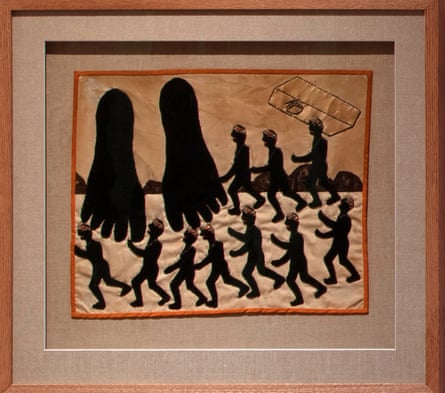
One of her most visually stunning and powerful works is The Black Feet Are Kicking, made in response to the independence of African nations from imperial powers such as Britain in the 1950s and 60s. A procession of appliqued black figures, adorned with sequins, march, or perhaps dance, against a cream satin background dotted with lacy hills. Dominating the scene, though, is a giant pair of black feet, while an eye peering out of a golden box in the sky above seems to suggest a transfer of power is imminent.
Allen had a curious relationship with religion. Late in her life, she recalled how she asked her mother why she had been born with a disability, and was told it was the sins of the fathers falling on their children. From that moment, she decided she did not want that God in her life. Later, her mother threw her out of the family home for being an atheist. And yet the Bible provides the inspiration for many of her pictures, including one of Jonah being swallowed by the whale, and another depicting the “fallen woman of Babylon” riding a many-headed beast.
“She seems to have been critical of the church as an institution,” says Ila Colley, folk art curator at Compton Verney. “But she definitely has a relationship to the Bible and that informs her work. One piece, Beetles Come and Go But Christ Remains Forever, is a reflection on celebrity.” It shows insects crawling up an altar cloth and was inspired by John Lennon’s statement that the Beatles were more popular than Jesus. “She was deeply suspicious of fame,” says Colley. One time after her “discovery”, she was irritated when a film crew knocked out the stove light as she was making tea.
It was the presence of a work by Allen in Compton Verney’s folk art collection that led to the exhibition. “Many artists, like Allen, have been marginalised,” says Colley. “And we want to see art in a more inclusive way.” Allen was a working-class woman who lived outside the norms of the art world. She wasn’t conventionally trained and had probably never visited a gallery. So she was barely even seen as an artist by art history. “Allen also lived with disability,” says Colley. “And that’s a big part of what she is making art about.”
Allen’s works would have been lost had it not been for Bridget, a young art student who lived near her in Biggin Hill. Her mother encouraged her to visit elderly neighbours. When she went to see Allen, she became fascinated by her work and her life, eventually going to live with her and help her. Bridget’s tutors, curious about these events, went to visit, later returning with Patrick Heron. Bridget, whose identity is being protected by Compton Verney, is now in her 80s: her letters from the time helped Colley to put the show together.
Colley hopes the show will lead to the discovery of more works by Allen, and perhaps a better knowledge of her life. “It’s an investigative project,” says Colley. “We hope to have another exhibition of her art – but bigger.”