.png) 1 month ago
50
1 month ago
50
The BBC has announced the 2026 Proms season, the 99th under the broadcaster’s control (the so-called Promenade concerts began in 1895). Seventy-two concerts in the Royal Albert Hall and 14 across the UK – in Bristol, Gateshead and, in a Proms first, Mold – will showcase a vast range of UK classical music talent.
Sam Jackson, controller, BBC Radio 3 and BBC Proms, hailed a “creatively bold season that packs a punch when it comes to international orchestras and names”.
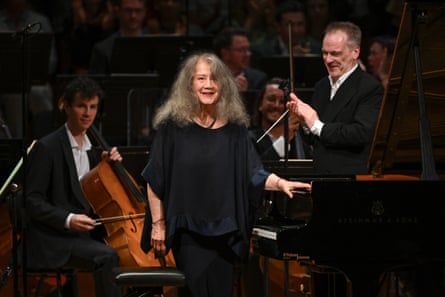
International soloists include star pianists Yunchan Lim and Yuja Wang (performing on the first and last night respectively) and legendary Argentine musician Martha Argerich, who will be 85 when she steps on to the Albert Hall stage to play Beethoven’s second piano concerto. Visiting orchestras include the Berlin Philharmonic, the Munich Philharmonic, the Oslo Philharmonic, the Spanish National Orchestra (making its Proms debut) and the Freiburg Baroque orchestra, which will be conducted by Sir Simon Rattle.
The Los Angeles Philharmonic with its outgoing conductor Gustavo Dudamel are also among the international groups, and, making their first visit to the festival is New York’s Metropolitan Opera’s Orchestra with music director Yannick Nézet-Séguin, who will give two concerts, one an all-Strauss programme; the second pairing Saariaho and Mahler.
In the year that marks the 250th anniversary of the signing of the Declaration of Independence, American music and music-makers are a particular focus of the eight-week festival. An American Classics Prom will feature the music of Bernstein, Copland and Gershwin, and among the composers whose work will be premiered are US-born Wynton Marsalis, Jessie Montgomery – her cello concerto These Righteous Paths will be performed by Abel Selaocoe, and the US/French composer Betsy Jolas, who will celebrate her 100th birthday after the UK premiere of her Tales of a Summer Sea.
Beyond the core-classical programme, Miles Davis’s centenary will be marked in a concert with US trumpet virtuoso Ambrose Akinmusire; other concerts will feature the music of Marvin Gaye and Alan Menken’s Disney scores.
Jackson acknowledged that this might not necessarily be a moment when all UK audiences were minded to celebrate the US. “[But] we’re not making a comment about any one ideology or any one president. We would be doing this no matter who was the president of the United States of America. I feel very strongly that we mustn’t allow the geopolitical situation to stifle great music or to stop us telling stories about America’s composers of the past and present.”
Suzy Klein, the BBC’s head of arts and classical music TV, added: “America has been an engine of enormous cultural influence and dynamism over 250 years – why would we not celebrate that? The Proms have always offered a space where people can get out of the nitty-gritty of what is occurring now.”
Overt escapism will come in the form of a Bond and Beyond Prom, which will showcase the music of the 007 franchise and other classic spy stories. Another British invention, prog rock, will make its festival debut with the BBC Concert Orchestra performing arrangements of music by the likes of Genesis, Jethro Tull and Mike Oldfield.
“It’s an opportunity for us to showcase a really exciting genre of music and to tell what is a really compelling British music story, as well as bring in new audiences,” said Jackson.
More new audiences will be sought in the families Proms, which this year includes a collaboration with CBBC’s Horrible Science, co-hosted by “Albert Einstein” and “Marie Curie”.
Forty years after Paul Simon’s landmark album Graceland, Ladysmith Black Mambazo will celebrate the classic recording in a late-night Prom with the Nu Civilization Orchestra; other anniversaries to be marked include Steve Reich and György Kurtág – who celebrate their 90th and 100th birthdays this year, the centenaries of John Coltrane and Morton Feldman and, 200 years after its composition, Weber’s opera Oberon will make its first ever appearance at the Proms.
Despite a challenging year, Jackson and Klein said they were feeling “buoyant” about the state of classical music at the BBC. “Last summer, the Royal Albert Hall was filled to over 90% capacity every evening. Forty per cent of ticket buyers were first-time visitors to the Proms, and 40% were under 40,” said Jackson. Viewing and listening figures on BBC Sounds and iPlayer were up 25%, added Klein, and there were 35m views across YouTube, TikTok and Facebook. “We’re constantly evolving what the Proms is, what it looks like and how people can find it,” she said.
Nick Mohammed will be one of the team of TV presenters. “He’s got a genuine passion for music, as well as authentic knowledge and real warmth,” said Klein.
The first half of the Last Night programme will include two premieres – details to be announced – and something “amazing and exciting”, promised Klein. But the traditional, and controversial, closing half hour of music remains in place.
“There are a significant number of people for whom that element of the Last Night of the Proms is really important. There’s an equally significant number who do not like that and would rather we do something different. Our job is to make sure that as far as possible, we cater for all audiences,” said Jackson.
But in a world in which the BBC’s real-terms content budget has fallen by about 30% since 2010, “we already cannot always do everything that we did previously,” Jackson continued. “It’s incumbent on us to make sure that the money that we do have is absolutely focused on audiences and on giving people the kind of content that they don’t get elsewhere.”
Promming tickets – standing in the arena or the gallery – remain at £8, seated tickets start at £12.20. General booking opens on 16 May.