.png) 1 month ago
53
1 month ago
53
We have known for some time, I think, that men are not OK. Richard Gadd’s new drama, conceived before his astounding, semi-autobiographical creation Baby Reindeer sent his reputation stratospheric, and now broadcast in the slipstream of that success, is a fiercely intelligent, unforgiving, harrowing attempt to show us how and why.
Half Man begins in the present, with two men circling each other in a dark barn. One, Niall (Jamie Bell), is in full Scottish wedding fig. The other, Ruben (Gadd), is stripped to the waist and has his hands wrapped like a sparring boxer. The fight that is surely about to come does not seem a fair one.
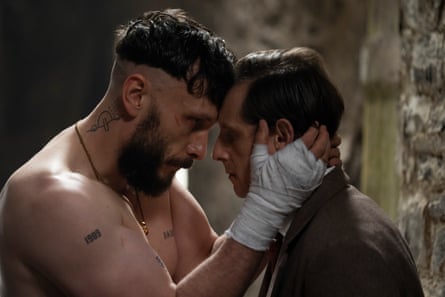
We then flash back over 30 years – and six brutal episodes – to piece together the men’s shared story. We first meet gentle, bookish Niall at 15 (when he is played by Mitchell Robertson), as he is being horribly bullied – and let the unrelenting agony of this scene prepare you for everything to come – by other boys in his class. His day goes from bad to worse when he hears that Ruben (Stuart Campbell – like Robertson, turning in an altogether phenomenal and hopefully career-making performance), the 17-year-old son of his mother’s partner, Maura, has been released from the young offenders’ institute to which he was sent after biting off a boy’s nose, and is coming to live with them all.
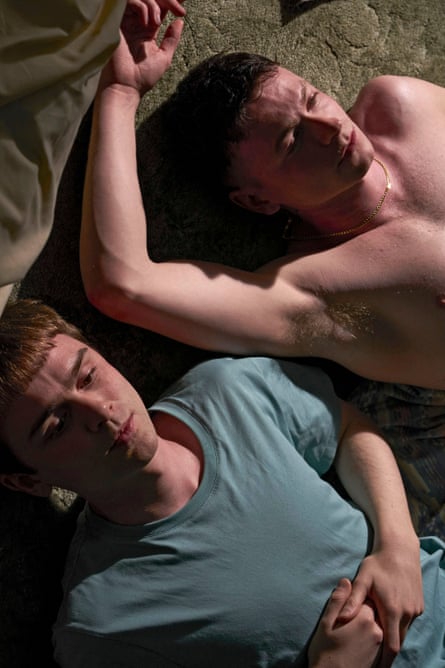
They share Niall’s bedroom, once Ruben has stripped it of the younger teen’s things and replaced them with his own – a foretaste of Niall’s life to come. The two become as close as siblings (“My brother from another lover”, Ruben calls him, which becomes variously a refrain, a promise and – as most things involving Ruben do – a threat). Ruben sorts out Niall’s bullies, then assists in taking Niall’s virginity in a scene infused with what is becoming Gadd’s signature queasily heady mix of desire, coercion, tenderness and hate. But the price he demands escalates relentlessly over the years. Actually, “exacts” might be a better word than “demands”, suggestive of something less calculating by Ruben, who operates on survival instinct and a kind of animal cunning. The problem for Niall is that whatever the reason, the damage to him and his life – to his emotional, mental and physical freedom – is the same, especially when he comes to realise the truth about his sexuality, and the idea of Ruben finding out is paralysing. When he meets the boy who shows Niall not just that he is gay but that there is a way of viewing the whole of life not through Ruben’s prison, all he can do is freeze.
Hurt people hurt people, the saying goes. Ruben, as Gadd and Campbell reveal his backstory, is a study in how terrorised people terrorise people. He cannot help but scent vulnerability in others and use it, but the question of whether he can help convulsing with rage and violence when thwarted, or when he wants to show affection or support to others, is one the drama unflinchingly interrogates. To a rare degree, it asks the question of when and how men – not just men like Ruben, but less “toxic” versions of masculinity like Niall, and like the shadowy father figures in the story – must take responsibility for their actions. To put it most bluntly, and far more bluntly than Gadd’s dense, allusive, periodically lyrical script does, it asks whether there really is no point at which you are stomping on a man’s head that you cannot pull back and ask: should I be doing this? Why am I doing this? And should I not be doing everything in my power to make sure I never do this again?
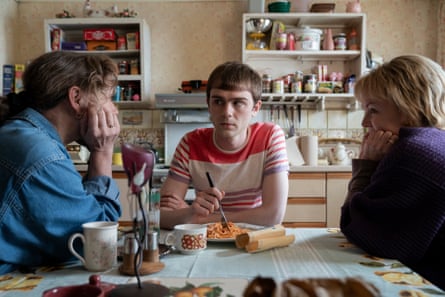
Half Man is a bleak and brilliant thing. It has its weak spots – the women are underwritten, with Niall’s mum (Neve McIntosh) seeming particularly obtuse regarding Ruben and his relationship with her son, and I’m not sure I buy the final detonation, which sets up the scene in the barn – but these are quibbles. Gadd’s drama is brave and blazing. It leaves you with that rare and precious feeling that everyone involved – Gadd, of course, who has once again pulled out his viscera, spread them over the page and taken a scalpel to every bloody organ, but every actor too (Bell is on career-best form and then some here) – has given us the very best of themselves. You cannot, in any meaningful sense, find it wanting.
If Jack Thorne’s Adolescence is to be shown in schools, Half Man needs to be shown in any place men gather. Ruben is an extreme case of – well, everything – but the fact that he exists anywhere on a scale for 48% of a population suggests that none of it can be OK. Let Gadd show them why.