.png) 3 months ago
72
3 months ago
72
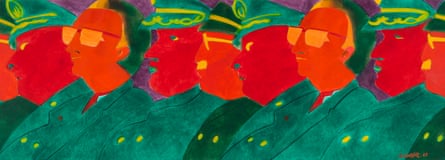
The art of Beatriz González is drenched in light, strong colour and blood. Her sprawling, uneven retrospective reflects the turbulent politics and violence of her native Colombia, and the breadth of a body of work that addressed art history and popular culture, provincialism and universality. At times she is as biting as a cartoonist, depicting generals as a row of anonymous blank-faced parrots. “I did not want to be a lady who paints,” she once said. Born in the provincial town of Bucaramanga in 1932, González died this January in Bogotá, shortly before the current exhibition travelled to the Barbican from the Pinacoteca in São Paolo. She was 93.
González’s show is compelling. It is also, at times, difficult to bear. She didn’t get going as a painter until her 30s, beginning with loose transcriptions and variations on Diego Velázquez’s 1634-35 The Surrender of Breda (all big-hatted Spaniards and Dutchmen, as the city behind them goes up in flames), and Vermeer’s 1669-70 The Lacemaker. Attentive to her task, perhaps Vermeer’s subject is a stand-in for the young Colombian painter herself. Soon she began flattening the forms and dialling up the temperature, making the paintings her own. She teetered, but never became an abstractionist. Her exposure to European art had been limited (although she had travelled to Europe and New York) and most of her knowledge came from reproductions, often of poor quality.
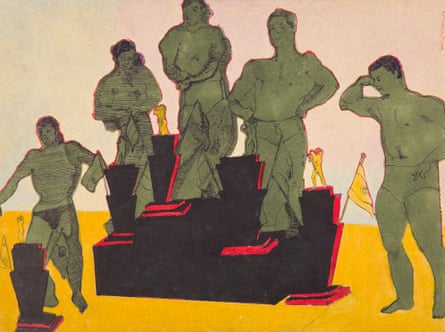
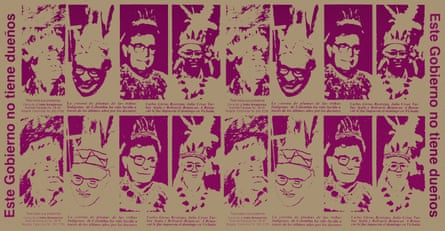
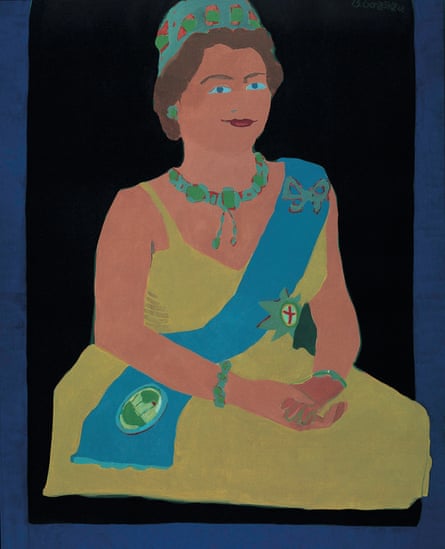
From early on, González was an avid consumer and collector of images. She built up a huge archive of postcards, news stories, adverts and press images, often concerned with macabre and salacious events, incidents on the street, crime scenes, all of which reflected the texture and the turmoil of her country. She never threw anything away, and it all fed her art. Annotated rafts of these images, presented in vitrines, punctuate the current show. Masked wrestlers and bodybuilders, beauty queens, suicides by hanging, old master reproductions, Catholic priests wearing Indigenous feathered head-dresses, Jackie Onassis on a camel, a young Queen Elizabeth II presiding over the loss of Empire, saints at their devotions, religious kitsch, gallery flyers: the longer I look, the more trepidation I feel. What’s coming next?
González’s archive, like Gerhard Richter’s Atlas, is more than a repository of source images. It is a work in itself, a way of thinking through her times. What’s missing also matters, the decades of disappearances and torture, kidnaps and internecine warfare, the narcoterrorism and battles between political factions, left and rightwing guerrilla groups and paramilitaries and the assaults on Indigenous rights.
In 1965, González lighted on the story of a young couple – Antonio Martinez Bonza, a gardener, and Tulia Vargas, a domestic worker – who had hurled themselves into a reservoir at the Sisga dam, near Bogotá. It was an attempt, so Bonza wrote in a suicide note, to save his girlfriend’s purity from a sinful world. An earlier posed, formal portrait of the couple appeared in many Colombian newspapers, staring out with a kind of bleak, half-toned anonymity. González painted several versions, flattened, simplified, brightly coloured, their hands melded together, their faces masks of normality and a kind of void. One should never equate González’s bright colour for optimism.
She began making prints, based on the grisliest newspaper crime reports, the murder of a homeless bullfighter in the middle of a furniture store, another incident in which a man committed hara-kiri on the street. He stares down at his waistcoat of gore, as though mystified. There were unaccountable deaths, bodies without names and people killed for no discernible reason. “What caught my attention was the presence of death, the position of the heads, or the disarray of a bedroom where a homicide had taken place,” González observed.
Sometimes she would return to images years, even decades later. In 1985, González revisited two 1969 prints, based on photographs of an unknown sex worker found dead on a mattress, and another of the corpse of an elderly man, Catalino Diaz Izquierdo. She repainted the images of the bodies and the gouts of blood on cheap patterned bedspreads; the old man horribly twisted on a repeat pattern of deer pausing at a stream, while the anonymouswoman is painted on to a bedspread bursting with flowers, much like the patterned mattress on which her murdered body was found. At first sight you might think these were images of calm, and that her subjects were asleep. Then there’s the twisted mouth and the unnatural position and all that blood.
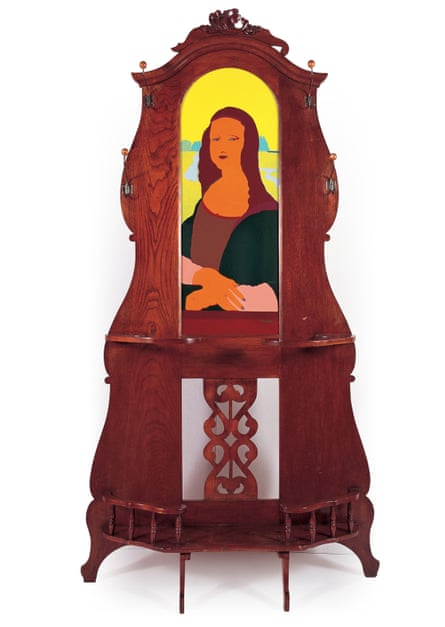
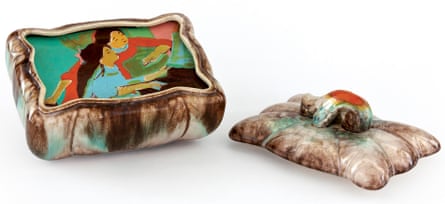
For a long time González moved away from oil painting, working instead with enamel, and painting not on canvas but on cheap metal furniture. She painted glutinous portraits of cardinals on bedside tables, emblazoned a version of Leonardo da Vinci’s Last Supper on a hideous low table, and painted a tormented Christ on the base of a metal bedstead. She revelled in kitsch.
She also painted sickly portraits on TV screens, including one of the Colombian president Julio César Turbay. Turbay had previously been part of military junta through the period of La Violencia. In 1981, the president and his entourage were photographed singing Mexican folk songs at a party to celebrate the military officer who passed a new security law that caused the writer Gabriel García Márquez and others to flee into exile. Turbay, avuncular and bow-tied, looks like an impresario or a gameshow host among his hysterically beaming acolytes. González turned the image into a pleated curtain, called Interior Decoration, that could be bought by the yard.
In 1985 the M-19 guerrilla group besieged the Palace of Justice in Bogotá and held everyone inside hostage. The recently installed president Belisario Betancur ordered the military to storm the building, which started a fire that killed about 100 people, including civilians and members of the judiciary. González responded with Mr President, What an Honour to Be With You at This Historic Moment, a large drawing in which the smiling president and his ministers are at work, a charred body resting on the table before them.
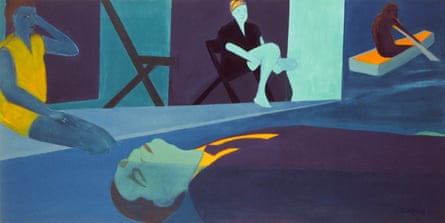
The violence goes on, and it gets worse. The bodies pile up. González’s paintings become more direct and more biting through the 1980s and 90s. As events escalate, her responses take on a more elegiac tone. Women cover their faces with their hands. A rower looks over one shoulder and gives the viewer a suspicious look. Corpses often have more presence than the living, even hidden in their coffins.
In 2003, the mayor of Bogotá announced that he intended to demolish a number of mausoleums in the Central Cemetery, which housed the remains of hundreds of victims of conflict in Colombia. González and her friend and fellow artist Doris Salcedo undertook to save the structures, of which Salcedo wrote that they were “fragments of Bogotá’s history that convey aspects of the past that are essential for undertanding the present”. The artists’ project floundered and eventually the remains were removed, leaving the niches open and empty, and González had the idea of sealing them with small tombstones, each one of the 8,956 graves emblazoned with a silkscreened silhouette motif of two men carrying a corpse. She produced eight variations of the image, the bodies hefted in a bag or slung between poles and carried like a trophy.
The final room at the Barbican is lined with a digital print of the tombstones and the images of the men carrying the cadavers. The mausoleums, and González’s 2007-09 Anonymous Auras, have only recently been denoted as national heritage and permanently secured as a site for remembrance. Anonymous Auras may well be the best of González’s work, in terms of its succinctness and effect. Everything led to it, inexorably. What a forceful and generative artist she was, what times she lived through.