.png) 3 months ago
79
3 months ago
79
Celebration and mourning broke out across Iran in response to the death of the supreme leader, Ayatollah Ali Khamenei, in an extraordinary public response to the end of nearly four decades of the top cleric’s rule.
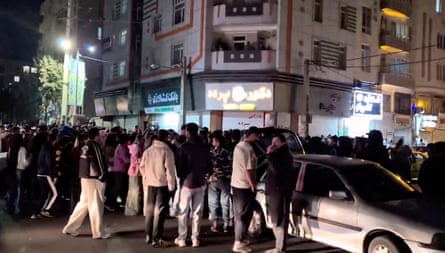
In the squares of Tehran, crowds gathered to mourn the leader, chanting and holding placards with his image. But videos shared widely on social media also showed people celebrating, dancing, honking car horns and setting off fireworks as news of the leader’s death broke.
Some families took to their balconies to join the jubilation. Among them was Nazanin, 24, a media professional based in Tehran. “The street was full! I had tears rolling down my eyes. No one outside can understand what Iranians who were victims of this murderer feel right now,” she said.
“I was hoping – for the sake of Nika, Sarina and Mahsa – that the news was true,” she said, referring to Nika Shakarami, Sarina Esmailzadeh and Mahsa Amini, three women who were killed in 2022, and became icons of the Women, Life, Freedom protests. “But I couldn’t believe it. I hardly slept.”
The contrasting responses reflect deep faultlines in a country stunned by the sudden demise of the man who ruled for 36 years. For those who experienced the violence of the regime’s recent crackdown on nationwide protests, the news was sweet. More than 7,000 people have been confirmed killed in the demonstrations, with 11,000 more deaths under investigation, the US-based human rights group HRANA has found. Tens of thousands more were arrested or injured.
Mina, 20, a university student in Tehran, was in a group of protesters hit by gunshots when state forces opened fire in January. “I saw people falling in front of us. I will never forget the scene of beautiful, young boys and girls with their whole lives ahead lying in a pool of blood. The only thing in my head at that moment was to hope those responsible for their murder will face a worse fate. And today, that wish for vengeance I felt was fulfilled when I saw the news of Khamenei’s death,” she said.
One doctor based in Rasht said he was still traumatised by a January spent treating hundreds of protesters with gunshot wounds to the head, chest and genitals – but had quietly celebrated the news. “I smoked a cigarette for the first time last night. It was the best Saturday night ever,” he said.
He said that while he was apprehensive about what would come next for Iran, the supreme leader’s death brought relief for many.
“We as a nation have been waiting for this news for decades. I feel like I am dreaming but we are cautiously celebrating. For now we celebrate – despite the security forces armed with AK47s.”
In Arak, residents said that moments after the news hit online, people were gathering in the squares and offering tea to one another. In Khamenei’s home town, Mashhad, groups of students got on motorbikes and drove jubilantly through the city, one witness told the Guardian.
But many Iranians remain fearful after the deadly crackdown on the anti-government protests in January.
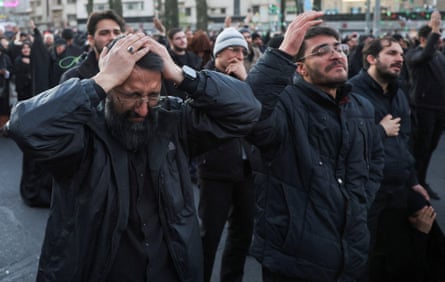
The thousands who did gather in the centre of Iran’s capital were mourning Khamenei’s death. Footage from Tehran showed mourners packed into a square, dressed in black and many of them weeping.
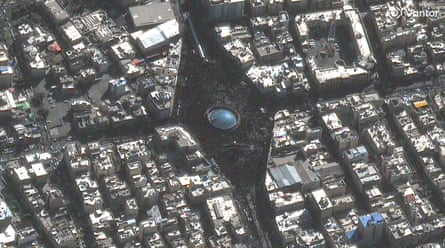
Some chanted “death to America” and “death to Israel” in Enghelab Square, with many waving Iran’s flags and holding photos of Khamenei.
The university student Hossein Dadbakhsh, 21, in Mashhad, said Iran would avenge its leader.
“I am ready to sacrifice my life for Islam and for my imam Khamenei. The Zionist regime and Trump will pay a heavy price for the martyrdom of my leader,” he said, his voice trembling with emotion.
Atousa Mirzade, a schoolteacher in the central city of Shiraz, told Reuters she could not be happy about the country’s leader being killed by a foreign power.
“I also cannot be happy because I don’t know what will happen to our country. We saw what happened in Iraq: chaos and bloodshed. I would prefer the Islamic republic to that situation.”
For others, despite the uncertainty of what may follow Khamenei, hope was the dominant feeling. For Mahsa Piraei, who is based outside Iran but whose mother, Minoo Majidi, was killed by the regime’s forces during the Woman, Life, Freedom protests, the cleric’s death marked the beginning of a new era.
“Today is a beautiful day,” she said. “Of course, we all know that there is a long way to go … [but] my family and I, and all the families whose loved ones were killed by this murderous regime, have been waiting for this moment for a long time.”
-
Reuters and AFP contributed to this report