.png) 2 months ago
57
2 months ago
57
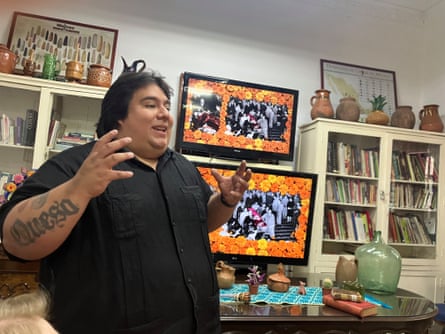
‘Today you’re going to eat art,” says Federico Valdez, a chef at the School of Mexican Cuisine and a man so passionate about food he has the word Queso (Cheese) tattooed on his forearm. “Today,” continues Valdez, “you’re going to eat history.” What unfolds, in a sun-filled dining room lined with Mexican flowers, books and artefacts, is a three-course feast inspired by Frida Kahlo, her life, her art and her loves, including her first lesbian affair.
The starter, inspired by her childhood fascination with revolution, is a lightly spiced Mexican take on pirozhki, the Russian favourite. The main dish – served with pulque, an agave-derived drink Kahlo loved – taps into her rebellious spirit. “It’s called Frida Against the World,” says Valdez, as we are presented with a giant stuffed chilli that sits amid a nutty, beany sauce similar to the one eaten at Kahlo’s wedding to Diego Rivera, then the most famous artist in the world, now much more in her shadow.
“I wanted this to be hot and horny,” says Valdez, explaining that halved figs were added to reference Kahlo’s sexuality. “Her first love, with a female teacher, happened at a time when Mexico wasn’t so open. I wanted to get in all that spicy gossip. I’m not a big fan of playing it safe.”
I’m in Mexico City with a Tate delegation just as the huge jacaranda trees are blooming purple and violet across its parks and boulevards – to follow in Kahlo’s footsteps ahead of Frida: The Making of an Icon, a show of more than 30 of her works at Tate Modern in London that seems destined to be a summer blockbuster, adding yet more fuel to Fridamania.
One work, Self Portrait With Thorn Necklace and Hummingbird, was painted in 1940 after her painful divorce from Rivera. A spider monkey, similar to the one he gave her as a present, is pulling on her thorn necklace, drawing blood. The two soon remarried, Kahlo inscribing the clocks in their house with the years of their separation and reunion.
“The exhibition is like a movie,” says Tobias Ostrander, its curator. “Frida is the star but it’s also about her life, her people, her impact.” Charting Kahlo’s rise from unknown painter to global phenomenon, the show will also examine merch (expect a Kahlo Barbie) and gauge her influence on later artists.
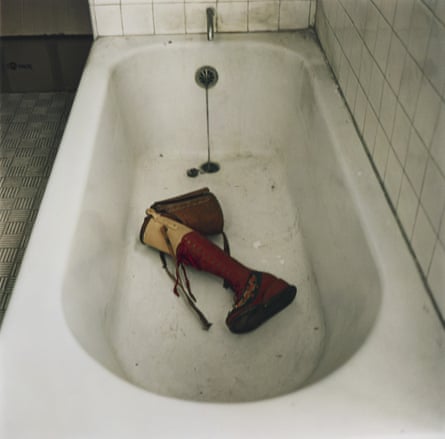
On display, too, will be many of the artist’s treasured possessions, including her brilliantly patterned tehuana dresses. Graciela Iturbide’s ghostly photographs of her crutches, customised medical corsets and prosthetic leg will also feature. These were taken 50 years after Kahlo’s death, when all her belongings were finally freed from the bathroom in which Rivera had ordered them to be locked away.
This took place at Casa Azul, the house in Coyoacán (The Place of the Coyote Owners) where Kahlo was born and spent most of her 47 years. It’s now a beautiful, beguiling museum with smooth exterior walls painted a gorgeous blue. These border shiny red concrete paths that thread through fountains and lush gardens bursting with palm, yucca, cactus and bougainvillaea. Off in a corner, seen through trees, a maroon pyramid with yellow steps displays on its ledges Rivera and Kahlo’s pre-Hispanic, Aztec and Toltec artefacts.
“We don’t know exactly where the blue came from,” says Perla Labarthe Álvarez, the museum director. “But in her diary, Frida expressed what the colour meant to her: purity, electricity and love. Because of her health – she had surgery all her life, more than 30 operations – she was at home a lot so it had to be a comfortable place where she could rest. Many of her still lifes were done in the garden. She called her home A Place Full of Places.”
It’s a perfect description. For this is a breathtakingly evocative location, even leaving aside the fact that Trotsky lived here for two years with his wife, having a brief affair with Kahlo.
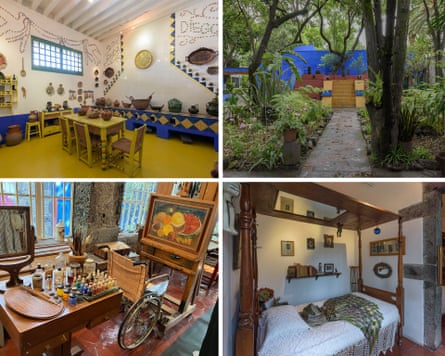
Tours begin in the living room, with its hefty pyramid-style fireplace designed by Rivera and, as an old photo shows, once flanked by two of his macabre Judas dolls, papier-mache devils that are stuffed with fireworks and set alight at festivals. Opposite is Kahlo’s mesmerising portrait of her beloved photographer father, painted 15 years after he died, his eyes as captivating as hers.
On the walls, photos and texts detail the polio Kahlo contracted at the age of six, leaving her with one shorter leg, and the trolley-bus crash at 18 that impaled her on an iron handrail and left her in pain for much of her life, as well as unable to have children.
She could never paint this accident, even though what she did paint was often deeply painful and personal – and these works were largely created at Casa Azul, upstairs in her studio, where visitors can see the easel adapted to allow her to use brushes lying on her back or seated in her wheelchair.
In the next room is the four-poster single bed in which her mother placed an overhead mirror, giving Kahlo, frequently confined there, both a distraction and a subject. “I paint myself,” she once said, “because I am so often alone and I am the subject I know best.”
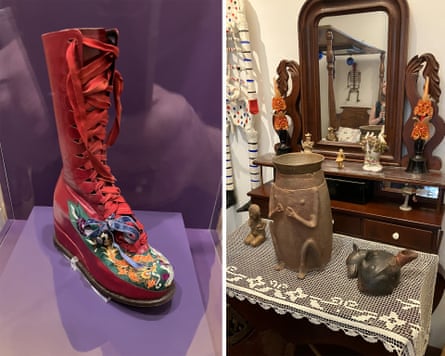
As well as her corsets, she customised her orthopaedic footwear, turning one stepped-up mid-calf red boot into a work of art. Embroidered with Mexican patterns and adorned with a blue ribbon, the chunkily laced boot now proudly stands in its own case, extraordinarily alive, looking like it could take the whole house down with one kick. Meanwhile, on a dresser, Kahlo’s ashes sit in a delightfully playful ancient urn. Boasting cartoon-like arms and legs, it’s shaped like a toad, a nod to her affectionate term for Rivera. “You found me torn apart,” says a sign, “and you took me back full and complete.”
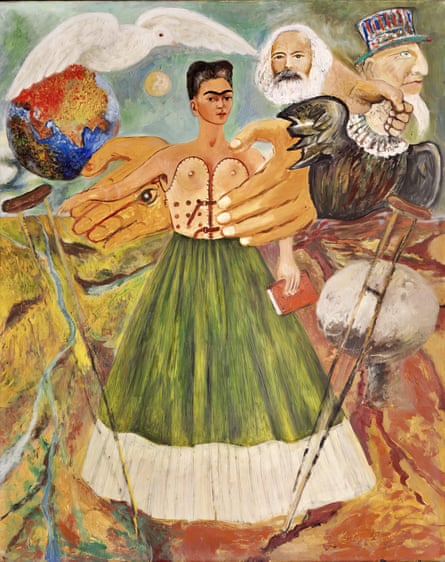
Across the courtyard, you can see Kahlo’s crutches and corsets, one decorated with a hammer and sickle. She painted herself in these corsets, too. In Marxism Will Give Health to the Sick, a 1954 work that hangs close by, the garment has morphed into her skin, her bare breasts. She’s throttling a bald eagle wearing an Uncle Sam hat while Marx’s enormous hands reach out to cradle her. As ever, her penetrating, all-seeing eyes stare out beneath that monobrow.
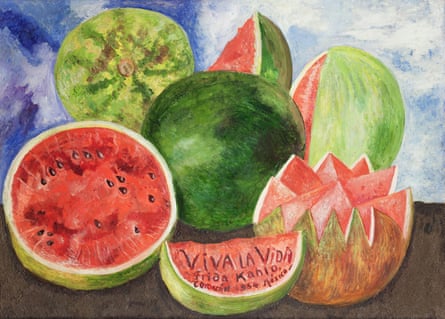
The most stunning work at Casa Azul, though, is the last one she ever painted, completed eight days before her death in 1954. Called Viva la Vida, or Long Live Life, it portrays several sun-drenched watermelons, the de facto national fruit of Mexico. In some places, their flesh is as red as blood. One has been cut in half in a crisscross pattern, echoing the Vs of the title, which appears in big black letters on another slice. It’s as if the fruit itself, life itself, is talking to you, imploring you. Live, live.
What you take from Casa Azul is an almost overwhelming sense of both Kahlo’s talent and her resilience, especially as you walk the neighbouring streets she skipped along as a child in her sailor’s blouse and hat, on her way to the school where she and her friends would later plant what many like to call a bomb. It was actually a firecracker, albeit one powerful enough to blow out some windows. No one was hurt and, unlike some, Kahlo escaped expulsion.
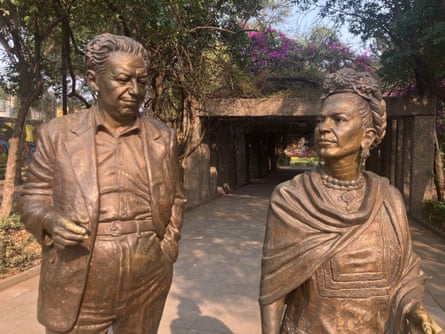
There’s a park not far off, now named after her, with a pyramid by a fountain and lifesize bronze statues of Rivera and Kahlo. She’s ahead of him, purposeful, her head half-turned, as he follows happily in her wake, smiling gently and clearly in awe of this woman, despite all his affairs. The bar they liked, La Guadalupana, still stands, a shrine to el toreo with the heads of bulls on its walls, as well as paintings and posters of fighters. Perhaps it’s more appealing if you’ve had, as Rivera and Kahlo sometimes did, “a tequila or 10”.
Downtown, we find, the streets are not so tranquil. Some are barricaded and hoarding has been placed around national monuments. These were erected in response to a recent march of 180,000 women, furious at the rates of femicide in Mexico. About 2,500 women are murdered a year, but less than a third are categorised as femicides even though there is evidence they should be. Less than a quarter of femicides are punished.
Would Kahlo have painted this outrage if she were alive today? She already did. In 1935’s Unos Cuantos Piquetitos, or A Few Small Nips, Kahlo recreates a story she read in the paper that left her incensed. A woman lies slashed and naked on a blood-splattered bed, murdered by her husband, who holds a knife and would later dismiss his crime to the police with the words of the title. Initially, she put the children in, as they witnessed the entire horror, but this was just too brutal and they have now gone.
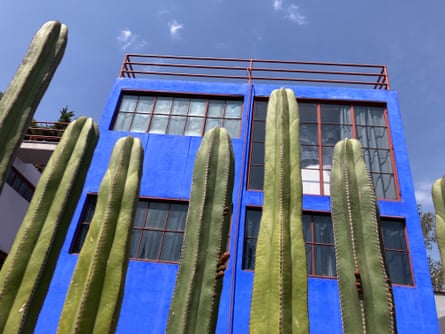
Kahlo also painted in a studio across town, in the bohemian neighbourhood of San Ángel. It’s a beautiful, boxlike, three-storey building painted that signature blue. A rooftop bridge links it to Rivera’s much bigger workplace, a white-and-ochre structure where he would often put in 15-hour days.
Built on modernist Le Corbusier lines and now part of a museum, these studios caused a sensation when they first appeared. Unadorned constructivist creations sitting among the elaborate residences of San Ángel, they’re still ringed by a superb perimeter fence of tall, perfectly placed pole-like cactuses, this being a way for both artists to bring Mexico and nature into their workplaces.
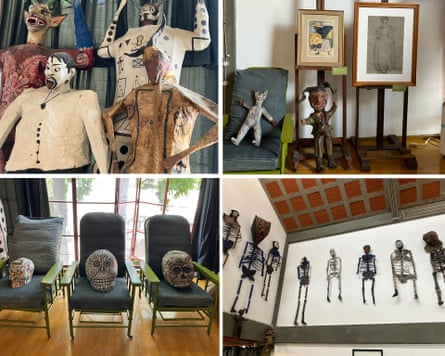
Rivera’s studio is magnificent, overflowing with ceramics and artefacts from his folk-art collection, all arranged alongside paintings and paintpots. There’s an almost party vibe: death masks sit grinning on chairs, those Judas dolls leer conspiratorially around the windows, while chorus lines of strangely joyous skeletal figures dance wildly across the walls above. It feels appropriate: the parties here were legendary, attended by presidents, revolutionaries and exiles alike, as well as Hollywood stars such as Charlie Chaplin.
Over the bridge, above the bath in Kahlo’s studio toilet, you can see a copy of What the Water Gave Me, her 1938 painting of her feet as she bathed, with elements adrift on the water symbolising events in her life, from exotic plants to nude figures on a bed to an erupting volcano. There’s not a whole lot else to see in her studio, Kahlo having packed everything up and left after catching Rivera in bed with her sister. According to the museum guide, she told him: “I am going to get all my furniture and get out of here because I hate you.”
What the Water Gave Me is the favourite Kahlo painting of Helena Chávez Mac Gregor, writer of The Ribbon and the Bomb, a book about the artist’s continuing and even growing relevance. Its title refers to the words French surrealist André Breton used to describe Kahlo’s work – “a ribbon around a bomb” – although Mac Gregor thinks there’s “maybe no ribbon, only bombs” and they’re still exploding through times beyond her own, as new generations of (largely) women see themselves, their bodies, their sexualities and their struggles mirrored in her masterpieces.
“There’s the bomb of her illness,” says Mac Gregor, as she joins us for lunch at the fabulous San Ángel Inn, a former Carmelite monastery opposite the studios famed for its gardens and margaritas. “She’s vulnerable yet she’s strong and erotic, not what you might expect of someone so ill. And she was so ahead of her time, making the personal political, living on her own terms, playing with gender roles and cutting her hair. Then there are the bombs of femicide and abortion, her own.” This was chiefly to safeguard her damaged pelvis. “Frida painted these things people didn’t talk about. Even with this illness – and one year she managed only one work – she created such beauty.”
Clearly delighted, Mac Gregor adds: “Frida is more important than Diego Rivera now, which is weird because she was the artist she was because of him. He was a macho Mexican womaniser but he loved and supported her. And the essays he wrote about her work are amazing, talking about her representations of the interior and the exterior. He said she was going to be the most important artist in Mexico.” Kahlo didn’t stop there. When The Dream (The Bed) fetched $54.7m in 2025, this set a new world record for a female artist.
The Tate has been lucky to get any works at all, given how proud and protective Mexicans are of Kahlo, especially with the World Cup having just kicked off in their country. This was brought home to me at the Museo de Arte Moderno, where you can linger all you want in front of, say, a María Izquierdo – but gaze too long at a Kahlo and you’ll soon start to feel the pressure from other visitors to move on.
This happened to me twice: first in front of The Two Fridas, in which she explores her mixed heritage, dressing one self in European attire, the other in Mexican; and secondly at Self-Portrait with Monkeys (see above), in which Kahlo, faintly moustached, is seen with four of the creatures she kept as pets. They are often seen to represent the four pupils, nicknamed Los Fridos, who stuck with her even as her health made teaching harder and harder. Kahlo would also say that the monkeys in her work symbolised the children she could not have.
No visit to Mexico City is complete without a trip south to the floating gardens and canals of Xochimilco, for a voyage on one of the 500 colourful big gondola-like boats that ply its busy waterways. Kahlo loved to come with her family to these canals, which were created by the Aztecs. There’s a famous photo of her face hovering over the water, looking serene as she dips her arm in up to the elbow.
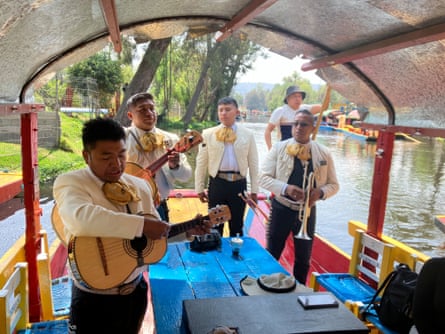
“Every boat has a female name,” says the captain of our vessel, Rosamaria, “because they are like flowers.” As we set off, smaller, faster boats speed by, bearing vendors of pulque and tacos. Before long, we are being pursued by two very loud mariachi bands, one called the Pintorescos, meaning the Picturesques, the other the Axolotls, named after the tiny, endangered and ridiculously cute species of salamander native to these waters. The Axolotls win, boarding our boat in seconds and performing for £10 a song, first Cielito Lindo (Lovely Sweet One) with its rousing singalong chorus, and then of course La Bamba.
As the Axolotls speed off in a blur of strings, brass and tight trousers, peace returns and we idle along as the afternoon sun beats fiercely down. I dangle my arm into the cool water, just like Kahlo did, and remember something Federico Valdez said as he unveiled the final course of his feast, a rice-pudding-like dish in a watermelon sauce, washed down with a liquor made from Chihuahua apples.
“This dessert is going to blow your mind,” he said, as a picture of Kahlo’s funeral appeared on the screen behind him. “Frida died – but she didn’t pass away. She was like a rocket. She just went up and up.”