.png) 2 months ago
59
2 months ago
59
Spain’s prime minister, Pedro Sánchez, is facing one of the longest and most difficult weeks of his premiership as his wife and his fellow socialist predecessor prepare to appear before judges investigating them for alleged influence peddling and other offences.
Sánchez, who came to power in 2018 by promising to end the corruption that had mired the ruling conservative People’s party (PP), has found his family, his party and his administration engulfed by a series of scandals.
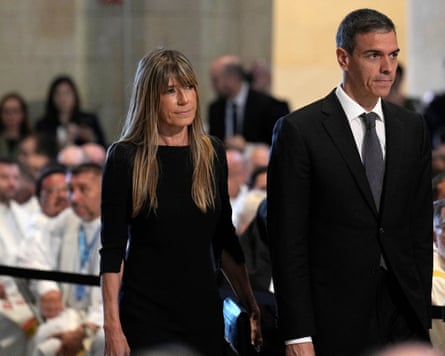
His wife, Begoña Gómez, has been summoned to court on Monday afternoon by a judge who has charged her with embezzlement, influence peddling, corruption in business dealings and misappropriation of funds at the end of a two-year investigation.
She has been accused of using her influence as the spouse of the prime minister to secure and manage a post at Madrid’s Complutense University, and of using public resources and personal connections to further her private interests.
The judge, Juan Carlos Peinado, has also charged Gómez’s personal assistant, Cristina Álvarez, and a businessman, Juan Carlos Barrabés, in connection with the case. Gómez, Álvarez and Barrabés – who have all denied wrongdoing – are expected to face a jury trial.
The investigation into Gómez was triggered by a complaint from Manos Limpias (Clean Hands), a self-styled trade union with far-right links that has a history of using the courts to pursue those it deems a threat to Spain’s democratic interests.
Sánchez had repeatedly dismissed the case against his wife as a baseless and politically motivated smear. The prime minister has accused his political and media opponents of pursuing his family and has also openly questioned the impartiality of some members of the judiciary.
Sánchez’s brother, David, is on trial for alleged influence peddling in another case that began with a complaint from Manos Limpias. He is accused of being handed a bespoke job as the coordinator of music conservatories by the socialist-led council of the south-western city of Badajoz in July 2017, when his brother was the national leader of the Spanish Socialist Workers’ party (PSOE) but not yet prime minister. David Sánchez, who denies the charges, faces a three-year prison term if found guilty.
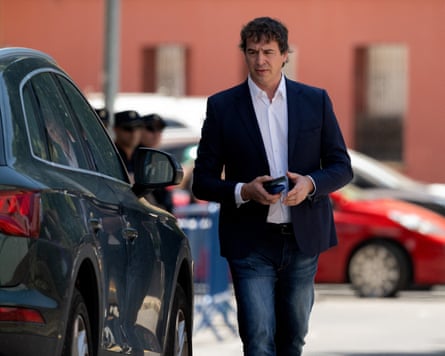
Two of the prime minister’s former righthand men have been accused of taking kickbacks on public contracts, while a judge is also investigating whether members of the PSOE engaged in a campaign to destabilise judicial proceedings against the socialist party and the government.
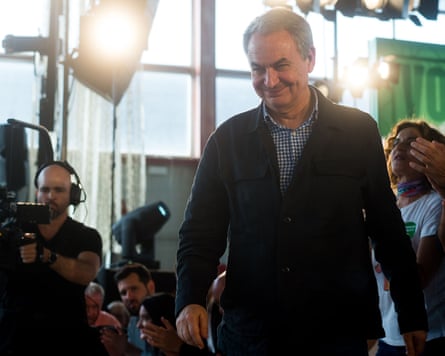
But perhaps the biggest political upset of all came last month when the former socialist prime minister José Luis Rodríguez Zapatero – a totemic figure for the Spanish left – was placed under investigation for alleged influence peddling and other offences by a judge examining the state bailout of an airline during the Covid pandemic.
Zapatero, who served as prime minister from 2004 to 2011, has been ordered to testify before Spain’s highest criminal court, the Audiencia Nacional, on Wednesday and Thursday this week.
The investigation is part of an inquiry into the €53m (£46m) state rescue of the Spanish airline Plus Ultra in March 2021. Prosecutors are examining whether the company made “inadequate use” of the public funds the government approved for the bailout, while anti-corruption police are investigating whether the airline used the rescue money to launder funds from Venezuela through France, Switzerland and Spain.
The case took another twist last week when the Audiencia Nacional announced that Zapatero was being investigated for possible tax fraud and smuggling after police discovered jewellery valued at more than €1.3m (£1.1m) while searching his office safe as part of the Plus Ultra inquiry. The former prime minister has denied any wrongdoing.
The PP has called for a snap election to be held, claiming “everything begins and ends with Pedro Sánchez, in whom the government, the PSOE and corruption all converge”.
But the prime minister has dismissed such calls and said he would fight on and contest next year’s scheduled general election. A poll on Monday for the online newspaper elDiario.es found that 64% of socialist voters think Sánchez should remain in office until the next election, while 22.8% want him to call an early vote.