.png) 2 months ago
49
2 months ago
49
“When I was younger, they thought I was a mute,” Beau Greaves says with a wry smile, thinking about all the ways darts has changed her. “Never said owt in school, really shy. Didn’t really know what to say half the time. I suppose playing darts just brought me out of my shell. When you get popular, people want to meet you and talk. It’s matured me.”
Greaves was 18 the first time she won the Lakeside women’s world championship, thrusting herself firmly into the crosshairs of public adulation. And even if she played like a natural born star, with her beautiful fluid throwing arc, she didn’t always feel like one. Endless interviews, viral fame, global domination: this was never what she had craved from the sport. She was Beau, and she just wanted to throw.
A lot has altered in the intervening time, but one important thing has not. Greaves remains utterly dominant in the women’s game, more so than anyone who came before her or anyone who is likely to come in future. Her unbroken run of wins on the Professional Darts Corporation Women’s Series stands at 86. In an era of rising standards and ever fiercer competition, Greaves remains ridiculously, outrageously clear of the pack.
But as her legend has grown, so have her horizons. Now 21, she returns to the main world championship for the first time in three years, having refused to play the 2024 and 2025 tournaments in favour of defending her Lakeside women’s titles. The player who once said it was “silly” to think that top female players could ever compete with the top men has beaten Luke Littler and Josh Rock on the tour this year, pushed Michael van Gerwen and Gary Anderson to deciding legs, averaged 94.9 across the season. This time, she means business.
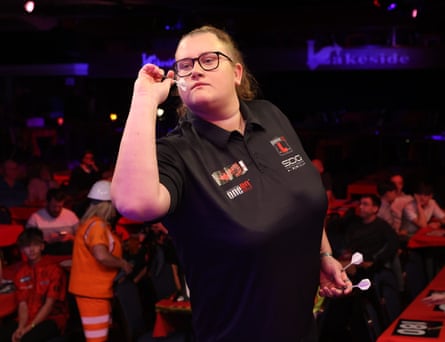
“I’ve changed my perspective on it,” she says. “When I first started playing, I just wanted to be a ladies’ world champion. But I started beating better players, and the penny dropped: I can be good enough to do this full-time.”
Exactly how good remains, for now, a matter of some conjecture. Her potential top level is frightening. When she beat Littler in the semi-finals of the World Youth Championship in October, she averaged 105. According to the Darts Orakel power rankings, which take into account underlying metrics and strength of opposition, she’s the 22nd best player in the world on current form.
By the same token, Greaves simply hasn’t played enough big-stage, high-pressure, long-format darts for us to be really sure. Most of her games are contested over the best of nine legs, with no crowd and against painfully outmatched opposition. Against the very top players, by contrast, elements like stagecraft and timing, self-belief and killer instinct intercede.
“In the nicest way possible,” she explains, “when I play against the ladies now I can get away with a lot more. If I miss a double, I might have another three or six darts at it. So I need to really nail that part of my game. That’s what I’ve tried to focus on: to make myself as competitive as possible.”
Six years ago Fallon Sherrock became the first woman ever to win a match at the world championship. To date, she’s still the last. “You only get two chances a year to play against the men: the World Championship and Grand Slam,” Greaves says. “Which kind of throws you in the deep end a little bit. But more exposure to that level of competition will help.” Already, by virtue of her performances on the Development Tour, she has secured her Tour Card for 2026 and 2027.
Littler has known her for years, and has also noticed the rising ambition in her, driven in part by a change of sponsor in May. “The last few years, she just wasn’t bothered about going to Q-School, getting a tour card,” he says. “But I think Target are pushing her, her manager’s pushing her. And she’s going to cause some damage on that tour next year.”
She plays the world No 22, Daryl Gurney, in the Friday night primetime slot: a “really tough” opener, she says, albeit one in which the bookmakers make her a marginal favourite. “I don’t want to get dragged into people expecting too much,” she says. “I want to do stuff on my own terms.”
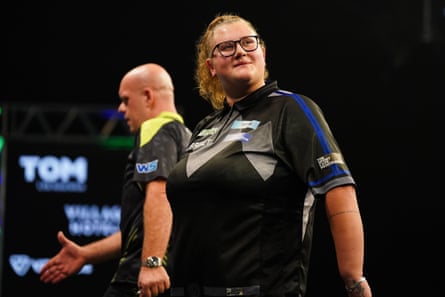
And so what started as a bedroom hobby has turned into a viable career, a way of life, a way of finding her voice. “I always wanted to get a house out of playing darts,” she says. “I still live with my mum and dad, but I’m looking to move out next year. Obviously I’ll stay in Yorkshire, don’t want to be too far from home. But that’s something I’m looking forward to: finally leaving the nest.”
Which feels like a pretty good metaphor for Greaves the player: a career on the verge of taking flight, ready for its first great leap. Long-term, the PDC’s goal was always to develop women’s darts to the point where the distinction could eventually be abolished entirely, and Greaves is exactly the sort of player they were envisioning: a talent transcendent enough to smash down the old barriers and throw the doors of the sport wide open.
As a girl, Greaves always used to get told she “threw like a bloke”. Perhaps there is a certain irony, then, in the fact that she has done more than anyone to consign the old prejudices to history. “Most of the men aren’t bothered,” she says. “They just refer to me as a darts player, rather than a ladies’ darts player. I definitely think the whole lady-against-the-bloke thing is wearing off now.”