.png) 2 months ago
27
2 months ago
27
Serving looks all summer on the green carpet of Kensington Gardens, the often wildly experimental Serpentine pavilion is best viewed as a piece of architectural haute couture. For the last 25 years, it has hosted all sorts of fashionistas, from the American Frank Gehry, whose pavilion resembled an explosion in a lumber yard, to Swiss magus Peter Zumthor, who built a charcoal-walled hortus conclusus (contemplative room), that tuned out the wider park landscape entirely.
The Serpentine’s rules of engagement are simple: the selected architect should not have built in the UK, so it’s a chance to showcase new or unsung talent. The constellation of largely white male superstars doing elaborate parodies of themselves, which characterised the pavilion’s early imperial phase, has given way to what might be described as more nuanced midlife, featuring younger emerging architects from more diverse backgrounds.
This year it’s the turn of Lanza Atelier, a Mexico City-based studio founded in 2015 by Isabel Abascal and Alessandro Arienzo. They’re known for reinterpreting (and subverting) familiar materials and forms through their explorations of craft, technology and spatial design traditions.
Abascal and Arienzo have gone back to basics and produced one of the most literal Serpentine pavilions in years, featuring an actual serpentine, expressed as a wavy wall of rust-coloured brick. The delightfully onomatopoeic technical term for this is a crinkle-crankle wall. Particular to rural Suffolk, the crinkle-crankle was originally introduced by Dutch engineers engaged to drain the marshes of the Fens from the mid-17th century onwards. The Dutch called them slangenmuur (snake walls). But they are also common in Mexico and have been found in excavations of ancient Egyptian civilisations.
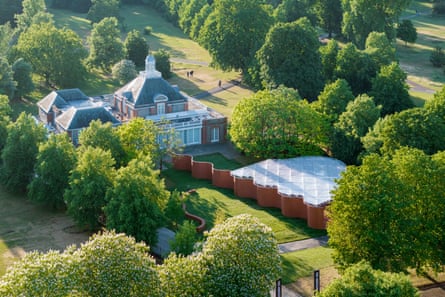
Mathematicians might describe them as sinusoidal, while structural engineers would point to their elegant economy of materials: the curvilinear form provides inherent stability and resists lateral forces, creating a robust structure that requires only a single layer of bricks, with no need for additional buttressing. If constructed on an east-west axis, as is the case here, the south-facing side catches the sun, generating warmth for the historic cultivation of fruit trees and prolonging the growing season. “They’re structures that temper climate, create shelter and enable growth,” says Abascal.
Walls have had a pretty dismal press of late, particularly in respect of President Trump’s “big beautiful wall” on the US/Mexico border. This, then, is an opportunity to reframe a maligned (and often malign) structure. “We’re doing a wall that attracts instead of divides and becomes a gathering place and creates a series of little rooms,” says Abascal. “A wall doesn’t necessarily need to be built for division.”
The duo like the idea of “gentle geometry”, which is “continually responsive to those who move through it.” The concept of a “serpentine” pavilion originated when setting out the building line around the curves of existing tree canopies. “So that’s where the geometry comes from, understanding the common limits of the site,” says Arienzo. The undulating form also alludes to the Serpentine pond weaving through the park, while a serpentine-shaped bench is a kindred “mini-me” of the pavilion.
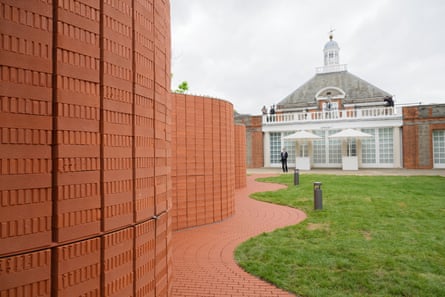
The structure is topped by a flat glass roof supported by a steel grid, inset with fixed louvres to deflect the summer sun and throw cooling shade around the interior. It’s all very simple and logical, the only hint of potential showbiz drama being a row of glittering lights set along the top of the crinkle-crankle wall.
To date, the inventory of building materials used in Serpentine history has included cork, timber, slate, glass, concrete and an inflatable. But, surprisingly, it’s the first time that brick has been employed, hitherto possibly regarded as too earthbound and permanent for a temporary structure.
Manufactured in Surrey, at a plant that historically supplied material for London buildings, the bricks are a standard size, their ordinariness subtly transformed and elevated by Lanza’s design. Set without mortar joints, they are threaded through reinforcing bars, like beads on a chain, which will make the pavilion easier to dismantle, without damage or waste.
Unconventionally, the bricks are set back to front, ribbed sides out, which adds further textural interest, the surface resembling a kind of woven textile (normally, the ribs face inwards, providing an adhering surface for mortar).
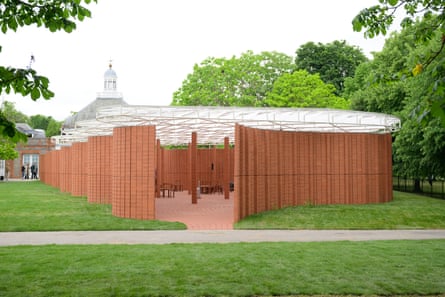
Lanza’s wiggly brick walls allude to the weathered red brickwork of the neighbouring Serpentine South Gallery, itself a grand 1930s version of a parkland pavilion, as well as the wider South Kensington milieu, with its Victorian brick mansion blocks and the pièce de résistance of the Royal Albert Hall.
The pioneering American modernist Frank Lloyd Wright once famously said: “Do you know what a brick is? A brick is a small, ordinary, worthless thing that costs 11 cents, but give me a brick and it becomes worth its weight in gold.”
Arienzo agrees. “A brick is nothing very sophisticated,” he says. “But once you see it laid down or built in a different way, it sparks curiosity and that makes people enjoy it more.” As the archetypal building block, used for millennia, but still fitting into a human hand, it seems only right that after 25 years, brick’s Serpentine time has finally come.