.png) 3 months ago
82
3 months ago
82
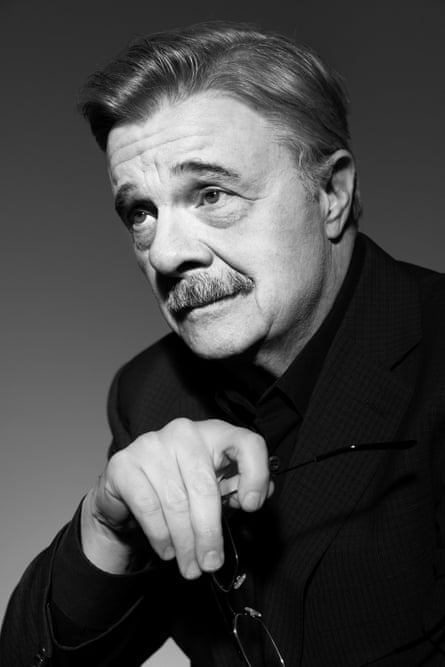
“It’s, like, 10 minutes. I pee, I have a cup of tea, I put the jacket back on and I go out and fight my way to the death.”
The way Nathan Lane describes spending the intermission of Death of a Salesman – the nearly three-hour play in which his character flails and ultimately fails through an epic depression – reflects the actor’s own spirit: practical, lightly fatalistic, artfully hyperbolic and very, very funny. Today he is in fine form, nestled into a corner table in New York’s classic Upper West Side haunt Cafe Luxembourg. When I ask him if Salesman marks his first time performing at the Winter Garden Theatre, he responds without missing a beat: “Yes, except when I took over in Mame.”
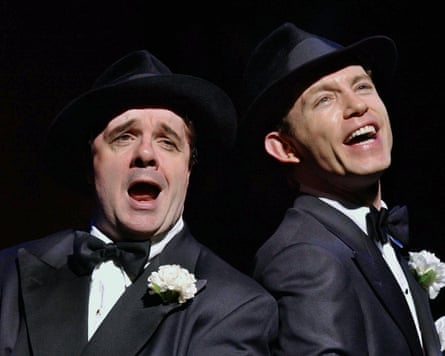
Lane has an easy charm that he has magnified into five decades of award-winning performances, from off-Broadway beginnings to his Tony-nominated turn in 1992’s Broadway revival of Guys and Dolls. The brassiness that the actor brought to The Birdcage and The Producers – as well as scene-stealing cameos in 30 Rock and Sex and the City – has remained Lane’s eternal flame, even as he has moved into more dramatic roles in the past decade. Death of a Salesman’s Willy Loman is a beast of a role, though. The peripatetic lead of Arthur Miller’s 1949 tragedy must embody both the dissolution of an average family and the catastrophic failure of the American dream. Like his character, the man can only laugh for so long.
“It’s taken this long to feel worthy of doing it,” says Lane, who recently turned 70. “I’m doing eight shows a week and I haven’t keeled over.” While the role of Loman carries mountaintop prestige, it’s a relentless part and actors as venerated as Dustin Hoffman and Philip Seymour Hoffman have struggled with its emotional and physical toll. Echoing the loneliness of his character, Lane says of the demands of the role: “It’s hard to explain unless you’re doing it. Nobody understands.”
Death of a Salesman has personal significance for the actor. He recalls watching Lee J Cobb, the role’s originator, in a 1966 televised broadcast: “Other children were watching Gilligan’s Island and I was more drawn to Miller’s indictment of capitalism.” Lane’s passion for the play, far as it was from his classmates’ interests, presaged his fascination for theatre, and a year later took on a terrible relevance when, as he puts it, “my father essentially committed suicide by drinking himself to death”.
Lane is exceptional in the role, evoking a searing meta-awareness of his own life as a performer. Like him, Loman is a man who lives and dies on his ability to sell a high-spirited fantasy, only Miller’s character can’t see that his audience has long moved on, and can see through his act. Lane is clear-eyed about the character’s significance, and points to “Cobb’s wounded lion, Dustin’s tiny tyrant”, and “[Brian] Dennehy’s bipolar mountain of a man”, and seems comfortable leaving it to audiences to decide what his interpretation adds to that lineage.
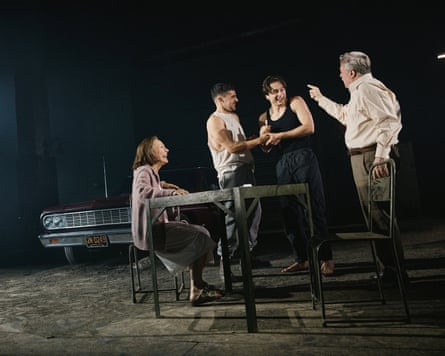
The production is a long-in-the-wings collaboration among Lane, the director Joe Mantello and Scott Rudin, marking the producer’s return to Broadway after five years away following allegations of bullying colleagues (“I was too rough on people … I have more control now,” he said in a 2025 interview). Lane says that he initially found the role a daunting prospect, in commercial as well as creative terms. “I was fearful for the intimacy of the play, and just the practicality of [co-star] Laurie Metcalf and I having to sell a lot of tickets,” Lane says, of the play opening at the 1,600-seat Winter Garden Theatre. The upside is that tickets are more affordable.
“Because I’m not George Clooney, they’re not charging $900,” he says, referencing the Hollywood star’s turn in Good Night, and Good Luck at that theatre last year. “For $900, I would go to your home and do selections from the play.”
Neither Lane’s star, nor note-perfect cynicism, are in danger of waning. While telling me about an upcoming film he shot with Jonah Hill and Kristen Wiig, he picks up on a stray “good for you”, overheard from an adjoining table. “I thought she was talking to me,” he gasps, before picking up the bit and pretending to address her: “Thank you, thanks very much.” (Later, the stranger does actually praise his work while standing to leave, as if he’d set up a perfect callback.)
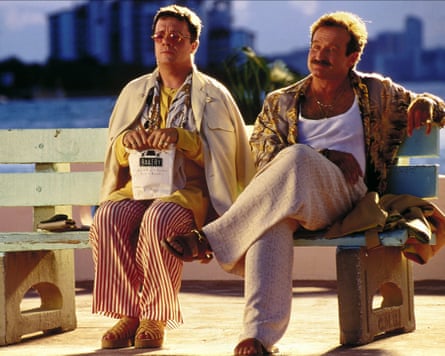
While he’s perhaps better established as a theatre icon, Lane’s Hollywood legacy is not exactly obscure. Lending his inimitable voice to Timon in Disney’s The Lion King brought him sonic recognition in 1994, and starring opposite Robin Williams in 1996’s gay comedy The Birdcage catapulted him to mainstream stardom. It also presented the actor with the challenge of navigating public queerness, especially given that he plays a drag queen in the movie. There’s a clip that makes its rounds every so often, from an appearance he and Williams made on Oprah Winfrey’s talkshow that same year. When the TV host asks whether Lane fears being typecast as gay “and people forever saying: ‘Are you? Are you not? Is he?’”, Lane is uncharacteristically at a loss for words, and visibly uncomfortable, before Williams steps in and deflects the line of questioning. Lane attributes the gesture to the late actor’s “incredibly kind, generous soul”.
Lane casts his mind back to the time. His sexuality was no secret to those around him, but he had only just hired his first publicist (with whom he remains) and was not prepared to take his private life public.
“In those days, you might as well say: ‘And by the way, I love cock,’” he deadpans. “But I wasn’t ready; I wasn’t brave enough. I was a character actor. I wasn’t thinking I was going to become a leading man. For better or worse, that’s what I did.” He came out in a profile for the Advocate in 1999, by which point the secret was out: “Then it was like: ‘Yeah, big deal, we already knew.’ So there was no winning that one.”
Winfrey was just being playful, Lane thinks. And it doesn’t sound like the incident keeps him up at night, but he wishes he could go back and reply: “If you’re asking me why I’m good at it in the movie, it’s because I’m a wonderful actor. And if you are asking me if I’m gay, the answer is yes.” It was a trial-by-fire introduction to celebrity. He remembers, a few weeks later, being stuck in Manhattan traffic when a man in a nearby van saw him and screamed: “Hey, faggot! Hey, faggot!” Lane grimaces. “It was humiliating,” he says. “I went: ‘Well, this is the other side of fame.’”
The actor is just as open about other kinds of perceived slights. A 2010 article by the former New York Times theatre critic Charles Isherwood heaped praise on Lane, calling him the greatest Broadway entertainer of the past decade. “It couldn’t have been a nicer piece,” Lane admits, spearing his omelette. “But there was something about the word entertainer that bothered me, because I thought, I’ve been doing this a long time now and he doesn’t think I’m an actor. I just couldn’t let go of it.”
He knows it’s a nitpick, knows that many of the greats have been consummate entertainers as well as respected thespians. But still, but still: “It’s like, what, you mean I’m not acting? If you didn’t believe what I was doing, you wouldn’t laugh. I’m glad you laughed, because it’s a comedy. Glad you think I’m funny. But anyone who’s done comedy as an actor [knows] they try to put you in a box.”
He began to carve a hole out of that box in the early 2010s by pitching himself to the director Robert Falls after hearing of his plans for a production of Eugene O’Neill’s surly The Iceman Cometh. As the lead role of Hickey, Lane would play another salesman, albeit one who’s the life of the party – until he gruesomely murders his wife. “When I read the extremely lengthy character description, he seemed to be describing me. Nothing against Kevin Spacey” – he quips about the actor who played the part before him – “but when he comes in the room, you think: ‘Oh, he probably just killed his wife.’”
The production materialized in Chicago in 2012, later transferring to the Brooklyn Academy of Music and radically changing Lane’s life and approach to the craft. Lane credits the play and the rave reviews for his performance with shifting his public perception, which he parlayed into diabolical roles in projects like American Crime Story and Angels in America, for which he won his third Tony. “By the time I got to [Angels’s] Roy Cohn,” he says, “it wasn’t met with that kind of reaction that I got when it was announced that I was doing Iceman.”
Lane returned to screen comedy last year, starring and executive producing Mid-Century Modern for Hulu. A sort of “gay Golden Girls”, the series earned glowing reviews but was not renewed for a second season. “It got a high score on Rotten Tomatoes,” he says, with elite comic timing. “Maybe that was its downfall,” he ponders, “that it was an R-rated gay sitcom.”
In the shadow of Heated Rivalry, does Lane think there’s only room for one mainstream gay series a year? “Well, yeah, there you go: young hot guys,” he laughs. “It might be too easy to blame it on that, I really don’t know. There was Will & Grace. People now look down upon the multicam, live audience [sitcom]. It’s seen as antiquated, like we’re using a butter churn. To say it doesn’t work any more is hilarious, because people are still watching Friends.”
The theatre landscape, especially post-pandemic, is still too expensive, and Lane is not optimistic about the US taking a sudden turn toward subsidising. “I don’t think that’s going to happen, not in this country,” he mourns. “The Trump National Theatre? No. More than ever, arts funding and education, it’s all under attack on a daily basis. From the Corporation for Public Broadcasting to the Kennedy Center, everyone is struggling.”
That includes the American people, who have continued to see themselves reflected in the plight of Willy Loman, “this very flawed human being who bought into something and has lived by it”. Lane sees the play’s essential meaning as having shifted from its 1949 premiere, when, he says, the character was viewed as a victim of capitalism writ large, resonating with our societal misreading of what success looks like.
“His self-worth and idea of success is all based on the opinion of others, being liked,” he explains. “If you’re on Facebook, you understand that concept. If you’re an actor, you understand. Today, to do it right now, there’s a certain group of white men who feel they were promised something and it’s been taken away: they were entitled to something, and it’s been taken away by AI, DEI, all the letters, and they’re angry, and they all decided to follow this lunatic in the White House.”
He remains committed to the stage, and complains, as only true theatre lovers can, about Death of a Salesman’s intense use of dust, smoke and extreme side lighting which, to him, feels “like the Gestapo is in the wings and you’ll be arrested by the end of the scene”.
The grind of Broadway scheduling comes up again. “This eight-a-week stuff, it’s crazy,” he says. “A play like this takes a toll and costs you to do it. It’s also the reason you want to do it.” Aside from the Hill-Wiig movie, which will reunite him with fellow stalwart Bette Midler, he’s “attached, as they say”, to an action-comedy pilot directed by Paul Feig. Screen work makes fewer demands of an actor, so as for what’s next on stage: “Oh, Jesus, who the hell knows?” he muses as we order the check. “This could be my farewell to Broadway.”
Death of a Salesman would hardly be a bad exit-stage-left for the lovable sourpuss, who imbues every performance with a deep current of charisma. If a role were to pique his interest, he’s never far from the brazen instinct that got him that life-changing Iceman gig. As Lane puts it: “How do you think you survive in show business, by being shy?’’
-
Death of a Salesman is at Winter Garden Theatre, New York City, until 9 August