.png) 3 months ago
89
3 months ago
89
Israeli military 'continues fighting and ground operations' against Hezbollah in Lebanon, IDF says
The Israeli military said it “continues fighting and ground operations” in Lebanon against the Iran-backed militant group Hezbollah.
In a statement on social media, the Israel Defense Forces (IDF) said it carried out extensive strikes on launch sites across Iran overnight before halting fighting after the ceasefire was announced.
“In accordance with political directives, the IDF has contained the fighting in the campaign against Iran and remains on high alert for defence, ready to respond to any violation,” the IDF said.
It added that in Lebanon, “the IDF continues its combat and ground operations against the Hezbollah terrorist organisation”.
Key events Show key events only Please turn on JavaScript to use this feature
Oman foreign minister urges both sides to return to negotating table
Oman’s foreign minister, Badr Albusaidi, who mediated indirect nuclear talks between Iran and the US before the war, said the ceasefire meant “for now the world has stepped back from disaster”.
“But there’s no room for complacency,” he said in a post on X. “Serious negotiations now required for lasting peace. Oman will support this work for the vital and urgent purpose of strong and enduring regional security.`”
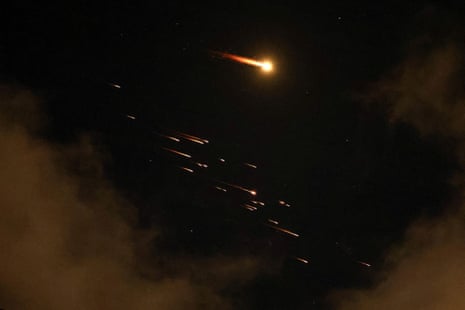
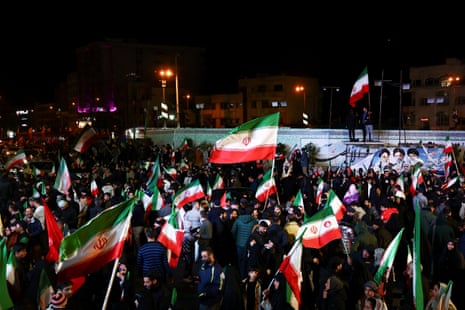
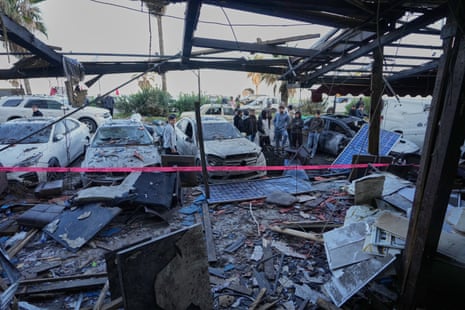
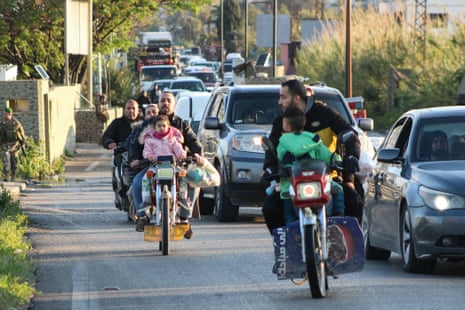
Here are some of the latest images from across the Middle East:

Will the ceasefire see a resumption of pre-war shipping on the strait of Hormuz?

Lisa O’Carroll
Last night, 1,441 ships were stuck on either side of the strait of Hormuz , according to shipping software company AXSMarine, which tracks global vessel movements.
The majority - 959 - were in the Gulf, west of the strait, with 621 to the east either waiting to enter the gulf to load up with gas, oil, chemicals or dry bulk or with deliveries for gulf states.
No ships carrying liquified natural gas have passed the strait since the war started on 28 February, according to AXSMarine’s data.
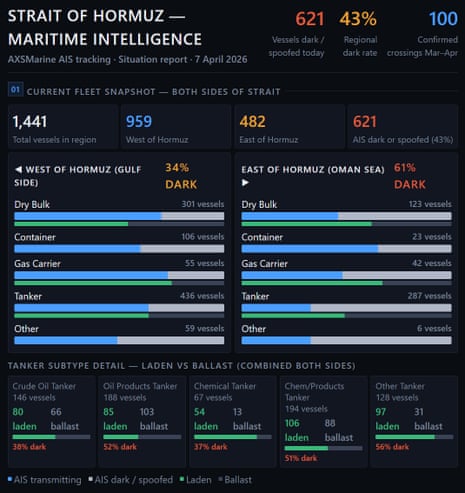
A significant number on both sides were “spoofing” or had gone “dark”, turning off communications to hide their exact location and try and protect themselves from projectiles.
In the last two weeks up to 6 April, just 51 tankers traversed the strait with 15 carrying crude oil and 9 carrying chemicals.
This compares to 51 daily movements before the war.
Before last night’s ceasefire, Iran had announced that ships owned by five nations (China, Russia, India, Iraq and Pakistan) would be allowed to transit. Malaysian and Thai vessels were granted access after diplomatic talks. On 2 April, Iran said it would allow Philippine-flagged vessels to cross following further negotiations.
While the Israeli military said it will push on with its ground invasion of southern Lebanon, sources told Reuters that Hezbollah has halted its attacks against northern Israel and on Israeli troops.
Three Lebanese sources close to the group told the news agency that Hezbollah is likely to issue a statement outlining its formal position on the US-Iran ceasefire and on Israel’s assertion that Lebanon is not included.
The Lebanese army, meanwhile, has urged displaced families to delay their return home to the south of the country, warning of ongoing Israeli attacks.
Israeli military 'continues fighting and ground operations' against Hezbollah in Lebanon, IDF says
The Israeli military said it “continues fighting and ground operations” in Lebanon against the Iran-backed militant group Hezbollah.
In a statement on social media, the Israel Defense Forces (IDF) said it carried out extensive strikes on launch sites across Iran overnight before halting fighting after the ceasefire was announced.
“In accordance with political directives, the IDF has contained the fighting in the campaign against Iran and remains on high alert for defence, ready to respond to any violation,” the IDF said.
It added that in Lebanon, “the IDF continues its combat and ground operations against the Hezbollah terrorist organisation”.
'Now it’s time for diplomacy, legality and peace', says Spanish PM

Sam Jones
Spain’s socialist prime minister, Pedro Sánchez, who has been perhaps the most outspoken western critic of Trump’s war in Iran, has issued a blunt reaction to the ceasefire announcement on X, saying his administration “will not applaud those who set the world on fire just because they show up with a bucket”.
He said:
Ceasefires are always good news - especially if they lead to a just and lasting peace. But this momentary relief cannot make us forget the chaos, the destruction, and the lives lost.
The Spanish government will not applaud those who set the world on fire just because they show up with a bucket.
What’s needed now are diplomacy, international legality, and PEACE.
Analysis: US learns a hard lesson about the folly of war

Patrick Wintour
Brett McGurk, a former senior US security official and reluctantly supportive of the conflict, conceded on social media that the ceasefire agreement Trump has signed is not “status quo ante bellum” ie the US is now worse off than at the start of this war of choice.
To spell it out, Trump needlessly started a war at the urging of Israel, refused to listen to those experts urging caution, devised a strategy built on a misapprehension of Iran, sparked a ruinous regional conflict, caused the death of thousands of civilians, unhinged the world economy, strengthened, for now, the repressive instincts of the Iranian and Russian governments, left America more discredited and isolated, provoked serious questions about the president’s fitness for public office, laid waste to large parts of Iran and Lebanon, including medical research centres, primary schools and universities, did not resolve Iran’s stockpiles of highly enriched uranium or its future nuclear programme, strengthened those in Iran backing possession of a nuclear weapon, and, yes, ensured Iran and Oman still plan to control and toll the strait of Hormuz for the first time.
A return to war will doubtless soon be threatened even before the two-week ceasefire ends, but the use of force in this decades-old conflict has now been test driven and proven the wrong vehicle since it can only achieve its objectives at an inconceivable price.
In further comments to RNE, Albares has criticised Israel for its continued offensive in Lebanon, saying it was “unacceptable”.
“It is inconceivable that the bombing continues. This has to stop,” he said.
There has been some confusion over whether the ceasefire announced this morning includes Lebanon. The Israeli prime minister, Benjamin Netanyahu, indicated Israeli troops would continue fighting there, contradicting an earlier statement from the Pakistani prime minister, Shehbaz Sharif.
'Unthinkable escalation has been avoided, but the ceasefire is not yet definitive', says Spanish foreign minister
While more officials from around the world are issuing statements praising the cessation of hostilities between the US and Iran, the Spanish foreign minister, José Manuel Albares, has erred on the side of caution, saying the ceasefire is “only for two weeks” and that it was too early to determine whether the war was truly over.
Speaking to the Spanish radio station RNE, he said the world came “perilously close to disaster” after US president Donald Trump threatened to wipe out Iranian civilisation in his ultimatum to Tehran.
“When the leader of a military superpower makes such threats, I take them seriously,” Albares said.
He continued: “We are talking about something unthinkable for humanity and which would have led to an unthinkable escalation.”
While acknowledging the ceasefire announcement brings “a day of hope and joy” he cautioned that “it’s only two weeks, not a long time, and the two sides are far apart”.
He added: “We’re still far from achieving what we want. The ceasefire is a necessary step, but not a definitive one.”
Jet fuel supplies 'will take months' to recover, says IATA chief
It will take months for jet fuel supplies and prices to return to normal even after the strait of Hormuz reopens due to the disruptions to refineries in the Middle East, said Willie Walsh, the director general of the International Air Transport Association (IATA).
Speaking to reporters in Singapore, he said that it was difficult to say how long fuel supplies would take to recover, but that “it’s not going to happen quickly”.
“It will still take a period of months to get back to where supply needs to be given the disruption to the refining capacity in the Middle East,” he said, according to the AFP news agency.
“I don’t think it’s going to happen in weeks.”
Anwar Gargash, the UAE’s senior diplomatic envoy, said his country has triumphed in the war following the announcement of a US-Iran ceasefire.
Writing in Arabic, a translation of his post on X reads:
The UAE emerged victorious from a war we had sincerely sought to avoid, and we triumphed through an epic national defence that safeguarded our sovereignty and dignity and protected our achievements in the face of brutal aggression. Today, we are poised to navigate a complex regional landscape with greater experience, deeper insight, and a more robust capacity to influence and shape the future.
Our strength, resilience and steadfastness have reinforced the UAE’s model of renaissance.

William Christou
As news of a ceasefire with Iran broke, it was unclear whether the halt in fighting would extend to Lebanon, the second front of the war, where Israel’s fight against Hezbollah has killed more than 1,500 people, many of them civilians.
Conflicting statements came from Iran and mediator Pakistan, both of which insisted any ceasefire would include an end to Israeli strikes in Lebanon, and Israel, whose prime minister plainly stated a ceasefire would not include Lebanon. The US had yet to weigh in. Israel had previously said that it would redouble its focus on the Lebanese front once fighting in Iran ended.
Israel continued striking Lebanon into the morning, pounding the south with artillery fire and carrying out two separate drone strikes on the town of Qana and al-Qaleileh. An hour before the Iran ceasefire was announced, Israel bombed a car in front of a row of beach-side cafes in Saida, killing eight people and wounding 22, according to the Lebanese ministry of health.
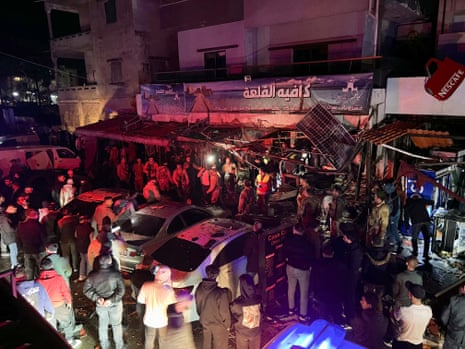
Despite the lack of a ceasefire on the ground in Lebanon, the highways leading to the south of the country were choked with traffic as dawn broke. Residents were attempting to return to their homes in south Lebanon, but Hezbollah, in a statement, urged people. not to return to certain villages across the border due to the continuing presence of Israeli troops there. Israel’s military spokesperson also issued a renewed evacuation order for the city of Tyre, in south Lebanon.
WhatsApp chats were filled with anxious and hopeful messages between people in Lebanon as they tried to parse whether or not the country would be included in the Iran ceasefire. The almost five weeks of war in Lebanon has brought the country to its breaking point, with more than 1.1 million people forcibly displaced, many of whom are living on the streets.
Keir Starmer says ceasefire 'will bring a moment of relief to the region and the world' as he heads to the Middle East
UK prime minister Keir Starmer has joined a chorus of world leaders welcoming the announcement of a ceasefire between Iran and the US.
“I welcome the ceasefire agreement reached overnight, which will bring a moment of relief to the region and the world,” he said.
“Together with our partners we must do all we can to support and sustain this ceasefire, turn it into a lasting agreement and reopen the strait of Hormuz.”
Starmer is travelling to the Middle East today to meet Gulf leaders to “discuss diplomatic efforts to support and uphold the ceasefire”, No 10 said.
Interim summary
For those of you just joining us, here’s where things stand in the Middle East after a dramatic day.
-
The US and Iran have agreed to a two-week ceasefire, barely an hour before Donald Trump’s Wednesday deadline to obliterate the country and its infrastructure.
-
Iran’s Supreme National Security Council said it had conditionally accepted the two-week ceasefire if attacks against Iran are halted.
-
Iran’s foreign minister said passage through the strait of Hormuz will be allowed for the next two weeks under Iranian military management.
-
Iranian state media said negotiations with the US would be held in Islamabad to finalise details of an agreement. Talks will begin on Friday 10 April and may be extended, state media reported. State media also reported that talks with the US do not amount to the end of the war.
-
Pakistan’s prime minister, Shebaz Sharif, announced that Iran, the US and their allies had agreed to an immediate ceasefire everywhere, including Lebanon, but Israel disputed this, saying fighting Hezbollah in Lebanon was not part of the ceasefire. Sharif has been a key figure in attempting to reach a diplomatic solution between the two warring parties.
-
Trump said Iran had proposed a “workable” 10-point peace plan. According to Iranian state media, the proposal includes a number of conditions that the US has in the past rejected, among them controlled transit through the strait of Hormuz coordinated with Iranian armed forces and the withdrawal of all US forces from regional bases. The plan would also require the lifting of all primary and secondary sanctions, payment of full compensation to Iran and release of all frozen Iranian assets.
-
Even as the ceasefire was proposed, missile alerts continued in the United Arab Emirates, Qatar, Bahrain and Israel.
-
Countries around the world have welcomed the tentative ceasefire. Australia’s PM, Anthony Albanese, welcomed the “very positive” developments but issued a rare rebuke of Trump’s “extraordinary” language beforehand. South Korea, Japan and New Zealand were among the other nations to welcome the news.
Ceasefire a 'political disaster' says Israel's opposition leader
Israeli opposition leader Yair Lapid has offered up his reflections on the last few hours of diplomacy and said “there has never been such a political disaster in all of our history.”
Lapid, who heads the centrist Yesh Atid party, has said Israeli prime minister Benjamin Netanyahu “failed politically, failed strategically, and didn’t meet a single one of the goals that he himself set.”
It will take us years to repair the political and strategic damage that Netanyahu wrought due to arrogance, negligence, and a lack of strategic planning.

Peter Beaumont
Analysis: US power has been severely diminished
The likely biggest consequences are the ones most difficult to assess. But it seems clear that the despite a bellicose assertion of US military power under Trump and his defence secretary, Pete Hegseth, US power has been severely diminished by an illegal adventure with ill-defined war aims.
With Iran still in control of the strait of Hormuz, a middle ranking global military power that has suffered under years of punitive sanctions has not only managed to survive weeks of heavy US and Israeli bombardment but pursued a succeessful strategy of horizontal escalation that imposed heavy global economic costs.
The more militarily significant Gulf states, to the surprise of few, turned out to be paper tigers, despite a huge investment in arms. Netanyahu, who promised an easy war was revealed, not for the first time, to be hopelessly unrealistic in his assessments about Iran and the wider region.
Across the globe friends and foes will draw their own conclusions. China and Russia will have noted the limits of US power and that, despite the jaw-jaw, the US did not commit ground troops to its chaotically conducted campaign.
The damage wrought by Trump to a weakened Nato will also have been well-noted, even as European countries have moved to distance themselves from Washington.
Practically, other big questions remain. Does the ceasefire deal cover Lebanon, as mediator Pakistan has suggested? In the run-up to the ceasefire, one suggestion was that one off ramp from the war would see the US and Israeli assault on Iran halt while Israel continued with an expansionist campaign against Lebanon to get Netanyahu off the hook.
“Trump lost this war in every possible sense – morally, legally, politically, economically, reputationally, and strategically”, suggested Timothy Snyder, a historian of authoritarianism, echoing the views of many experts.
Allow content provided by a third party?
This article includes content hosted on embed.bsky.app. We ask for your permission before anything is loaded, as the provider may be using cookies and other technologies. To view this content, click 'Allow and continue'.
“Trump has given the theocracy in Iran another lease on life with this failed war,” said Trita Parsi, an Iran expert at the Quincy Institute for Responsible Statecraft, “just as Saddam Hussein did in 1980 when he invaded Iran and, by that, ensured that Ayatollah Khomeini could consolidate his power.”
It is hard to disagree.