.png) 2 months ago
47
2 months ago
47
When Dolores Jacoby’s doctor told her there was little she could do to treat her acute myeloid leukemia, a deafening silence filled the hospital room, where she was surrounded by her family. Dolores had only recently been diagnosed with the rare aggressive cancer. Her beloved nursing assistant, Janeth, was standing just outside her room. After the doctor left, Janeth entered with a tray containing each family member’s favorite beverage. “If there’s anybody who can recover, it’s your mother,” she told John Jacoby, Dolores’s son, before leaving the room as inconspicuously as she had arrived.
It was 2012. More than a decade later, John still remembers that day in his mother’s hospital room in the San Francisco Bay Area clearly. “We had just heard the worst news of our lives, and Janeth injected life into my mom, into her veins, into the atmosphere, you know, for all of us,” he said.
Dolores was given three months to live after her diagnosis, her children said. She lived for three years. The family largely credits Janeth, who later attended Dolores’s funeral and stayed in touch with them.
In March, the Guardian informed John that Janeth, who is from Honduras, had lost her job because of her immigration status. He was gutted. “That makes no sense,” he said. “They need to take her back for the patients. I just hope I don’t ever end up in a hospital bed without someone like [her] by my side.”
Janeth, 50, prefers to be identified by only her middle name for this article because of the sensitivity of her immigration case. She has been in the United States for over two decades on temporary protected status (TPS), a legal program that has allowed more than a million people to live and work in the US. TPS is granted to individuals from countries facing conflict, environmental disaster, or other circumstances that make it unsafe to return. Last year, the Trump administration revoked TPS for many countries, including Honduras, leaving its former beneficiaries without lawful immigration status virtually overnight – and at risk of detention and deportation as a legal battle over it continues.
After winning a prestigious national nursing award seven times during her 23-year career, Janeth was suddenly considered by the government to be in the United States illegally. She and her 85-year-old mother had to move in with Janeth’s daughter because she can no longer pay her mortgage. “I just want my job back, I just want my life back. I want to take care of my patients again,” she said.
A central promise of the second Trump administration has been the mass deportation of immigrants who are deemed to be in the country illegally. But less publicized is the administration’s efforts also to strip thousands of immigrants of their legal status in the US – and in particular what that means for people seeking medical care in the country.
The administration’s policies are straining an already fragile multi-trillion dollar US healthcare system, as about one in six hospital workers directly involved in patient care is an immigrant, and an estimated 4% of hospital workers are not naturalized citizens. These workers fill an important gap in healthcare that experts say cannot be easily replaced. “Just because we are stopping immigration pathways and banning people from these countries doesn’t mean we can ban patients, too. They continue to come to hospitals and nursing homes, except now there is a shortage of people who can attend to their needs,” said Kimberly Pierce Burke, executive director of the Alliance of Independent Academic Medical Centers, a national organization of about 90 independent teaching hospitals.
It is difficult to quantify exactly how many healthcare workers are affected by these policies. But FWD.us, a DC-based immigration advocacy organization, used census and other government data to estimate that, as of early 2025, nearly 1.3 million people in the US were on TPS, of whom at least 50,000 were working in the healthcare sector. US Citizenship and Immigration Services (USCIS), which is part of the Department of Homeland Security (DHS), said in response to questions from the Guardian that the government does not maintain data on TPS holders’ occupations.
Individual employers sometimes try to keep track. Amina Dubuisson, vice-president of clinical services at Ventura Services Florida, who oversees nine nursing homes across Miami, said at least 20% to 30% of their workers are TPS holders. Each nursing home has 200 to 300 staff members. “They do a lot of the jobs that Americans don’t want to do,” she said, such as nursing assistants, who clean and feed patients.
TPS was established in 1990 and the secretary of homeland security determines whether a country meets the criteria for protection. The designation can be made for up to 18 months at a time, and is continually re-evaluated to determine if it should be extended or terminated. For some countries like Honduras the designations have been extended over and over again for decades. TPS does not lead to permanent residency or citizenship, although TPS holders may separately apply for other immigration benefits.

Ever since Donald Trump’s first term in office, he has held that TPS has been abused and extended unnecessarily. “TPS was never designed to be permanent, yet previous administrations have used it as a de facto amnesty program for decades,” said a DHS spokesperson in a statement to the Guardian.
Since returning to the US presidency in 2025, the Trump administration has ended or attempted to end protected status for 13 of the 17 countries with TPS designations, including Honduras, Venezuela, Syria, and Haiti.
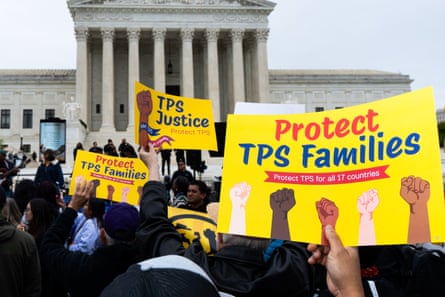
The administration’s policy has become entangled in lawsuits, rulings, and appeals, including an anticipated supreme court decision this month that will determine whether the government can immediately end TPS for Haitians.
‘Suddenly I wasn’t legal’
Originally from Tegucigalpa, the capital of Honduras, Janeth migrated to the United States with her daughter in 1998 to escape gun violence and find better economic opportunities. She had a brother in the US with a conditional green card whom she hoped could help her.
She taught herself English, completed a nursing assistant course, and started working with post-surgery and cardiac patients at a Kaiser Permanente hospital in the Bay Area.
In September last year, the government announced it was terminating TPS for Honduras, which had been in place since 1999. “I was in a state of shock. I couldn’t eat. I couldn’t sleep,” Janeth said, adding it was like “I was here all this while, legally, and then suddenly I wasn’t legal.” When her colleagues learned that she had to abruptly stop working, they raised over $13,000 in a crowdfunding campaign for her.
Janeth’s absence is felt at the hospital every day, her former colleagues say. When she was around, even if she was the only nursing assistant on shift, the staff was assured that all patients would be taken care of, said a nurse at Kaiser. “Not everyone has the heart to go above and beyond,” she added. “There is a lack of joy and camaraderie that’s been prompted by her leaving.”
Another nurse whom Janeth assisted, recalled that she was able to turn “difficult patients” into her “biggest fans”. She remembered a patient with alcoholism, who didn’t want anyone to come near them. But after one shift with Janeth, the patient only wanted her all the time. That kind of skillset you can’t ever replace, said the nurse, who worked with Janeth for eight years.
Both nurses didn’t want their names used, as they still work at the hospital.
Kaiser Permanente did not comment directly on Janeth’s case, but said they have been “looking for ways to reduce the anxiety and uncertainty for any of our employees who might find themselves in this situation”.
On September 8, the day TPS ended for Hondurans, Michael Fein, a retired Kaiser physician, wrote a letter to US senator Adam Schiff of California about Janeth, who he only referred to as “a close friend” who had worked at Kaiser for 23 years.
“She is reliable, compassionate, dedicated, and knowledgeable. Recently she was told her Honduran TPS status was revoked and she would have to return to Honduras,” Fein wrote. “This is devastating and so unfair. Anything you can do to support TPS would be appreciated.”
Janeth has kept a small carton filled with handwritten letters from patients spanning two decades. Since losing her job, she struggles to even look at them as she finds it too painful. Janeth “spends a lot of time doing extra kind things to make your stay pleasant. She was my cheerleader for long walks all over the hospital,” wrote one surgery-ward patient in a 2004 letter. “I could tell right away that [Janeth] calmed and comforted my mom. She bathed and took time with her, more than any nurse has done in the four days my mom has been here,” wrote the daughter of another patient in 2014.
Not in the box of cards, but still etched in her heart, is something her patient Dolores used to say about her. Due to her compromised immune system, Dolores was in the infectious diseases ward, and everyone had to wear masks. For the longest time, Dolores didn’t see Janeth’s face, only her eyes. She told her son, John, that Janeth’s big fluttering eyelashes reminded her of butterflies. “So every time she enters my room, I feel like I am in a garden.”
The year 1998, when Janeth came to the United States, was also when Jhony Silva entered the country, also from Honduras. He was only three years old. Silva grew up in the San Francisco Bay Area being “as American as possible”, he said. In his teens, he tried to join the military, but was turned away because of his TPS status. He thought the US military could be a pathway to citizenship, not knowing one must already be a citizen or at least a green card holder to join the military.
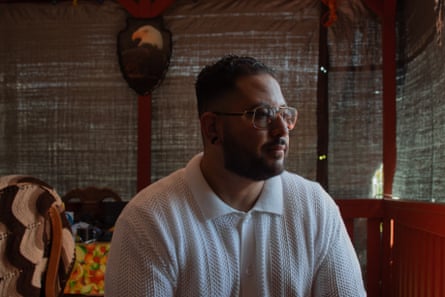
His dream, though, was to become a nurse. He enrolled in a nursing school, and in the meantime, he worked as a nursing assistant at the Stanford hospital in Palo Alto. “I met him as part of the ‘float pool’,” said Renee Yee, a senior nurse in the cardiac surgery and heart transplant floor. The “float pool” consists of healthcare workers who aren’t part of one specific unit, but move from one to another as needed. Yee said that her unit has seriously ill patients, connected to chest tubes and wires, and having multiple comorbidities. Most people are nervous around them, she said. “But Jhony was very comfortable with very complex patients.” Impressed, she went to the manager and requested that Silva be made permanent in the unit.
He served there for a year, before last year’s TPS revocation meant he had to leave. When the National TPS Alliance, a non-profit headquartered in California, decided to file the lawsuit challenging the government’s decision, Silva stepped up to be one of the lead plaintiffs. “I’m going to use my voice to speak up about what’s going on, for people that can’t speak like me,” he said.
Not only did Silva lose his job, he also had to drop out of nursing school, as he could no longer afford it. He still washes his hospital scrubs regularly, in the hope that he’d be able to go back to work.
‘We are losing patients’
Last September, 95 US representatives and 13 US senators, all Democrats, including Schiff, wrote to Kristi Noem, then DHS Secretary, and other government officials to express concern about how the TPS revocations will specifically impact the healthcare sector. “The most vulnerable Americans in need of healthcare will pay the price,” the lawmakers warned.
While TPS has periodically been revoked for various countries over the years, plaintiffs suing the government over the most recent moves have argued that the Trump administration is not following the required legal procedure in its terminations. On June 16, lawyers for Haitian TPS holders filed a motion requesting the supreme court dismiss the case, claiming that newly released emails show that the DHS did not analyze conditions in Haiti or consult with the state department, as required by law, before terminating the TPS for Haiti.
In December, a federal court ruled that the Trump administration’s decision to end TPS for Honduras, Nepal, and Nicaragua was unlawful because the DHS did not consult other government agencies or review the conditions of the countries, as the process requires. But the government appealed and in February this year the ninth circuit court of appeals upheld the administration’s TPS revocation. The plaintiffs decided not to take the case to the supreme court for now, ending hope for a quick resolution for immigrants like Janeth.
Changes to immigration policy affecting health care workers aren’t limited to TPS. In June last year, the Trump administration also ended a humanitarian parole program launched by the Biden administration in 2023. The program, implemented at a time when people were arriving in record numbers at the US-Mexico border, was aimed at providing “safe and orderly pathways to the United States”, mainly for Cubans, Haitians, Nicaraguans and Venezuelans (CHNV). Nearly 500,000 people came to the US through the program, according to Fwd.us. Trump criticized the humanitarian parole program, saying it exacerbated a border crisis during Joe Biden’s term. The DHS, in an emailed response to questions, said many of the parole recipients were “very poorly vetted” and that ending the program was a “return to commonsense policies”.
According to Fwd.us, as of September 2024, there were about 30,000 healthcare workers allowed into the country and working under the CHNV program. Though DHS said the program allowed new arrivals to “compete for American jobs and undercut American workers”, some employers told the Guardian they are reeling from the consequences of the termination last June.
Joseph Durandis, a doctor based in Miami, lost one of the three medical assistants he had when the CHNV program disappeared. This person had been a doctor in Cuba, and became an integral member of his team. Almost a year later, Durandis still hasn’t found a replacement for the assistant, who had been allowed to come to the country under the CHNV humanitarian parole program. He described the assistant’s calibre as “not replaceable”. Moreover, finding someone that qualified who would be willing to serve the community here isn’t an easy task, Durandis said, adding that many of the patients at his clinic are on food stamps and need essential care. Since losing that assistant, Durandis said that patients have to wait more before he can see them. “Triage takes much longer and that causes annoyance among patients,” which “affects patient retention”. He added that patient “satisfaction is dropping too, definitely, we are losing patients”.
Rachel Blumberg, the president and CEO of Sinai Residences, a seniors’ assisted living and long-term care facility in Boca Raton, Florida, was devastated to learn that the government was ending the CHNV program. She went to work the day the CHNV expired, she said, and pulled aside nine members of her staff who were on the program, gave them $2,000 each, and asked them to leave, because they had lost their work authorization. “It felt like I had to do the dirty work of the government,” Blumberg said.
The CHNV program was designed to provide temporary legal status and work authorization for up to two years. Workers with temporary permits like TPS and CHNV often seek more permanent options to stay in the US, such as applying for asylum or seeking a green card, but long wait times due to significant backlogs often make the process inaccessible.
To be eligible for TPS, applicants must prove they have been continually present in the United States since the date the country was designated for the protection, and can apply even if they originally entered the country unlawfully. However, they are generally ineligible for the status if they have committed crimes in the US or pose a security risk.
In 2021, the supreme court had barred TPS holders from obtaining a green card within the United States if their initial entry into the country was not authorized. The court ruled that they must first depart the country to have a visa processed, making the pathway to residency even narrower for many TPS holders.
Blumberg recalled two sisters from Haiti on her staff who came to the country under CHNV parole, which allows them to stay for two years. After they arrived, they applied for TPS, hoping that it would be renewed, so they could stay in the US longer. One applied for TPS sooner and received it, while the other was still on CHNV when the administration killed the program and she had to leave the facility. The other sister is now waiting to find out if her TPS status will disappear as well.
Supreme court ruling affects Haitians in US
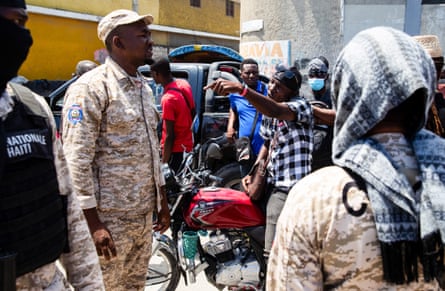
While TPS for Honduras and some other countries has ended, Haiti’s TPS status remains in limbo. The country was granted the TPS in 2010, following a devastating earthquake that killed thousands and displaced over a million people. The first Trump administration tried to terminate TPS for Haiti, triggering extensive litigation. The Biden administration ultimately redesignated Haiti as a TPS-eligible country. In 2025, after Trump took office for his second term, DHS moved to shorten and then terminate Haiti’s TPS designation.
TPS for Haiti was set to expire on 3 February but a federal judge in Washington ruled that terminating it would cause “irreparable harm” to Haitians, who would be forced back to a country that the state department says in a travel advisory that Americans should not go to “for any reason”. Had the federal judge not ruled against the termination, many Haitians, including many working in nursing homes, would have lost their TPS status. According to 1199SEIU, Florida’s largest healthcare union, over 30% of the nursing home workers it represents would have lost their legal status overnight.
The government appealed the judge’s ruling and the case is now at the US supreme court, which will soon decide if Haitians (and Syrians, who are also included in the lawsuit) will be able to keep their status. In oral arguments in the court in April, lawyers representing the TPS holders argued that the Trump administration is discriminating against particular immigrants and attributed termination of the TPS to “the president’s racial animus towards non-white immigrants and bare dislike of Haitians in particular”.
US solicitor general John Sauer, who represented the administration in court, dismissed the argument, stating that the president’s statements referred to the “problems of crime, poverty, welfare dependency”. President Trump had previously referred to Haiti and other countries as “shitholes”.
In its statement to the Guardian, the DHS said “these decisions have nothing to do with race” and instead are taken after “reviewing conditions in the country and consulting with appropriate US government agencies”. It noted that Haiti’s TPS was granted after an earthquake that took place over 15 years ago. “Now is the right time to conclude what was always intended to be a temporary designation.”
‘There is no plan B. This is where my life is’
Esther Birnbaum, a 96-year-old who lives in Palm Beach county, north of Miami, is dependent on Maryse Balthazar, who is from Haiti, for her primary care. Balthazar moved from Port-au-Prince, Haiti’s capital, to the United States in 2010 after the earthquake. She was a journalist and the president of the Association of Haitian Women Journalists, but after moving to the United States she got a nursing assistant certificate and began working as a home health aide. For several years, she cared for Birnbaum’s elder brother, a pilot in the second world war who died in 2024, at the age of 102. Balthazar then began taking care of Birnbaum. “I can’t imagine my day-to-day life without her. I don’t know how she does it, really. From hooking me on to my lymphatic drainage machine to keeping me active, it’s all her,” Birnbaum said, adding that she would be “devastated” if Balthazar has to stop working.
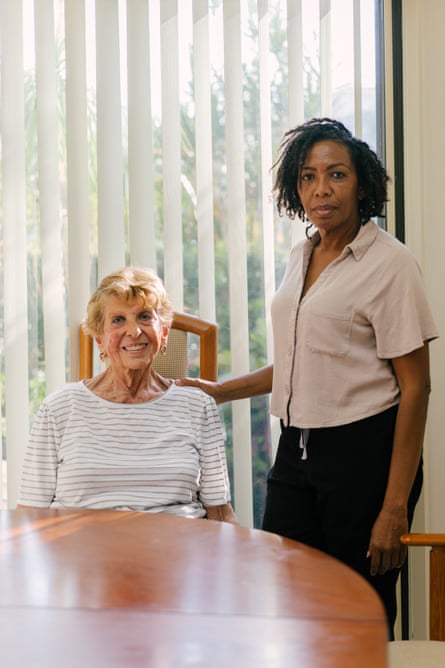
Balthazar, who has two children, says she has nowhere else to go. “There is no plan B. This is where my life is, I wouldn’t know what to do if TPS isn’t protected,” she said.
Another Haitian healthcare worker living under a cloud of uncertainty is Marie Esther Duval, 55, who moved to Washington state after working in various nursing homes in Florida, to start an adult family home in Spokane in 2022. Duval, who came to the United States from Haiti in 2000, wants to help young adult women with severe mental illness. The facility aims to provide a safe, home-like environment for her four patients, who live together as a family. It has a large living area with a fireplace and lots of board games and puzzles. A Christmas tree adorns the space year-round, and there is cake on each resident’s birthday or anniversary at the adult family home.
The residents range in age from 29 to 34. One of them, Demica, also has developmental delays. “It scares me how much she cares about me,” she says of Duval. “I can see her heart pounding out of her chest when she thinks I am not doing well,” Demica said.
Nemehi, another patient, is Haitian and was adopted from an orphanage by an American couple after the earthquake. On the first night of the earthquake, she slept next to a dead body. Since coming to the United States, Nemehi has struggled with persistent PTSD. Duval “is like a mother to me. The best thing is that I can speak my language here with her,” she said.
A third patient, Michelle, has schizophrenia, and used to hear voices, which caused her to sleep with a knife under her pillow. “I finally feel safe here. She makes me feel so protected,” she said.
They are all dependent on Duval, and none of them knows that she risks losing her legal status. She is too scared to tell them that the Trump administration’s immigration policies could upend their lives. “These are people with chronic anxiety and depression. They won’t be able to handle this news.”
This series was produced in partnership between Columbia Journalism Investigations and the Guardian
Chris Caurla contributed to this report