.png) 2 months ago
35
2 months ago
35
Who is the World Cup for? Fifa appeared to share some of its thinking on this topic in the past week. On the one hand, there was the revelation that spectators are being asked to pay more than twice as much for match tickets than they were in Qatar. On the other, the news that prize money for competing teams is to rise by more than 50% on four years ago. Stakeholders are doing good! Fans? Not so good.
It hasn’t taken long for some of those watching to wonder whether things could be done differently. Tom Greatrex, the chair of the Football Supporters’ Association, which represents fans in England and Wales, argued that the ability to pay expanded prize money, itself a result of expanded revenue, showed “there is no need to charge extortionate ticket prices to the supporters who bring the vibrancy to the World Cup”. You could go so far as to say there was never a real need to do it in the first place.
Here’s one version of what could happen next. Given the 37 members of the Fifa Council are in Doha, likely enjoying some of the best of Qatari hospitality on the back of Wednesday’s official meeting, it wouldn’t be hard to arrange an extra day of deliberation. Commandeer a meeting room in a six-star establishment, crack open the pomegranate Red Bulls, and get to work. First off, correct the most offensive part of this whole thing and redistribute some of the expanded prize money into slashing ticket prices for disabled supporters and their companions across the piece (currently, there is no discounting at all). Second, give free match tickets – 300 a match, say – to fans who lug drums and flags and face paint halfway across the world to provide 90 minutes of noise and colour (you could do this through associated fan groups such as the England Supporters Travel Club). As a third suggestion I’d say scrap dynamic pricing and ticket resales, but let’s not shoot for the moon.
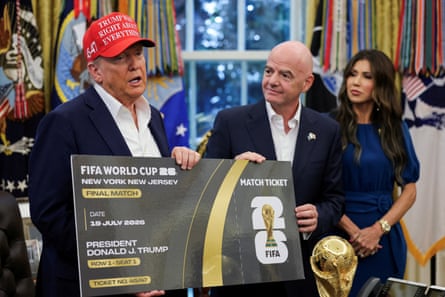
Once you’ve done that, the positive effects would start to flow. For the first time in a long time, Fifa would be perceived by the public as, in some way, a progressive organisation. Yes, Fifa is a not-for-profit organisation, one that does unacknowledged work sustaining the sport across the world and channels all its money back into the game (more on that in a moment). But so many have been the missteps, the failures and the downright egregious actions (Fifa peace prize to Trump the most recent, failing to provide financial remedy for migrant workers in Qatar the most abhorrent), that it would be good for Fifa to do something that would stick in the mind of the public as half decent. In turn, it may free up space to ask some more existential questions.
There is a debate, pursued by the Premier League among others, over whether governing bodies (such as Fifa) should also be running competitions. But this request is different: that Fifa should use any moment of grace to ask for whom they should be doing all this stuff. The model Fifa has created for this World Cup benefits itself, and by extension, its member associations. That’s where all the money goes. In some instances, those associations may exist in countries where – without Fifa’s assistance – there might not be the resources to create a national team worthy of the name. But in others – those most likely to benefit from the largesse of increased prize money – there’s enough money to sustain the game, and then some.
Take Spain, for example. They are the world’s top-ranked side and have benefited from new Fifa rules that will keep them apart from teams ranked two, three and four until the semi-finals of the World Cup if they all win their groups. If they get no further than the semis, the Spanish football federation (RFEF) will receive $29m (£21.6m) in prize money. Meanwhile, on Monday, the RFEF announced its budget for 2026 (ie without new prize money taken in), and presented a sum of €403.5m (£353m), €87m of that being redistributed to its participating clubs. Some of those payments are made to those competing in the Spanish Super Cup, for which Saudi Arabia pay €40m each year for the hosting rights. This year Barcelona won it and took home an estimated €9m.
Does the RFEF need another $29m? Does England’s Football Association for that matter? No doubt they could do some good with the money, but – not beyond the bounds of reason – they could also fritter it away. More centrally, would the value accrued for the game by giving the money to a national association be greater or lesser than if that same cash was plugged directly into lowering the costs and increasing the accessibility of a sporting event that, rightly or wrongly, the world believes belongs to the people?
It’s a mouthful of a question and, in all likelihood, not one that will echo repeatedly around the corridors of Fifa headquarters, on Fifa-Strasse, in Zurich. They’ve got a World Cup to put on. But the longer it goes unasked, never mind unanswered, the more antipathy among people who feel frozen out of the game will grow. And maybe, one day, all that money may just stop flowing.