.png) 3 months ago
73
3 months ago
73
I was at work last Saturday when I heard the blast. Since that moment, the world has been turned on its head. The school called asking me to come and pick up my child. I rushed to the metro and headed north in a carriage filled with anxious people calling their loved ones to ensure their safety, melancholy etched on their faces, uncertainty metastasising from one to another as they checked the latest news on their mobiles.
This is the second time within a year that Israel has decided to go for a war of choice with Iran, but I suppose that is the new normal. Israel has long enjoyed a unique position of near-total impunity when it comes to harassing Palestinians, and now the green light to aggression seems to extend to its unending wars and spreading of terror across the region. And it feels different this time. The pretence that there is some level of precision in the strikes is gone. Instead, the attacks appear indiscriminate, with targets ranging from schools to hospitals, from police stations to urban amenities – all hit with a level of might that seems aimed at demolition, total destruction, the flattening of the city.
“Beirutification” should become a word if it is not already. By that, I mean the slow normalisation of periodic attacks on a city by a capricious and violent state, until blasts and death become woven into the fabric of urban life. It is urban death by a thousand knives. It is the suffocation of imagination and the thwarting of any civil attempt at a better life, and the gradual dilapidation of a nation to the point where it can no longer stand again, condemned instead to rot in exhausted silence. That is what years of war have done to Beirut. Now something similar is unfolding in Tehran.
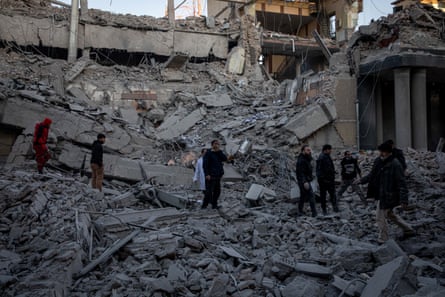
A few days into the war, Tehran is emptying. Many residents are trapped within the four walls of their homes; others have fled the capital. Loud explosions and distant rumblings are becoming routine. Middle Eastern wars have long been framed to Iranians as someone else’s problem, unfolding in distant places. An “Arabic” phenomenon, something to watch on television but not something that could reach us. Now it is here. Real. Terrifying.
And yet if you venture into the thinning city, life still appears in fragments – in parks, in shopping centres, in the small spaces where people can gather. A few days ago, I met a group of youngsters in a park overlooking Tehran. They had gathered to ease the weight they felt and talk things through, making jokes and bantering about the predicament they found themselves in. Perhaps we Iranians can find humour in any form of suffering, and can turn even misery into something to laugh about.
Their company eased some of the anxiety I carried with me. And as we were parting, one of them said, by way of goodbye: “Don’t die.”
The brutal nakedness of that sentence, its honesty, its immediacy, said everything about the conundrum we live in. About survival itself. Don’t expire. Stay alive.
I recount this story not to solicit pity or to whet the appetite of sympathetic Europeans. We are tired of being cast in the role of victims, and even more tired of hearing about “humanitarian wars” supposedly fought to plant the seeds of democracy. The justifications are painfully familiar: a country “days away” from a nuclear bomb; the need to rescue people from a “tyrannical state”; the spectre of some “imminent threat”. These narratives have been used before, from Iraq to Afghanistan to Libya. And they are always paid for with the blood of ordinary men, women and children.
Nor should criticism of war be dismissed with the usual labels. Anyone who questions western military intervention is quickly branded a “regime supporter” or a “terrorist sympathiser”. We have seen this script before. The same lines are simply rehearsed again, each time for a new country.
I write these words as someone who has long been a critic of the Iranian state. But criticism of one’s own government does not mean welcoming the destruction of one’s society. Across borders, there are many people who imagine a different order, one devoid of imperialism and its domination – one grounded in peace.
Perhaps we have entered a darker era, one in which diplomacy recedes and bullets replace words. Yet there is also another possibility. More and more people are beginning to see through the machinery of war and the industry of democracy-making that accompanies it.
If there is hope, it lies there – in those who refuse to accept that endless war is simply the way the world must be.
-
The author is an Iranian citizen living in Tehran
-
Do you have an opinion on the issues raised in this article? If you would like to submit a response of up to 300 words by email to be considered for publication in our letters section, please click here.