.png) 3 months ago
65
3 months ago
65
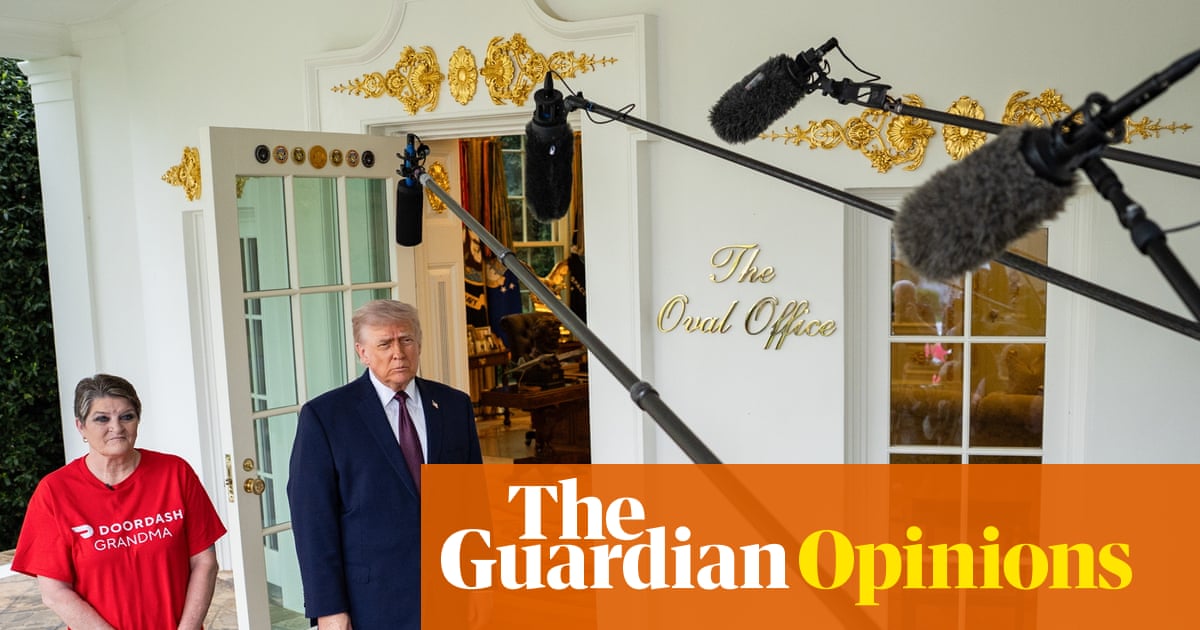
Did you notice history being made this week? I am not referring to what may have been the most pathetic moment in recorded time – Donald Trump gratefully taking the Nobel peace prize medal from the woman who actually won it – nor the defection of a politician from one British rightwing party to another, but something grimmer. For this week witnessed what could well prove to be a landmark chapter in the blood-soaked history of the Middle East.
Thanks to an information blackout caused by Tehran’s decision to switch off the internet, it is hard to be precise about what just happened on the streets of Iran. But one official has admitted to a death toll of 2,000. CBS News put the number of dead at 12,000, while some warn it could be many thousands more – all of them Iranian civilians, gunned down for daring to protest against their government and to demand a better life.
The reports are horrifying and scarcely denied. Doubtless to frighten and deter the Iranian public, the regime itself has published pictures of morgues brimming with body bags. There are reports of security forces using automatic weapons on demonstrators, firing into crowds indiscriminately, mowing down their fellow citizens. Others speak of pellet guns discharging birdshot into the eyes of protesters in order to blind them.
Those who took to the streets would have known the risk they were taking. After all, when Iranians protested the election that was stolen from them in 2009, when they complained about exorbitant fuel prices in 2019, and when they rallied under the slogan “Women, life, freedom” in 2022-3, the response was brutal each time. Knowing all that, they protested anyway. They did it in all 31 of Iran’s provinces, and from all parts of society. Not just middle-class urbanites, but young and old, women and men, the poor and the better off. This movement is not about a single, animating grievance, such as 2022’s rebellion against the compulsory hijab for women, but rather an expression of all-out fury at the regime. And you can see why.
The Iranian economy is broken, the currency all but worthless, the national income of a country rich in oil crushingly far behind the global average. Its wealth has been criminally wasted, diverted to the pursuit of regional superpower status, whether through a nuclear weapon or by the sponsorship of proxies abroad: Hezbollah in Lebanon, Hamas in Gaza, the Houthis in Yemen. The result is a domestic infrastructure so parlous that last month the capital city came close to running out of water.
But the privations of Iranian life are not only material. Iranians are denied the essentials of a free life. People cannot choose those who rule them because democracy is a sham, with all but those loyal to the regime barred from running for office. They cannot speak their minds or hear the true views of their neighbours, because the censor shuts out criticism. They cannot love who they love, because same-sex activity is punishable by flogging and even death. As the New York Times put it, “Misogyny is official government policy” in a state where a woman’s word in court is officially worth less than a man’s, and where women are barred from singing alone in public. To the regime, life itself has little worth: in 2025, the state executed more than 2,000 of its own citizens. That’s an average of about six people put to death every day.
So Iranians were not short of reasons to protest. But they were also explicitly urged on by the most powerful man in the world. “Keep protesting,” Trump posted on Tuesday. “HELP IS ON ITS WAY.” In a speech later that day, he told Iranians to “take over institutions”, to keep up their fight, safe in the knowledge that the US would come to the rescue. The US, he promised, was “locked and loaded and ready to go”.
If Iranians thought that meant military action to oust the regime, they have so far been disappointed. In an echo of the first President Bush’s February 1991 exhortation to the Iraqi people “to take matters into their own hands” against Saddam – a plea that was heeded by Shia and Marsh Arabs, only for them to be slaughtered in immense numbers when Bush’s rhetoric proved empty – so far there has been no Trump rescue.
To be clear, there are few reasons to believe that US military action would help. You only have to look at the catastrophic record of US intervention in the Middle East these past 25 years to reach that conclusion. Repeating this month’s Venezuela operation and forcing out Iran’s supreme leader, Ali Khamenei, would give Trump a trophy but not much more. Even removing the entire top layer of leadership would not achieve much, so deeply entrenched is the theocracy that has ruled Iran since 1979, say those who know the country best. “This regime will simply replace itself,” said Suzanne Maloney, who has advised both Democratic and Republican administrations on Iran, when we spoke for the Unholy podcast this week. If US strikes did somehow topple the regime, it would leave a dangerous vacuum. After nearly half a century of the ayatollahs, there is no coherent alternative ready to step in.
Still, there is much the outside world can do. Sanctions on Iran are tight, but could be tighter still. When it comes to economic pressure, one very senior UN official says privately: “There’s still a long way to go.” That could translate into sanctions on named individuals implicated in this month’s bloodbath but also on core institutions. The EU could set a lead by sanctioning the Islamic Revolutionary Guard Corps. All such moves would begin to change the calculus of key figures in the regime, making them wonder if their best interests are served by staying loyal or breaking away.
Which is not to say there are not more direct ways to limit the regime’s ability to slaughter its own. Cyber operations have proven their worth in Iran before and could do so again, if aimed at those centrally involved in repressing the current uprising: say, the morality police and the despised Basij. And there are ways, through Starlink and the like, to provide internet service to ordinary Iranians so they are no longer kept in the dark.
In the meantime, there is something small everyone in the world can do – and that is to give the battered and besieged people of Iran our attention. After the massacres, the protests seem to have reduced in intensity – the natural consequence of fear. But as they have receded, so has media coverage and political discussion, even as thousands of corpses from a colossal slaughter are barely cold. Many of those who usually pride themselves on their solidarity with the oppressed of the Middle East have been uncharacteristically restrained this time and oddly quick to move on, perhaps reluctant to be too hostile to an Iranian regime that defines itself as the foe of the US and Israel. Maybe they think that any enemy of Trump’s is automatically a friend of theirs. Maybe they fear it weakens their support for the Palestinians to oppose a regime that wants to see Israel destroyed.
But shrugging as thousands of Iranians are gunned down in the streets is not a moral stance worthy of the name. It does not help the oppressed, but only their oppressors – those who flog and hang and shoot and blind their fellow citizens while the world looks on.
-
Jonathan Freedland is a Guardian columnist
-
Guardian newsroom: Year One of Trumpism: Is Britain Emulating the US? On Wednesday 21 January 2026, join Jonathan Freedland, Tania Branigan and Nick Lowles as they reflect on the first year of Donald Trump’s second presidency. Book tickets here or at guardian.live
-
Do you have an opinion on the issues raised in this article? If you would like to submit a response of up to 300 words by email to be considered for publication in our letters section, please click here.