.png) 3 months ago
77
3 months ago
77
Eyes on Marinera oil tanker as Russia deploys naval escort
Meanwhile, a lot of attention is being given to an ageing oil tanker, formerly known as Bella 1 and renamed as Marinera, which is now going through the Icelandic territorial waters.
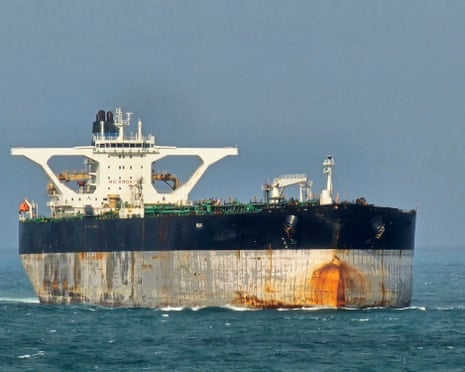
The Russian Navy has reportedly deployed a submarine and other naval vessels to escort the tanker, previously involved in Venezuelan oil exports, amid growing speculations the US and allies are monitoring its movements.
The tanker has recently switched to Russian flag in an apparent attempt to evade scrutiny, according to US media reports.
As my colleagues explained earlier this week:
“As Bella 1, the tanker had been preparing to pick up oil from Venezuela last month before the US Coast Guard approached it on 20 December, on suspicion that its country of registration was not valid. The ship was said to be registered in Guyana.
The crew refused to allow it to be boarded and the vessel fled, during which time it re-registered as the Marinera in the Russian port of Sochi. Its tracking transponders, which had been turned off since mid-December, were restored as it headed north.
Bella 1 had been under sanctions by the US treasury since July 2024, accused by the American authorities of being involved in carrying illicit cargo for a company owned by Hezbollah, the Iranian-backed Lebanese group.”
The New York Times reported that three other previously sanctioned tankers seen in Venezuelan waters have also re-flagged to Russia.
Key events Show key events only Please turn on JavaScript to use this feature
Ukraine's national interests will be protected at Paris talks, Zelenskyy's chief aide says
Head of Zelenskyy’s office, Kyrylo Budanov, offered a bit more detail on the talks, stressing however that “not all details of these discussions can be made public at this stage.”
“However, tangible results have already been achieved, and the work is ongoing. The national interests of Ukraine will be protected,” he stressed.
Ukraine-US talks to continue in Paris, Zelenskyy says
Ukrainian president Volodymyr Zelenskyy said on Wednesday that he expected the Russian-occupied Zaporizhzhia nuclear power plant and territorial issues to be discussed by his team and US negotiators in their talks now being held in Paris, Reuters reported.
In a post on X, he said that “another session” with US envoys, Steve Witkoff and Jared Kushner, will take place today, the third in two days.
Zelenskyy said that he told his team to “discuss possible formats for leader-level meetings between Ukraine, other European states, and the United States.”
“Ukraine does not shy away from the most difficult issues and will never be an obstacle to peace. Peace must be dignified. And this depends on the partners – on whether they ensure Russia’s real readiness to end the war,” he said.
Eyes on Marinera oil tanker as Russia deploys naval escort
Meanwhile, a lot of attention is being given to an ageing oil tanker, formerly known as Bella 1 and renamed as Marinera, which is now going through the Icelandic territorial waters.
The Russian Navy has reportedly deployed a submarine and other naval vessels to escort the tanker, previously involved in Venezuelan oil exports, amid growing speculations the US and allies are monitoring its movements.
The tanker has recently switched to Russian flag in an apparent attempt to evade scrutiny, according to US media reports.
As my colleagues explained earlier this week:
“As Bella 1, the tanker had been preparing to pick up oil from Venezuela last month before the US Coast Guard approached it on 20 December, on suspicion that its country of registration was not valid. The ship was said to be registered in Guyana.
The crew refused to allow it to be boarded and the vessel fled, during which time it re-registered as the Marinera in the Russian port of Sochi. Its tracking transponders, which had been turned off since mid-December, were restored as it headed north.
Bella 1 had been under sanctions by the US treasury since July 2024, accused by the American authorities of being involved in carrying illicit cargo for a company owned by Hezbollah, the Iranian-backed Lebanese group.”
The New York Times reported that three other previously sanctioned tankers seen in Venezuelan waters have also re-flagged to Russia.
EU reveals weak hand as Trump raids Venezuela and threatens Greenland

Jon Henley
Europe correspondent
From This is Europe newsletter – sign up here
The EU is in a deep, deep bind over Donald Trump’s smash-and-grab raid on Venezuela – just as it is over his repeated assertions that the US “absolutely” needs to take control of Greenland, a self-governing territory of the Kingdom of Denmark.
“If Europe acquiesces in US actions against the Maduro regime, it risks weakening the legal principles that underpin its opposition to Russia’s invasion of Ukraine,” said Alberto Alemanno, a professor of EU law, neatly summing up the dilemma.
“If, however, it condemns those actions,” Alemanno said, “Europe risks alienating its primary security guarantor and straining transatlantic unity – at a moment when collective defence against Russia is especially critical.”
Europe’s leaders, who have heard Volodymyr Zelenskyy say a peace deal is “90% ready” and on Tuesday met the Ukrainian president and the US envoy Steve Witkoff in Paris to discuss US-backed postwar security guarantees for Kyiv, are desperate not to derail it.
More broadly, they are also keen to avoid antagonising a US president who has made no secret of his contempt for Europe and its leaders for fear of reviving trade tensions or undermining already withered US security guarantees to Europe generally.
The weak position this has left them in was on full display in the aftermath of Trump’s Venezuela operation. In a statement, France’s Emmanuel Macron said he would shed no tears for Maduro.
In an even more contorted response, the German chancellor, Friedrich Merz, also stressed Maduro’s illegitimacy as Venezuela’s leader – and added that “legal assessment” of the US raid was “complex and requires careful consideration”.
Italy’s Giorgia Meloni went further, describing the attack as “legitimate” self-defence, while the European Commission president, Ursula von der Leyen, resorted to the well-worn formula that the bloc was “following the situation closely”.
A few leaders, most notably Spain’s Pedro Sánchez, were more outspoken. Spain “did not recognise the Maduro regime”, the Spanish prime minister said bluntly, “but neither will it recognise an intervention that violates international law”.
But the overall response came across as circumspect and was perhaps best characterised by the fact that Trump himself gleefully endorsed the French president’s remarks, reposting them on his Truth Social network.
Was Europe’s response right? Nathalie Tocci of Rome’s Istituto Affari Internazionali argued forcefully it was not. “The more European countries act as colonies, unable and unwilling to stand up to Trump, the more they’ll be treated as such,” she said.
Dr John Cotter, a researcher in EU constitutional law at Keele University, was equally forthright. European leaders who failed to condemn the US attack “out of fear of provoking Trump’s ire” were missing two fundamental points, he said.
“First, Trump clearly doesn’t care what they think. Second, he couldn’t hold them in more contempt anyway. In fact their mealy mouthed responses … will only heighten his contempt. European leaders might as well have shown some dignity.”
There are signs, though, that European resolve may finally be hardening when it comes to Greenland – led by straight-talking Denmark.
But … while their verbal rebuff of Trump’s Greenland threats may be significantly stiffer than their responses to his Venezuela raid, no one is willing to say what actual steps the EU and its members may take were the US to attempt any kind of grab.
Mujtaba Rahman of the Eurasia Group risk consultancy warned:
“A possible US intervention in Greenland is the biggest source of risk to the transatlantic alliance, and to intra-Nato and intra-EU cohesion – arguably far greater than [the risk] presented by Russia’s invasion of Ukraine.”
How a US takeover of Greenland would undermine Nato from within - analysis

Dan Sabbagh
Defence and security editor
The idea that one Nato country could attack another – a US invasion of Greenland – is so alien that the most famous article in Nato’s founding treaty does not distinguish clearly what would happen if two of its members were at war.
Article 5, the cornerstone of mutual protection, dictates that “an armed attack against one or more” in Europe or North America shall be considered “an attack against them all”. Simple enough if the military threat comes from Russia, but more complicated when it comes from easily the alliance’s most powerful member.
“If the US chooses to attack another Nato country, everything will stop,” Denmark’s prime minister, Mette Fredriksen, said on Monday. The military alliance may well continue to exist but its effectiveness will be called into fundamental question; the obvious beneficiary, an already aggressive Moscow.
There have already been several months of transatlantic uncertainty about Ukraine caused by two failed US efforts to force Kyiv, after the Alaska summit and again with the adoption of the Russian 28-point plan, to give up more territory as a precursor to the Kremlin even considering a ceasefire.
December’s US national security strategy hectored Europe, with its extraordinary warning that the continent faced “civilizational erasure”, partly because, within a few decades, “certain Nato members will become majority non-European”. On that extreme basis, the strategy questioned if these unnamed countries would view their alliance with the US “in the same way” as did the 12 who founded Nato in 1949.
If the diplomatic dance and the noises were not clear enough, then the re-emergence of the territorial lust for Greenland in the aftermath of the capture of Venezuela’s Nicolás Maduro has finally brought Nato itself sharply into focus, with the US explicitly challenging the historical sovereignty of Denmark, a fellow ally.
Nobody would realistically expect any of Nato’s 31 other members to defend Greenland militarily if the US sought to seize it, a point emphasised by Trump’s adviser Stephen Miller overnight. The real world, he added, was “governed by strength, that is governed by force, that is governed by power” – not treaties or mutual support.
Nor would they have any hope of doing so. The US has 1.3 million active military personnel, across all its services; Denmark 13,100. Nato figures show the US was expected to spend $845bn on defence in 2025, the other 31 allies a combined $559bn. The ease with which the US was able to capture Maduro and his wife, Cilia Flores, is a demonstration of the scale of sheer American power.
The alliance’s membership may not even change even if the US did take Greenland. There is no clear provision in the Nato treaty for expelling a country, though its preamble does commit the US and other allies “to live in peace with all peoples and all governments” and “to safeguard the freedom, common heritage and civilisation of their peoples” – wording once intended to be used against a member that became communist during the cold war.
Nevertheless, one alliance member turning on another, even over an Arctic territory with a population of less than 60,000, would undermine the credibility of the 76-year-old military alliance, intended to ensure peace and mutual protection across Europe and the North Atlantic.
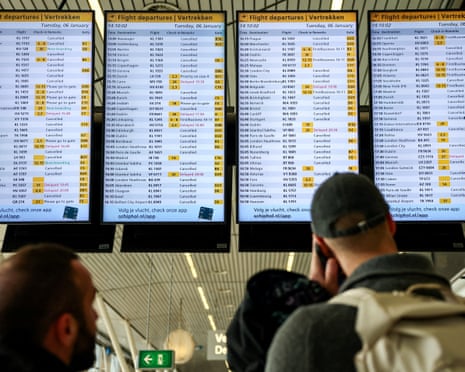
More than 700 flights from Amsterdam cancelled due to extreme weather
The latest update from Amsterdam’s Schiphol airport says that at least 700 flights will be cancelled today because of snow and wind.
Yesterday, Flightradar also reported on issues with the supply of de-icing fluid needed for planed to take off safely.
More than 1,000 people spent the night at Schiphol, the airport said, adding that it had set up camp beds and offered breakfast to travellers forced to sleep there. The number of cancellations is expected to rise throughout the day, AFP noted.
European leaders rally behind Greenland as US ramps up threats
Miranda Bryant Nordic correspondent and Dan Sabbagh
European leaders have dramatically rallied together in support of Denmark and Greenland after one of Donald Trump’s leading aides suggested the US may be willing to seize control of the Arctic territory by force.
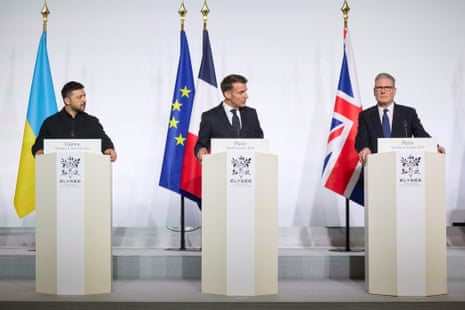
Keir Starmer, the UK prime minister, Emmanuel Macron, the French president, and Friedrich Merz, the German chancellor, declared that Greenland – a semi-autonomous territory of the kingdom of Denmark – “belongs to its people”, in a rare European rebuke to the White House.
“It is for Denmark and Greenland, and them only, to decide on matters concerning Denmark and Greenland,” the three leaders said in a statement on Tuesday, made jointly with the prime ministers of Denmark, Italy, Poland and Spain.
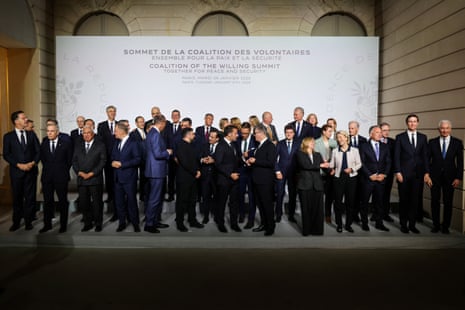
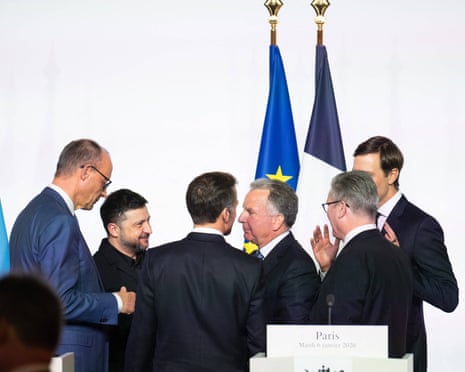
Later in the evening, Starmer repeated British support for Denmark at a press conference in Paris where Trump’s special envoy, Steve Witkoff, and son-in-law, Jared Kushner, were present. “I’ve been very clear as to what my position, the position of the UK government, is,” the British leader said.
But, anxious to avoid deepening the transatlantic rift, Starmer, Macron and Merz chose to focus on making fresh security commitments to Ukraine, at an event aimed at bolstering support for Kyiv planned before the Greenland crisis broke.
The European declaration emerged in response to renewed US demands to seize control of the self-governing territory in the aftermath of the capture of Venezuela’s president Nicolás Maduro by the US military.
Morning opening: One step forward, one step back

Jakub Krupa
It’s one step forward, one step back in Europe’s relations with the US.
Just hours after the Coalition of the Willing made a big step towards providing Ukraine with long-awaited security guarantees with potential UK and French troops deployments and all briefly seemed to be going in the right direction once again, the White House said that using US military is “always an option” for acquiring Greenland.
The comments came just hours after a number of European allies issued a stern statement backing Denmark and Greenland, as they continue to oppose Donald Trump’s plan.
Denmark held an emergency meeting of the foreign affairs committee last night to discuss its next steps.
Overnight, the Wall Street Journal reported ($) that US state secretary Marco Rubio told lawmakers that Trump’s preferred option was to buy Greenland from Denmark, and not invade it, but I am not entirely sure if that will convince anyone in Copenhagen about the merits of the proposal.
This morning, the French foreign minister Jean-Noël Barrot said that having spoken to US Rubio last night, he was also confident that a Venezuela-like scenario would not materialise in Greenland. For now.
But he confirmed that France was working with partners on a plan on how to respond should the US act on its threat to move to take over Greenland, with the issue expected to come up at today’s ministerial meeting with his counterparts from Germany and Poland.
Separately, I will keep an eye on EU talks on the Mercosur trade deal, which is back on the table today after a delay caused by some opposition from the likes of France and Italy, as the bloc looks to boost its international trade.
Oh, and there are numerous winter disruptions across Europe, causing havoc with hundreds of flight cancellations and delays at the Schiphol airport in Amsterdam (more than 3,300 flights cancelled since last Friday, as per Flightradar24’s count) and CDG in Paris, among others.
Large parts of Europe will see temperatures well below zero today, with -9 in Warsaw, -5 in Berlin, and -2 in Paris and Brussels.
I will bring you all the key developments here.
It’s Wednesday, 7 January 2026, it’s Jakub Krupa here, and this is Europe Live.
Good morning.