.png) 3 months ago
74
3 months ago
74
‘It all went so fast,” Markus Acher says. “We’ve never been this fast at making a record.” He is sitting at the far end of a sofa in the Notwist’s Munich studio. On the other end is his brother Micha Acher; next to them, Cico Beck, who joined the band in 2014, balances on a stool. For a group known for meticulous studio craft, speed is an unfamiliar sensation. For most of their career, the Notwist have worked slowly, layering, revising, rethinking, as if wary of committing too soon to anything at all.
Formed in 1989 in the Bavarian town of Weilheim, the Notwist began as a heavy metal trio before evolving, over the next decade, into one of Germany’s most distinctive bands. Their breakthrough album, Neon Golden (2002), married indie songwriting to electronic textures, shaped largely by then-member Martin Gretschmann, also known as Console or Acid Pauli, in a way that felt inward-looking and strangely expansive. Its influence travelled far beyond Germany, securing the band a place in the canon of early-2000s indie experimentalism. Pitchfork named Neon Golden one of the best albums of the 2000s.
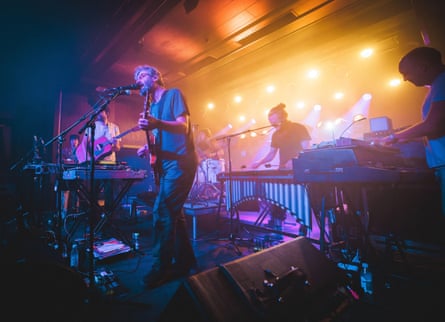
Markus Acher’s voice has always been at the centre of it all: soft, fragile, unmistakably accented. His Bavarian inflection, singing lyrics that hover between understatement and melancholy, offered a counter-image to the bombast with which German music has often been exported. Where the since disgraced, yet still commercially successful Rammstein symbolised one side of the Teutonic coin, the brutality, the hardness, the rolling Rs and the provocative play on Nazi imagery as spectacle, the Notwist represent another facet of Germanness: one rooted in introspection, curiosity and emotional restraint.
The deep melancholy of Romanticism, a sense of locally anchored worldliness and playful technological curiosity. Less Leni Riefenstahl, more Johann Wolfgang von Goethe on the Grand Tour, Robert Schumann at his piano, meditating on love, or Caspar David Friedrich catching the diffuse sense of longing and calm of a lone wanderer in the mountains in his paintings.
Nearly 25 years on, Acher and his brother remain the band’s constant core. Everything else has shifted. The Notwist left Weilheim for Munich, changed line-ups and continually reconfigured their sound, from grunge and indie rock to electronica, trip-hop, krautrock and jazz. Their last album, Vertigo Days (2021), embraced collaboration as method, featuring artists including Angel Bat Dawid, Ben LaMar Gay, Saya and Juana Molina.
That outward-looking impulse deepens on News from Planet Zombie, the band’s 10th studio album, but its significance lies as much in how it was made as in how it sounds. Usually spending long periods of time “tinkering“, as they put it, with every audio track, making Planet Zombie became a communal experience. After years of remote collaboration, filesharing and digital isolation – a mode intensified during the pandemic – the Notwist made a conscious decision to return to physical presence. The album was recorded over a single week at Import Export, a former industrial building in Munich now used as a nonprofit arts space, performance venue and lunch canteen.
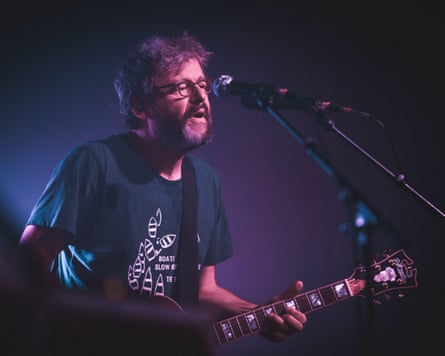
For the first time since their earliest records (apart from the many side projects of each band member), the band played together in one room. “More or less live,” Acher says. “It was an experiment.” The experiment worked. “Suddenly we were already done.” Friends and collaborators moved in and out of the sessions: Munich-based American-born photographer Enid Valu sings; Haruka Yoshizawa, half of Acher’s DJ duo Alien DJs, plays taishōgoto and harmonium; clarinettist Tianping Christoph Xiao, who relocated from Shanghai to Munich, joins in; jazz musician Mathias Götz contributes trombone. At lunchtime, the building served as a canteen. “Sometimes there were people listening in,” Micha Acher says. “That’s very different from a strict studio environment.”
The result is a record that feels tactile and exposed. Planet Zombie is warmer and rougher-edged than its predecessors, its spatial qualities emphasised rather than smoothed away. You can hear air moving around instruments, musicians reacting to one another. After years in which music, like so much else, was mediated through screens, the album insists on presence.
That insistence is not accidental. “During Covid, we were sitting in this room, working on whatever we had,” Markus Acher says. “We invited people to collaborate, but everyone was alone in front of their computers. That didn’t feel right any more.” Recording Planet Zombie collectively was an “emotional decision” – a way of reclaiming something lost during lockdown: proximity, coincidence, shared time.
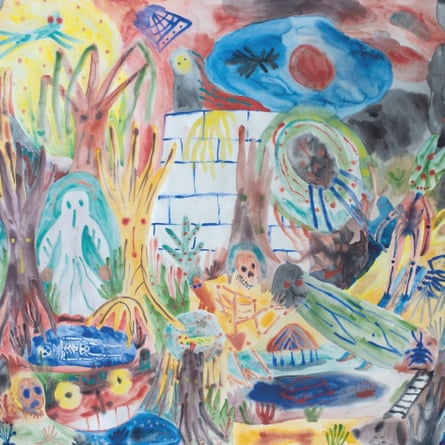
It is also, he suggests, a response to a broader cultural moment: “We felt the need to come together and not separate ourselves.” The Notwist have rarely been an overtly political band, but Planet Zombie carries a quiet political charge in its refusal of isolation, maybe a rejection of the frictionless, disembodied logic that the pandemic accelerated. The album’s title hints at unease. Zombies, after all, are figures of numb survival, trapped between life and death. Acher resists spelling out a direct message. “Even when it feels like the world is collapsing,” he says, “life continues. People still meet and make things happen.” Horror, he adds, has always been a way of processing collective, primal fears, of giving shape to anxieties that are otherwise hard to name.
Who, then, populates this “planet zombie”? “Isn’t it strange how simple things often are?” Acher asks. “That people with power are driven by greed, by basic impulses?” The answer remains deliberately unresolved. The lyrics on Planet Zombie stay true to the Notwist’s longstanding preoccupation with alienation and dislocation, offering fragments rather than slogans.
If the album has a stance, it lies less in what it says than in what it does. After a period defined by distance and disembodiment, in a culture still haunted by lockdown – by screens, solitude and the low-level dread of interruption – Planet Zombie feels almost radical in its modesty. You can hear people sharing air, time and uncertainty. There are no grand gestures here, only the insistence that life happens between bodies in rooms. If this is a planet of zombies, the Notwist suggest, then the cure may be as ordinary and simultaneously difficult as opening the doors, gathering and playing on.