.png) 3 months ago
49
3 months ago
49
The hardest part of the parachute jump, according to Capt George Lacey, is falling backwards through the air. It is Saturday and Lacey, and his squad of six plus two medics, have just leapt out of an RAF transport, 2,500 metres over the south Atlantic.
“The parachute can only go forward so quickly,” he says, meaning that it has to be pulled at precisely the right moment. “So you have to turn into the wind and basically fly backwards, which is a very weird sensation, as you can imagine.”
Below, with only its volcanic peak visible above the prevailing cloud cover, was Tristan da Cunha, the most remote of the British overseas territories, population 221, normally accessible only by boat, six days’ sail from Cape Town or the Falklands.
A resident suspected of having coming down with hantavirus after disembarking from the ill-fated MV Hondius cruise ship last month needed urgent treatment, including oxygen. It had been deemed there was only one way to get supplies over quickly enough.

Lacey and the other five, Pathfinders from the British army’s 16 Air Assault Brigade, learned they would be needed “in the afternoon of Thursday last week”, flying first to Brize Norton, then to Ascension Island, 2,000 miles to the north of Tristan da Cunha, to get ready for the drop.
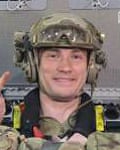
The six are experienced parachutists – Lacey says he has done nearly 200 jumps – but with them were a doctor and an intensive care nurse, who would be strapped to two of the jumpers, an extra but necessary complication. The nurse had done a civilian tandem jump before, Lacey says, but for the doctor apparently it was the first time.
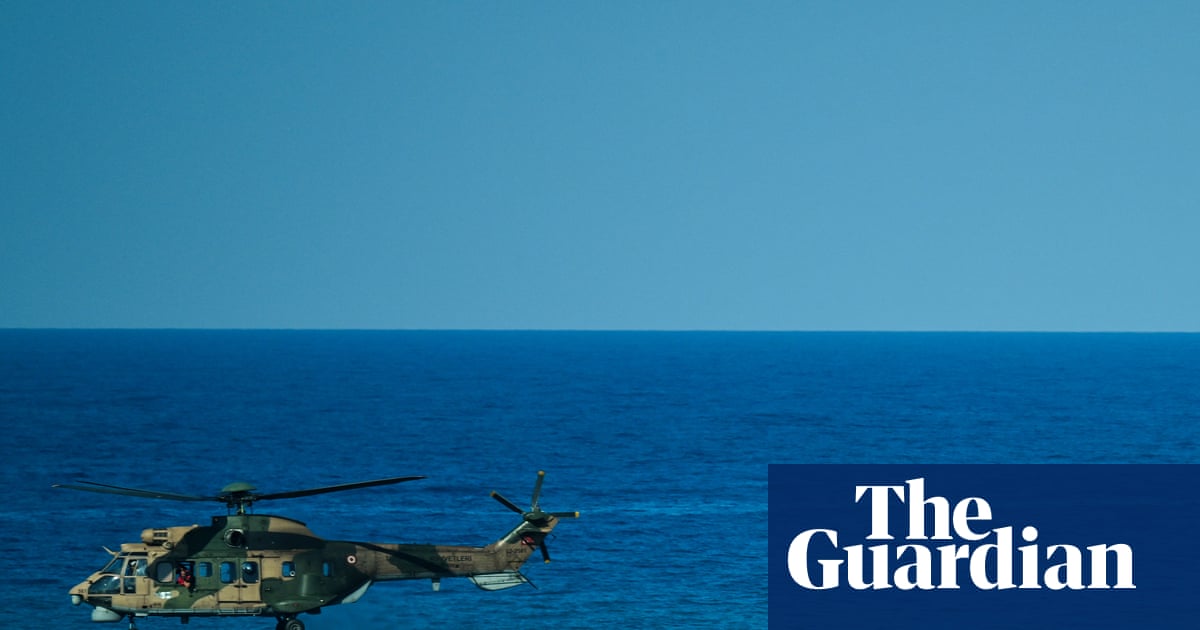
Together they took a four-and-a-half-hour flight from Ascension in an A400M transport, and when the plane refuelled midway, Lacey knew for sure the weather was good enough and the mission was on.
Calculations to allow for the wind meant Lacey and the others were lined up for the drop “about 5km off the north-east side of the island”. Once the back of the aircraft opened to the vast brightness below and the order was given, there was little time – a few dozen heartbeats – for the team to think.
“You’re very focused leaving the aircraft,” Lacey says, arguing that his training meant he was not afraid. “You’re just thinking of exactly what you need to do next, because there’s almost an overload of information and sensation.”
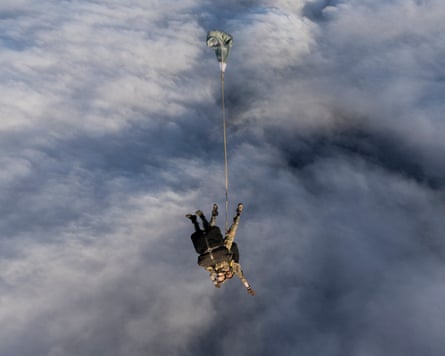
A near three-minute film taken from the helmet cam of another of the jumpers shows the moment of no return and what came next. Eight thousand feet is not the highest from which the parachutists can jump but the descent was hardly trivial, taking “somewhere between five and 10 minutes”, in Lacey’s memory.
Two thousand feet of the drop was through clouds – “you’ve basically just got to follow each other for that period of time” – until finally the ground became visible. “When you came out of the bottom of the clouds, you saw the island. You knew we were going to make the land, even if it wasn’t necessarily where we wanted to be. We knew we’re definitely going to be safe,” the soldier says, adding for emphasis: “That’s always nice to know.”
Once on the ground, the medical team went off to deal with the patient while the soldiers coordinated drops of equipment from the A400, including oxygen canisters and protective gear, so medical staff could deal with “worst-case, working with the patient continuously for a couple of weeks”.
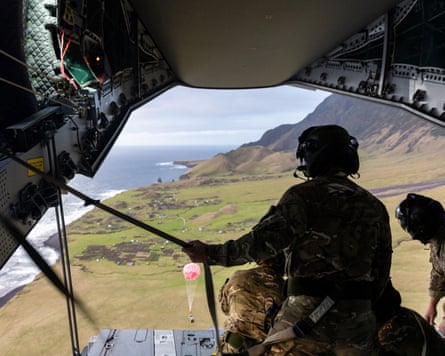
According to the last official update from the government of St Helena, of which Tristan da Cunha forms part, the suspected case “remains in a stable condition and continues to be monitored closely”, while Lacey and his fellow paratroopers from Colchester have been helping out on the island, talking to schoolchildren and the media.
Despite the film and television mythology, airdrops in combat are very rare – the last mass drop by British forces was at Suez in 1956 – though there was a Russian drop into Hostomel airport, north-west of Kyiv, on the first day of the invasion of Ukraine, and there is speculation of a US airdrop into Iran if fighting restarts.
“Parachuting is something that, as has been proven, doesn’t get used that often,” Lacey reflects. But the skill is trained and developed by the army just in case, for military and humanitarian emergencies around the world. “Sometimes it’s the only way to get somewhere,” he concludes.
As for getting off Tristan da Cunha, that has to wait. Exit plans are in place and, while Lacey does not say, one possibility is that the emergency military team will be able to board HMS Medway, an offshore patrol vessel now on its way from the Falklands. Sadly, Lacey agrees, there is no way to parachute off the island.