.png) 3 months ago
63
3 months ago
63
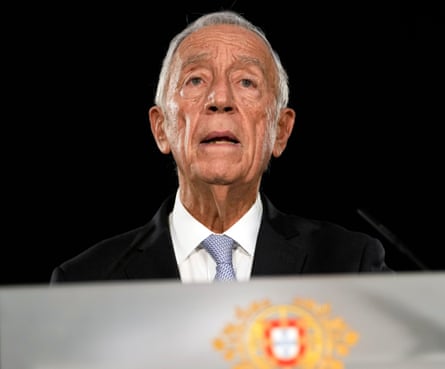
In Lisbon’s Campo de Ourique market earlier this week, conversation had turned – a little inevitably – to Sunday’s presidential election, which will decide who will take over from the outgoing Marcelo Rebelo de Sousa.
But amid the usual claims and counter-claims, promises and pledges, one candidate has been offering voters something a bit more enticing than his competitors have.
“Wouldn’t you like a Ferrari, as he promised?” one fishmonger laughingly asked a colleague.
But his colleague would not be swayed by the offer: his vote would go to André Ventura, the former football commentator who founded and leads the increasingly popular far-right Chega party.
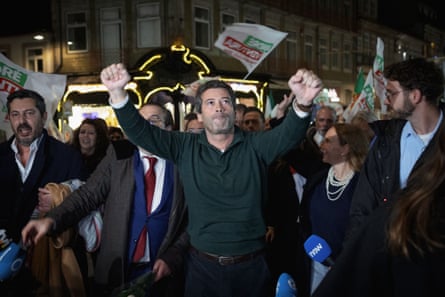
The man promising the Portuguese people a Ferrari each if elected is Candidate Vieira, a fictional character created and played by Manuel João Vieira, a renowned local artist, musician, and comedian who is running an official, yet satirical, campaign.
In a unusual presidential election that features 11 candidates – and with polls showing little ground between the top five candidates and no one expected to win outright in the first round – Vieira’s caricature campaign mirrors the growing anti-elite and anti-establishment sentiment taking over Portuguese politics.
Besides the Ferraris-for-all pledge, Vieira has promised wine running from taps at every household, the creation of a city called Vieirópolis, where AI would free people from the need to work, an individual mother figure for everyone to help combat feelings of loneliness, and a skin-tone homogenisation treatment to darken and lighten skin tones to solve anti-migration sentiment.
Ventura is narrowly leading the polls, closely followed by António José Seguro of the Socialist party. But the race for a place in the second run remains wide open. This is the first time in 40 years that Portugal’s presidential election will, in all likelihood, go to a runoff.
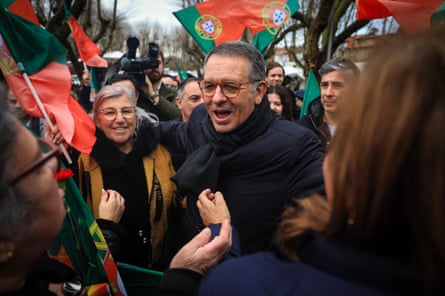
The fact that the Portuguese president has no legislative powers – despite wielding the right to dissolve parliament, call snap parliamentary elections, and veto legislation – doesn’t make Sunday’s results any less consequential.
“These elections mark the end of a tradition in which the presidency was sought by strong political figures associated with the regime and the elite,” says António Costa Pinto, a political scientist at Lisbon University’s Institute of Social Sciences.
He said that much became clear when Henrique Gouveia e Melo, a retired admiral who led Portugal’s vaccination campaign during the Covid pandemic, chose to run as an independent.
“It was also highlighted by the fact that some charismatic politicians decided to take a pass, most likely to avoid being associated with the elites by the far right,” Costa Pinto said. “As for the Socialist candidate, a more traditional politician, most people don’t seem enthusiastic about voting for him, and see it as something they need to do to prevent Ventura from winning.”
Although polls show more than 60% of voters would reject the far-right leader in a runoff against any of the other top four contenders, the likelihood of Ventura securing a place in the second round means he will probably continue to upend the political system in Portugal.
In last May’s general election, Chega – which Ventura founded in 2019 – capitalised on widespread dissatisfaction with Portugal’s mainstream left and right parties to leapfrog the socialists and become the main opposition party.
“If Ventura makes it to the runoff and gets 35% of the vote, that will alter the landscape of rightwing representation in Portugal, because it will mean Chega can appeal to voters from that spectrum, and not just what we now consider to be his electoral base,” Costa Pinto said.
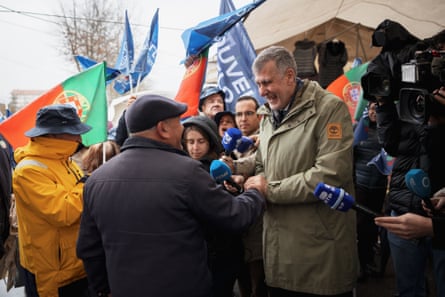
At the Campo de Ourique market, Carlos Elias, a 53-year-old fishmonger, had already made up his mind to vote for Vieira in the first round.
“Candidate Vieira is the greatest,” he said. “I’ve known him for years, I’ve watched his concerts, and I find him funny. If he ended up being elected, he would do the same as others anyway – he would just stroll around and take selfies with people.”
Vieira says he’s unconcerned that some electors compare him to Ventura because both are seen as the anti-establishment candidates.
“I understand some think that way since André Ventura has convinced people to believe he’s fighting against the system,” he said. “That’s not true. He’s part of the system. He’s pushing some age-old ideas as if they’re new, which gives some the impetus to vote for him.”
Vieira’s campaign, largely run on social media, has produced dozens of intentionally poorly made AI memes and videos containing utopian promises and mocking traditional TV political ads.
Borrowing dialect and aesthetics from Portuguese popular imagery, and often employing crude and vulgar language, Vieira’s posts – most of which have gone viral – serve to expose the absurd vernacular that has taken over politics.
“I want to be more absurd than Donald Duck Trump,” he said as he announced his run for the 2026 presidency. He also put himself forward in 2001, 2006, 2011 and 2016, but this is the first time he has secured enough support to be on the ballot.
Several young men approached Vieira as he campaigned in the market on Wednesday, asking for selfies, congratulating him, and cheering him on.
“I’ll vote for Candidate Vieira,” said Manuel Gil, an 18-year-old student.
“I can’t see myself voting for any other candidate. I think that the way he ridicules politics is important to get people to pay attention to all the misinformation going on. So many young people are voting for Chega, and we’re making an effort to stop them. Candidate Vieira has been helping us do that.”
With polls showing the comedian securing 1% of voting intentions, Vieira is narrowly trailing candidates from the historical Portuguese Communist party and Livre, a leftwing party represented in the European parliament.
Ludicrous and doomed as his run is, Vieira insists that his idealistic, unrealistic pledges have a deep and entirely worthy aim in a political system marred by apathy, discontent and disillusionment.
“I use metaphorical language, and I am interested in mixing fantasy with reality,” he said.
“Fantasy is a part of life, and Utopia used to be a part of politics, but it disappeared years ago. I want to mobilise people’s imagination because it’s through imagination that we create solutions that lead to happiness. These days, there’s a lot of rubbish.
“If people want to bet on the absurd, at least they should bet on the absurdity and surrealism of their dreams and desires. That’s one of the most honest things out there.”