.png) 3 months ago
66
3 months ago
66
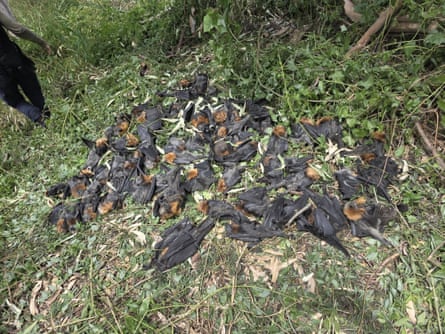
Thousands of flying foxes have perished in the heatwave that scorched south-east Australia last week, the largest mass mortality event for flying foxes since black summer.
Extreme temperatures resulted in deaths in camps across South Australia, Victoria and New South Wales. Grey-headed flying foxes, listed as vulnerable under federal environment laws, were the most affected.
The director of the Fly by Night Bat Clinic in Melbourne, Tamsyn Hogarth, said volunteers witnessed thousands of dead bats at Brimbank park, and hundreds more at camps in Yarra Bend and Tatura.
Sign up: AU Breaking News email
Wildlife volunteers did what they could to help, she said, rescuing dozens of pups found clinging to dead mothers. “These orphans will slowly die of heat stress, starvation or predation if they aren’t found.
“We also found countless adults who couldn’t withstand the heat in areas of the colonies that were hotter - like trees with less foliage and shade coverage, and the baking hot clay of the riverbank.”
Despite the best efforts of dedicated volunteers, thousands died in the heat. Researchers were still tallying the dead, estimating at least 1,000 - 2,000 flying foxes died in South Australia, thousands in Victoria, and up to 1,000 in New South Wales.
“Temperatures over 42 degrees are known to cause mortality in flying foxes, sometimes at biblical scales,” said Prof Justin Welbergen, an expert in flying foxes at Western Sydney University.
The loss of life in last week’s heatwave was the “most significant mass mortality event” since 2019-20, he said.
More than 72,000 flying foxes died in eight separate extreme heat events during black summer. One deadly heatwave in 2018 wiped out 23,000 endangered spectacled flying foxes in Queensland, a third of their population at the time.
Last week, Australia’s worst heatwave in years saw temperatures in Adelaide reach 43C on consecutive days, and surpass 42C on the hottest day in Melbourne and Sydney, with suburbs and regional areas recording maximums in the mid-to-high 40s.
The heat had a “double-whammy” effect, Welbergen said, placing animals under direct stress and impeding their ability to find food, by making it harder to fly and reducing the availability of nectar from eucalyptus flowers.
Mothers and pups were most affected, making it harder for populations to bounce back.
Dr Wayne Boardman, a wildlife veterinarian and flying fox researcher at the University of Adelaide, said flying foxes initially showed signs of distress.
“They fan their wings, they start to move down the trees, they pant a bit, some try to fly to dip in the river.”
But above 42C, dehydration and heat stroke made it “physiologically very difficult for animals to survive”.
Members of the public were advised never to try rescue any sick, injured or orphaned bats themselves, instead to contact their nearest wildlife organisation.
The chief executive of Wildlife Victoria, Lisa Palma, said the organisation increased its emergency response capacity to deal with a spike in cases, deploying its travelling veterinary service to a nationally critical flying fox colony.
“Heat events like this can be catastrophic for native wildlife. Unlike us, our native animals can’t escape the heat and are highly vulnerable to dehydration, disorientation, burns and even blindness.”
Welbergen said flying foxes weren’t the only wildlife affected by extreme heat, but their deaths were often more visible with the animals roosting in trees in large numbers, often in urban centres.
Flying foxes were like “canaries in the coal mine”, he said, providing an indication of what was happening to other animals as global heating increased the frequency and intensity of hot days and heatwaves.
The work of rescuing and caring for wildlife affected by extreme weather weighed heavily on volunteers and an under-resourced veterinary sector, with no national wildlife rescue strategy. “We’ve been hit with a terrible season for orphaned pups. We were already at breaking point and dreading what the hot weather would bring - now our worst fears have been realised.” Hogarth said.