.png) 2 hours ago
6
2 hours ago
6
Powerful German state leaders from Friedrich Merz’s party have rallied behind him as speculation builds that his days in office may be numbered.
The chancellor’s hold on power has looked increasingly shaky since a bombshell regional election result earlier this month in which the far-right Alternative für Deutschland (AfD) party routed his Christian Democratic Union (CDU) party in Saxony-Anhalt.
With two more states heading to the polls on Sunday where the AfD is expected to perform well, Merz cancelled a plan to speak at the UN general assembly in New York next week because “his presence is required in Berlin”, a government official said on condition of anonymity.
The announcement triggered fresh rumours that the unpopular chancellor could be preparing his own exit or wanted to remain and fight off a potential coup. With Merz on the ropes after just 16 months in office, eight state premiers from the CDU issued a surprise joint statement backing him.
Citing the threat posed by nativist parties across Europe, they wrote: “Now more than ever, Germany’s political landscape needs stability”, pointing to elections in Poland, Italy, Spain, Greece and France next year in which the political establishment faces a far-right challenge. “The path to restoring public trust in Christian Democrats lies in listening and taking political action, not in debates over personnel.”
They added that Germany needed “reliability and decisive action” and, as state leaders, “we want to, and will, do our part to achieve this together with the chancellor”.
The signatories included leaders who have been mentioned as possible Merz successors, such as North Rhine-Westphalia’s Hendrik Wüst. Markus Söder, the Bavarian premier and an ambitious conservative populist, has also said he was backing Merz.

It remains to be seen how long the demonstration of solidarity with Merz will hold, with much depending on the outcome of the weekend elections. Polls indicate voters are very likely to punish the CDU again in the states of Berlin and Mecklenburg-Western Pomerania on the Baltic coast, amid widespread dissatisfaction with Merz’s federal coalition government formed with the Social Democrats.
Merz, who is also the CDU’s chair, will convene a meeting of its leadership on Sunday evening to coordinate a response as the results come in, in what senior party members called a pre-emptive “show of unity” behind the chancellor.
The anti-immigration, pro-Kremlin AfD’s resounding win in Saxony-Anhalt sent a shockwave through Europe’s largest economy and beyond, although the party fell just short of the absolute majority required to govern alone in the state.
It is seeking enough support from other parties’ lawmakers in the state parliament to make its chief candidate, Ulrich Siegmund, the first far-right regional leader in Germany since the Nazi period.

Merz took office in May 2025 promising to cut the surging AfD back down to size by reviving the moribund economy and addressing fears around “irregular” migration.
Instead, the AfD is now topping the national polls with clear momentum behind it. The party’s co-leader, Alice Weidel, has targeted the CDU for “destruction” and pledged last week in parliament that Merz’s party would “never win another election again”.
after newsletter promotion
During the same debate in the Bundestag, a wan and defensive Merz lashed out at Weidel and the AfD’s lawmakers, accusing them of seeking “ethnic cleansing” with their calls for “remigration”, a legally dubious programme of mass deportations. Critics said he failed to outline a clear vision for the remainder of his term.
Weidel, whose party drew congratulations from Donald Trump and Elon Musk for its Saxony-Anhalt victory, on Wednesday taunted the state leaders backing Merz.
“The CDU is making it clear that it is committed to ‘business as usual’ rather than the positive changes that citizens need,” she posted on Musk’s social media platform X. “The only way to achieve those changes is with the AfD!”
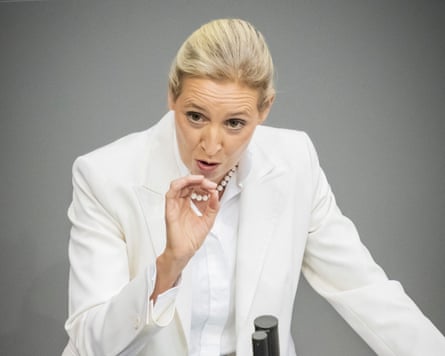
The month’s developments have triggered a sense of helplessness and fear among the mainstream democratic parties, with even the opposition Green party calling on the CDU to right the ship before it is too late.
“Get your shit together,” said the Greens co-leader Felix Banaszak in Berlin, appealing to Merz and the CDU to end speculation that he called destabilising.
Banaszak said that while he was no fan of the centre-right-led government, he warned that calls for a Kanzlertausch, a swap of the chancellor from Merz in favour of another Christian Democrat, could trigger new elections in which the AfD could come out on top.
“We live in such dramatic times that this country just can’t afford that right now,” he said.
The next general election is due in 2029.