.png) 2 months ago
70
2 months ago
70
Germany summons Russian ambassador over campaign to destabilise country, foreign ministry says
We are getting a breaking news line from Germany.
Germany’s foreign ministry spokesperson has warned that the authorities are “observing a significant increase in Russian hybrid activities,” claiming that a Russian campaign “seeks to destabilise Germany.”
The spokesperson attributed the activities to the Russian network Storm 1516, which specialises in foreign information manipulation and interference, saying it was behind activity attempting to affect the February federal election.
Separately, the government also attributed a cyber-attack against German air safety systems in August to a Russian hacker collective APT28.
As a result, Germany has summoned the Russian ambassador to Berlin, and the government “will decide on further diplomatic measures” at a later date.
We “made it clear that we are monitoring Russia’s actions very closely and will take action against them,” the spokesperson said, as reported by Reuters.
The UK has issued a similar warning about the network’s activities earlier this week, too.
Key events Show key events only Please turn on JavaScript to use this feature
Russia's central bank readying to sue Euroclear over frozen assets plans
Russia’s central bank said it was suing the Belgium-based Euroclear financial group, which holds Moscow’s frozen international reserves, as the EU moves closer to using the funds to support Ukraine, AFP reported.
The bank said it was filing “a lawsuit against Euroclear in the Moscow Arbitration Court” due to what it called “the illegal actions” of the institution.
“The actions of Euroclear depository caused damage to the Bank of Russia due to the inability to manage funds and securities belonging to the Bank of Russia,” the bank said in a statement.
AFP noted that it was unclear what the implications of any Russian-based legal claim would be.
Responding to the move, the European Commission’s chief spokesperson Paula Pinho said that the EU’s proposal to use frozen Russian assets to guarantee a reparations loan for remained under discussions, but the commission was “confident [about] its legality.”
Germany summons Russian ambassador over campaign to destabilise country, foreign ministry says
We are getting a breaking news line from Germany.
Germany’s foreign ministry spokesperson has warned that the authorities are “observing a significant increase in Russian hybrid activities,” claiming that a Russian campaign “seeks to destabilise Germany.”
The spokesperson attributed the activities to the Russian network Storm 1516, which specialises in foreign information manipulation and interference, saying it was behind activity attempting to affect the February federal election.
Separately, the government also attributed a cyber-attack against German air safety systems in August to a Russian hacker collective APT28.
As a result, Germany has summoned the Russian ambassador to Berlin, and the government “will decide on further diplomatic measures” at a later date.
We “made it clear that we are monitoring Russia’s actions very closely and will take action against them,” the spokesperson said, as reported by Reuters.
The UK has issued a similar warning about the network’s activities earlier this week, too.
Meanwhile, the Ukrainian military said on Friday it had liberated several villages near the north-eastern town of Kupiansk, Reuters reported.
Khartia Corps claimed on Telegram messenger that several hundred Russian troops had been surrounded in the area.
'Whole of Donbas belongs to Russia,' Kremlin says
And in a further sign why these concerns may be valid, the Kremlin’s foreign policy aide Yuri Ushakov has just asserted (falsely) that “the whole of Donbas belongs to Russia,” when asked about Zelenskyy’s idea of a referendum on any territorial changes.
Reuters noted that the status of Donbas, comprising Donetsk and Luhansk regions, has emerged as a key sticking point in talks on peaceful settlement in Ukraine.
Ukrainians 'right to be very wary' of US proposal on Donbas, former UK national security adviser says
Peter Ricketts, a former chair of the Joint Intelligence Committee and UK national security adviser, shared some of Zelenskyy’s concern about the US proposal to form a “free economic zone” in Donbas (10:20).
In a series of posts on X, he said:
“The Ukrainians are right to be very wary of a plan that would mean them pulling back to create a ‘free zone’ in the part of the Donbas Russia has failed to occupy. The US might pledge to ensure that this w’d be demilitarised. But what would any ‘guarantee’ be worth in reality?
Very little in my view. Once the issue was out of the headlines, US attention would move elsewhere. Putin would infiltrate his forces (remember Crimea?), create incidents as pretexts to move in to ‘protect Russian speakers’. Before long they would have occupied the whole area and the US would not lift a finger.
This would leave the rest of Ukraine vulnerable to the next Russian advance. So this is not just a technical point but a fundamental issue - for Ukraine and for European security. I’m sure the UK, French and German teams know this very well.”
Kremlin has not seen new proposals, but may not like them, it says
Kremlin foreign policy aide Yuri Ushakov said on Friday that Moscow has not seen revised US proposals made after talks with Ukraine, but that it may not like parts of them, Reuters reported via Russian news agency Interfax.
State news agency RIA also cited Ushakov as saying that Russia will, sooner or later, discuss with the US the outcome of the talks with Ukraine.
Slovakian government pushes ahead with controversial law on whistleblower protection
Meanwhile over in Slovakia, the ruling leftist-nationalist coalition has overturned the president’s veto to a law abolishing the existing Whistleblower Protection Office and replacing it with a new body, which critics say will be weaker.
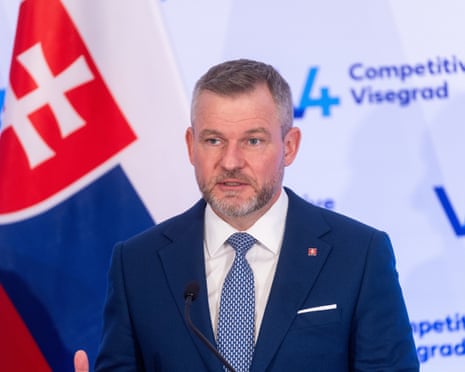
The controversial law, approved by parliament on Tuesday, was vetoed yesterday by president Peter Pellegrini. But this morning, the main government parties pushed ahead with the reform, rejecting the veto with 77 votes in favour of the new law.
Reuters noted that it was “a rare clash with the government he is normally aligned with,” with Pellegrini saying “there were no reasons to rush the legislation through and that concerns voiced by the European Commission were not addressed.” He warned that the law could threaten Slovakia’s rule of law and ability to benefit from EU subsidies.
The leader of the main opposition party, Michal Šimečka, has called for a protest against the government on Tuesday.
US wants Ukraine to withdraw from Donbas and create ‘free economic zone’, says Zelenskyy

Shaun Walker
in Kyiv
The US wants Ukraine to withdraw its troops from the Donbas region, and Washington would then create a “free economic zone” in the parts Kyiv currently controls, Volodymyr Zelenskyy has said.
Previously, the US had suggested Kyiv should hand over the parts of Donbas it still controlled to Russia, but the Ukrainian president said on Thursday that Washington had now suggested a compromise version in which Ukrainian troops would withdraw, but Russian troops would not advance into the territory.
“Who will govern this territory, which they are calling a ‘free economic zone’ or a ‘demilitarised zone’ – they don’t know,” said the Ukrainian president, speaking with journalists in Kyiv on Thursday.
Zelenskyy said Ukraine did not believe the plan was fair without guarantees that Russian troops would not simply take over the zone after a Ukrainian withdrawal.
Zelenskyy said: “If one side’s troops have to retreat and the other side stays where they are, then what will hold back these other troops, the Russians? Or what will stop them disguising themselves as civilians and taking over this free economic zone? This is all very serious. It’s not a fact that Ukraine would agree to it, but if you are talking about a compromise then it has to be a fair compromise.”
He said if Ukraine did agree to such a scheme, there would need to be elections or a referendum to ratify it, saying that only “the Ukrainian people” could make decisions on territorial concessions.
Under the US plans, said Zelenskyy, Ukraine would withdraw from Donbas, where Russia is advancing, while the frontlines would be frozen in the Kherson and Zaporizhzhia regions. Russia would give up a few small pockets of land it controls in other regions.
Zelenskyy has been under immense pressure from Donald Trump to sign up to the US peace plan. In recent days Trump has attacked Zelenskyy, claiming he “has not even read” the draft peace plan and suggesting he lacks legitimacy and Ukraine should hold an election.
Zelenskyy said the Ukrainian negotiating team had sent their revised plan back to Washington on Wednesday, and that questions over territory and control of the Zaporizhzhia nuclear plant were two of the remaining sticking points. “It’s not the final plan; it’s a reaction to what we received … the plan is constantly being worked on and edited, and this is a continuous process that is still going on,” he said.
If Washington and Kyiv do agree, the much bigger question remains of whether Vladimir Putin is really ready to sign a deal or is merely buying time with fake negotiations and hoping to continue his military advance over the winter.

Jakub Krupa
Let’s quickly remind ourselves on what is in the latest US proposal, as disclosed by Ukraine’s Volodymyr Zelenskyy yesterday.
Morning opening: The softest of pushbacks
Jakub Krupa
The European Commission president, Ursula von der Leyen, has delivered the softest of pushbacks to US president Donald Trump last night, telling him off in abstract terms for the suggestion that the US could try to influence elections in various EU countries.
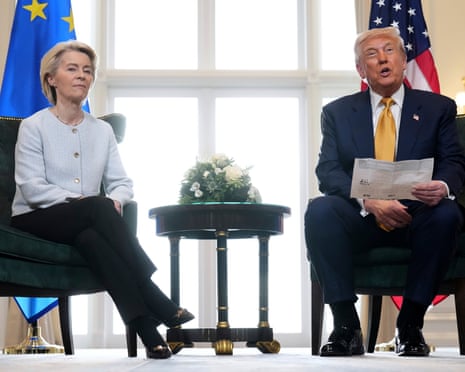
“It is not on us, when it comes to elections, to decide who the leader of the country will be, but on the people of this country … That’s the sovereignty of the voters, and this must be protected,” she told Politico.
I’m sure Trump is quaking in his boots.
As the talks on a potential peace deal on Ukraine continue today and into the weekend, the focus is on what involvement we will see from the US. Trump – and later his spokesperson Karoline Leavitt – insisted that the US would only join the Europeans for talks if they did not deem it a waste of time.
Let’s see what can be achieved before the Berlin summit, expected on Monday.
In the meantime, Europe continues discussing the contentious issue of frozen Russian assets, facing some opposition on both the idea of a permanent freeze (opposed by Hungary) and on using them for a reparations loan for Ukraine (opposed by Belgium).
The permanent freeze – meaning no more drama over rollovers every few months – is set to come into force today at 5pm, but Viktor Orbán is not happy. More on that shortly.
Meanwhile, after speaking with Germany’s Merz and von der Leyen last week, Belgium’s Bart de Wever is in London today for talks on security, migration, and – yes – frozen assets.
As co-chair of the Coalition of the Willing, Keir Starmer will no doubt try to convince him of the value of leveraging the frozen assets, likely with a promise that the UK could follow suit.
Lots for us to cover.
I will bring you all the key updates throughout the day.
It’s Friday, 12 December 2025, it’s Jakub Krupa here, and this is Europe Live.
Good morning.