.png) 2 months ago
68
2 months ago
68
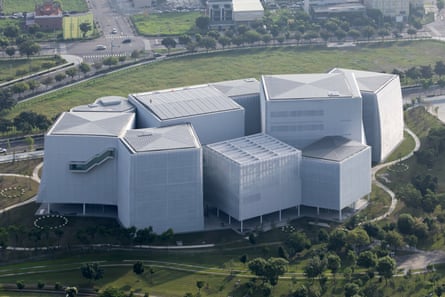
Walking through the brand new Taichung Art Museum in central Taiwan, directions are kind of an abstract concept. Designed by powerhouse Japanese architecture firm Sanaa, the complex is a collection of eight askew buildings, melding an art museum and municipal library, encased in silver mesh-like walls, with soaring ceilings and meandering pathways.
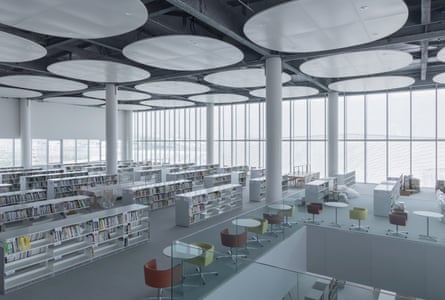
Past the lobby – a breezy open space that is neither inside nor out – the visitor wanders around paths and ramps, finding themselves in the library one minute and a world-class art exhibition the next. A door might suddenly step through to a skybridge over a rooftop garden, with sweeping views across Taichung’s Central Park, or into a cosy teenage reading room. Staircases float on the outside of buildings, floor levels are disparate, complementing a particular space’s purpose and vibe rather than having an overall consistency.
It is “easy to get lost in”, says Lan Yu-hua, an associate researcher at the museum, laughing. But she says that’s something to embrace: “We say that getting lost is good.”
The Taichung Art Museum is a municipal government-led project, and the latest in a string of high profile, ambitiously designed museums and performance spaces which have opened in Taiwan in the last two decades.
Led by 2010 Pritzker prize laureates Kazuyo Sejima and Ryue Nishizawa, Sanaa also designed the New Museum of Contemporary Art in New York, and the Sydney Modern gallery. They worked with Taiwanese firm Ricky Liu & Associates Architects+Planners on the six-year build commissioned by the Taichung city government, who had simply asked for an art museum and a library on the same site.
The final product has dissolved the borders between the two, and there’s a sense that the complex is designed to slow you down. It’s easy to picture a day spent in the library reading or working, taking breaks with a walk through the halls of art.
“We are so glad that we are with the library all together, because I think that can really open up another layer of audiences for us,” says Yi-Hsin Lai, the museum’s director.
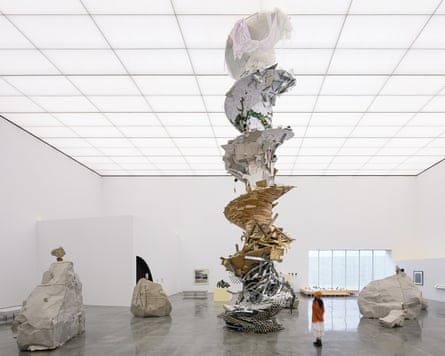
Their inaugural showing includes commissions by South Korean artist Haegue Yang and Taiwanese artist Michael Lin. Yang’s work is an abstract take on the banyan trees and fireflies ubiquitous to Taiwan and Korea. Dangling in the 27 metre-high central atrium, it blends her signature venetian blinds with lights and steel frames. At night, the light from her work glowing through the mesh can be seen a kilometre away.
The larger opening exhibition, A Call of All Beings, is an eclectic but coherent mix of commissioned works and newly acquired pieces by artists from 20 countries. Curated by an international team from Taiwan, Romania, Korea and the US, it hangs Taiwanese master painters of the mid 20th century next to postmodern video works. In something of a coup, the curators also sourced original early sketches of Antoine de Saint-Exupéry’s book, The Little Prince, and archive photos of Helen Keller.
It places an emphasis on Taiwanese artists, especially those from Taichung. And there is a particular focus on including artists with disabilities – a timely effort in the same week that Nnena Kalu became the first artist with a learning disability to take home the £25,000 Turner prize.
The museum officially opens to the public on 13 December. They are expecting international press and visiting museum directors, but otherwise a mostly local crowd. At least for now.
Taiwan’s international profile is often tied to geopolitics and threats of invasion, rather than its arts. But that’s slowly changing and events such as Art Taipei and Taipei Biennial are drawing bigger crowds every year. For at least half a decade, the scene has been described as “undergoing a vibrant transformation” and “gaining momentum on the global stage”.
For Taiwan’s art sector, this new museum is a chance to raise Taiwan’s presence in the global art scene and further “decentralise” it from the capital Taipei. Taichung, the second biggest city, is a short and easy trip from Taipei on the high-speed rail, and already hosts a well-regarded Museum of Fine Arts and a burgeoning sector of private galleries. But it struggles to attract international art fans.
“It’s quite dynamic and vibrant now. We hope that in a few years Taichung can be an artistic landmark Asian city,” says Lai.
Claudia Chen, chair of the Taiwan Art Gallery Association, says the new museum is a potential “gamechanger” for Taiwan, “shifting the focus from the north to south”.
“While Taichung and southern Taiwan have had many arts and cultural events in the past, none have reached the scale and importance of Taipei,” says Chen.
Jenny Yeh, executive director of the Winsing Arts Foundation, says Sanaa’s involvement with the project has drawn international attention and built on Taiwan’s artistic momentum. “This will encourage more international visitors to explore beyond Taipei and gain a fuller sense of Taiwan’s cultural landscape. Overall, it will be a major boost to Taiwan’s visibility on the global stage.”
Additional reporting by Jason Tzu Kuan Lu