.png) 2 months ago
46
2 months ago
46
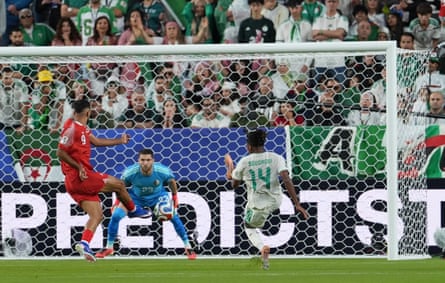
Poor old Luca Zidane. The Algeria goalkeeper has had a turbulent time. In two matches he has conceded five goals, and a pair of them – first from Lionel Messi, then, more embarrassing, from Jordan’s Nizar al-Rashdan – have gone through his fingers.
No doubt he has received messages of support from his father – at least he hasn’t butted anybody – but it is hardly the ideal performance on the world’s biggest stage. But Zidane is not alone. Senegal’s Édouard Mendy and Iraq’s Ahmed Basil have got their hands to shots, but been unable to stop them. Is something going on?
Certainly Joe Hart seems to think so. He has frequently been pointing out on BBC that goalkeepers are having trouble reading the speed of the World Cup ball, the Adidas Trionda. “The ball is coming into the keepers a lot faster than it feels when it comes off the foot,” he said. “Zidane is more than capable of saving that ball [from Messi]. When goalkeepers get up to speed with these World Cup balls we’re going to see these shots saved.”
Hart issued his assessment before Zidane had played his second match, when the 28-year-old’s inability to stop al-Rashdan’s outside-of-the-boot effort suggest the problem may continue for a while yet. But there is help at hand and it comes in the form of an 18-page paper produced by South Korean and Japanese academics.
It has the title Orientation-Dependent Drag Crisis and Flight Response of the Fifa World Cup Match Ball Trionda and its contents do not deviate from the outline. Researchers took the ball and fired it through a wind tunnel to measure the effect of aerodynamic forces upon it. They did so from six angles and found a consistent outcome.
Regardless of where the ball was struck, if the ball reached a certain velocity it would fly faster. This, the researchers from Seoul Women’s University and the University of Tsukuba found, was down to an effect called “drag crisis”. This occurs when an object flying through the air reaches the point where the air flow around it shifts from a smooth state (known as a laminal flow) to a turbulent one. When the flow is turbulent, it disrupts the drag behind a moving object, allowing it to move faster.
Researchers noted that the “upstream seam and groove arrangements” in the Trionda’s design made drag crisis possible at lower speeds.
If a ball does not slow down as expected, because of the drag crisis effect, you can understand how goalkeepers may be caught unawares. The researchers found further complicating factors. They observed that while there was a drag-crisis effect regardless of where the ball was hit, the level of the crisis would shift depending on whether the ball was struck on a seam or on a panel (hitting on the seam seemed to create the lower drag). Drag crisis was also variable according to altitude, with the higher the game, the less likely the occurrence.
Fifa did not hide the aerodynamic possibilities of the ball when it launched the last year. Among “several key performance innovations”, it said, was a shift to a four-panel ball for the first time in the tournament’s history (the Adidas Al Rihla used in Qatar four years ago had 20).
after newsletter promotion
“The four-panel construction incorporates intentionally deep seams,” Fifa said, “creating a surface that produces optimal in-flight stability by ensuring sufficient and evenly distributed drag as the ball travels through the air. Additionally, embossed icons that are only visible up-close elevate grip when striking or dribbling the ball in wet or humid conditions.”

According to Adidas, the Trionda underwent more than 300 laboratory tests before it was signed off, with the design ensuring “a more predictable trajectory”, according to promotional materials. Those who can remember the 2010 World Cup may regard this as a reluctant nod towards the Jabulani, the much-maligned ball used in South Africa that was described by Spain’s Iker Casillas as “horrible” and by Gianluigi Buffon as “absolutely inadequate” owing to its ability to suddenly change trajectory mid-flight. The Jabulani, unlike the Trionda, was smooth.
The South Korean and Japanese academics observe that the drag crisis affects trajectory and velocity. In the US, Canada and Mexico, however, it appears the issue is less with the former and more with the latter.
Their paper, freely available to read in the online journal Fluids, may yet prove an interesting distraction for goalkeepers during downtime at camp.