.png) 2 months ago
52
2 months ago
52
How much of our political agency have we sacrificed on the altar of imagined constraints? That question has been troubling me since last week, when I stepped out of the glitteringly art deco Grand Rex cinema in Paris. I had just been to see part one of La Bataille de Gaulle, a two-part epic based on British historian Julian Jackson’s extraordinary biography of Charles de Gaulle. Both Jackson and the film, which focuses on the second world war, present the towering French general as a combination of stubbornness, arrogance and genius.
As a mid-ranking two-star general, De Gaulle had little inherent claim to be the face of France in exile. For four years after fleeing to London in June 1940, he imposed himself next to Churchill, and then Roosevelt. He bullied his way in to top-table discussions thanks to an ego the size of a nation state: a nation state he himself would embody fully. “I recreated France from nothing, from being a man alone in a foreign city,” De Gaulle wrote of his time in London. Immodest, yes, but also right.
What De Gaulle did not do when he reached London – practically unaccompanied by anyone to form a government-in-exile with, much less an army – was look at the enormity of the task and resign himself to all the ways in which it was impossible. Instead, he decided that the future could be bent by the sheer obstinacy of his will. This is what it took to rebirth a country – which in turn gave new life to France’s sense of what it stands for.
The Free French Forces (FFF) are often little more than a footnote in portrayals of the second world war. But the French part of the story – tied up in tension between Maréchal Pétain and Admiral Darlan, who chose collaboration with Nazi Germany, and De Gaulle’s Free France in exile and the Resistance at home – is no less riveting than the scenes Hollywood has often chosen to portray.
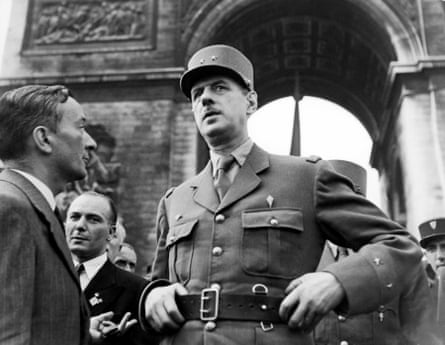
Take, for example, the battle of Bir Hakeim. For two weeks and two days, 3,700 FFF held off around 35,000 Axis soldiers under Erwin Rommel, allowing the British Eighth army to evacuate Tobruk, Libya. Historians credit their success as strategically crucial to slowing Rommel’s advance in north Africa, and thus to the British ability to ultimately hold Egypt and the Suez canal. (Despite his incredible stubbornness, there was one American demand that De Gaulle, shamefully, did not face down: to remove Black soldiers from French colonies from the columns that would march, victoriously, into Paris in 1944.)
When history presents us with instances of “success against the odds”, we venerate them. We present the people who conjure change from nothing as larger than life. And then we look at our present world and wring our hands that nothing truly transformative can be done.
See, as evidence, our collective response to the challenges of our own time: ecological and climate breakdown; a global oligarch class with extreme wealth that is both morally obscene and a threat to democracy; impunity for those who perpetrate imperialist wars of aggression, ethnic cleansing and genocide; an arms-race-like sprint into the anthropological and spiritual crises instigated by AI, a technology that large majorities actively do not want to be thrust on them in an unregulated way.
We know the rough basis of solutions to these dangers: taxing wealth in a way that becomes progressively international; ending subsidies to fossil fuels, putting a substantial global price on carbon and investing massively to decarbonise our energy consumption; regulating AI for the benefit of all (medical research: yes; non-consensual nudes at anyone’s fingertips: no); charging those responsible for war, genocide and ecocide with crimes and sanctioning them until justice finally arrives.
We’re just not doing any of this – and not because we’re even more powerless to impose ourselves than De Gaulle was in 1940. On the contrary: Europe is rich in culture, education and capital. It is politically united rather than at war with itself. Beyond Ukraine, no bombs currently fall on our heads. Everywhere, voters are crying out for someone to offer them a project imbued with meaning beyond sheer economic growth.
Unfortunately, we are also imagination-poor. We – and by this I mean to implicate everyone involved in European public policy – have simply conceded, in the twilight of neoliberalism’s ideological influence, that we cannot make history.
after newsletter promotion
Do we need a single stubborn, arrogant genius to prod us into action? Perhaps that couldn’t hurt. But De Gaulle was singular because his position at the time was singular: he had to be a rallying point counter to Pétain, to incarnate the idea that the French Republic was not extinguished. We don’t need, today, for a “great person of history” to re-form a nation beyond the state – to rally us in spite of ourselves.
In 1942, De Gaulle – citing the French aphorist Nicolas Chamfort – declared in a speech in London, “‘The reasonable have persisted and the impassioned have lived.’ For two years, we’ve lived much because we’re impassioned, but we’ve also persisted. Oh, how reasonable we must be!” What we need today is for people at all levels of national and European government – and certainly in the highest offices – to accept that we are again in a moment where passion and reason intersect, where we do indeed have agency – and that this is how democratic societies on a habitable planet will endure.
-
Alexander Hurst writes for Guardian Europe from Paris. His memoir Generation Desperation is out now