.png) 2 months ago
56
2 months ago
56
Gareth Gore was on a research trip to California earlier this year when he was told to expect a call from the Vatican arranging a one-on-one audience with the pope.
Gore was stunned. In 2024 he published the book Opus, a meticulously researched and gripping account of the abuses allegedly perpetrated by Opus Dei, the highly secretive Catholic group started by the Spanish priest Josemaría Escrivá in the 1920s. Over a century Opus Dei established itself as a deeply religious order that, they claim, helps ordinary people “love God and serve others through work well done, carried out with honesty and integrity”.
Gore’s book lays out claims the organisation is at the heart of a conspiracy involving child grooming, human trafficking, and psychological and emotional control, with former members saying the group used private confessions as leverage against members and drugged those under its sway – claims Opus Dei categorically denies. Gore reported that Opus Dei collaborated closely with the bloody dictatorship of Francisco Franco in Spain, before supporting rightwing causes around the world.
Gore laid much of the blame for these alleged abuses with the wider Catholic church, which relied on Opus Dei for financial support in the 1970s and in return gave it freedom to operate as a legitimate branch of Catholicism, but outside the Vatican’s normal structures. In 2002, Escrivá was made a saint after ferocious lobbying by Opus Dei, despite much protest from within the Vatican, as abuse allegations mounted and some Catholic leaders began to raise questions about the organisation.
Gore believes Opus Dei would never have been able to function without the complicity of the Vatican – which made the invitation from Pope Leo all the more surprising.
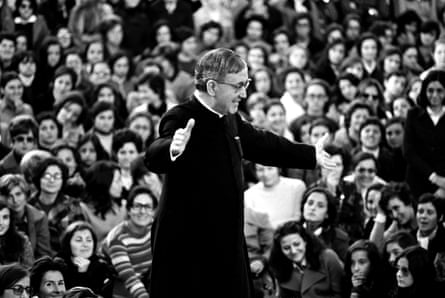
Gore began reporting on Opus Dei almost by accident. He was a financial journalist looking into the collapse of Banco Popular, one of Spain’s largest banks, in 2017. At the time, the world couldn’t understand how such a pillar of European banking had failed so spectacularly. Gore discovered that the bank had been hijacked by Opus Dei since the 1940s (the bank’s chair was a lifetime member, as were much of its board, and companies controlled by Opus Dei turned out to be the bank’s largest shareholders). Opus Dei had used the bank “as its personal cash machine”, Gore alleged, “siphoning off” funds to finance its expansion around the world. (The trial of Banco Popular’s former leadership, facing allegations of fraud, is scheduled to begin in Spain’s national court in 2027. For its part, Opus Dei has denied that it was involved in the management of the bank and said it “does not get involved in commercial activities”.)
Through hundreds of interviews with former Opus Dei members, Gore’s book traces how from the 1950s onwards, Banco Popular’s wealth went into creating a vast recruitment network targeting children and vulnerable teenagers, building palatial Opus Dei centres across the world, and eventually forming one of the most formidable clandestine political influences in the US. Its US members would become crucial in eroding reproductive rights, funding the Washington march that led to January 6, and heavily influencing Project 2025, according to Gore’s reporting.
Gore’s book also sheds light on the inner workings of Opus Dei. Its most religious members, called numeraries, live in single-sex dormitories in a life of servitude and self-flagellation: they fast for dangerously long periods, wear a small spiked chain called a cilice around their thighs, and whip themselves with ropes, former members told Gore. Every element of their life is strictly controlled and manipulated by the group’s leader and senior priests, Gore said. Mental illness, common in an atmosphere of constant physical and psychological abuse, was treated with a reported cocktail of antidepressants, sedatives and even Rohypnol, according to claims made by victims in interviews Gore conducted.
Female members known as “numerary assistants” – women and girls from mostly underprivileged backgrounds – staffed the Opus Dei residencies, working long days cooking and cleaning. Many of them were allegedly cut off from their families, transported internationally and, in many cases, expected to give their entire salaries to Opus Dei in an operation that Gore believes meets the UN definition of human trafficking. Some made claims to Gore of sexual abuse.
In Argentina, federal prosecutors are leading an investigation into senior leaders of Opus Dei who they accuse of overseeing the exploitation and trafficking of women and girls; Opus Dei in Argentina set up a “healing and resolution” office to hear the women’s complaints. In 2024 it also said allegations that girls were coerced into joining the organization on promises of education at its schools were “false and misleading”. Opus Dei said it is committed to safeguarding minors and vulnerable adults.
Most Opus Dei members don’t live in these conditions. These “supernumeraries” can marry and live in their own homes. The most critical mission of the numeraries is to recruit supernumeraries to make large donations back to Opus Dei and influence politics and society to further Opus Dei’s conservative goals. An Opus Dei priest in Washington DC, who Opus Dei acknowledged has credible accusations of sexual misconduct against him, oversaw the 2009 conversion of former speaker of the house Newt Gingrich to Catholicism.

In a statement to the Guardian, Opus Dei’s US communications director said: “There are cultural spheres from which the reality of faith cannot be understood. In this case, a financial journalist interprets the reality of the Church through an economic and political lens. Unless the dimension of faith is taken into account, one cannot understand the Church … at the same time, we firmly reject the serious allegations contained in the book Opus. The book contains numerous errors, distortions, and unfounded allegations.”
The organization previously denied claims that it “exercise[s] control of its members’ political and business dealings”. It has also denied that it is a “secretive” organization.
I spoke to Gore, who lives in London, two weeks after his 16 March visit to the Vatican about what happened when he met Pope Leo.
This interview has been edited and condensed for clarity.
You’ve spent almost a decade compiling this dossier on Opus Dei that implicates the Vatican. How on earth does it happen that you’re invited to present these findings to the pope?
Honestly, I don’t know. I was on a work trip in the states and I got a call from somebody I know in Peru who’s quite close to the pope. And he had heard from the pope himself, that the pope wanted to meet me and to hear more. I remember putting the phone down and having to take a moment: is this for real?
I was told to contact someone at the Vatican who would arrange the meeting. So I sent this message, still thinking: no one’s going to reply to this. And almost immediately I got a message from someone quite senior inside the Vatican who was like, “Yeah, yeah, the Holy Father has told me absolutely that he wants to meet you. Let me know what dates might work.”
It was then a pretty stressful lead up to the meeting. Not because I was stressed about meeting the pope, but because I felt this weight on me. Having conducted this investigation over the course of five years, having spoken to literally hundreds of former members of Opus Dei and having unearthed all of these secret documents about the way that this group operates, I felt this weight to ensure that he received all this information.
How much do you think Pope Leo already knows about the organization?
Who knows how much information actually gets to him. Opus Dei is renowned for having penetrated the Vatican. It’s highly likely there are people there who are limiting what information gets to the pope – perhaps for malicious reasons, but also, as with any other kind of big company or big institution, sometimes it’s better that the boss doesn’t know everything so that there can be some kind of deniability.
In the limited time you had to speak with Pope Leo directly, what was the central story that you wanted to tell him?
I think people on the outside don’t realize the founder of this movement, this Spanish priest Josemaría Escrivá, told his members that the idea for Opus Dei had come directly from God. He’d received this vision which he wrote down in meticulous detail.
These writings are the source of all of this control and manipulation and political manoeuvring that’s ongoing today. And so without understanding the internal documents, internal rules, and without understanding that the members truly believe that these rules came directly from God, it’s impossible to understand the mentality of how Opus Dei works. So I was trying to convey that message to [the pope], while also trying to explain why reforming this group will be unbelievably difficult, because the founder is revered as a saint, which he is. He was made a saint by the Vatican in 2002.
So the pope can’t just say, “You guys have got to stop doing this,” because the true believers will continue believing that all of these practices and all of this manipulation is what God wants of them.
How does one hammer things home to the pope? Did you feel like you had the freedom to be persuasive, or do you have to adopt a respectful tone?
I went into the meeting with this kind of burden of wanting to really get this information to him, but I had this attitude of not giving a damn. Maybe I want to rephrase that: I was unafraid of offending him or of breaching etiquette. I just thought: no one else has been given this opportunity and if they throw me out after five minutes, I can live with that because I’ve tried to do what I think is right.
But I had no idea about how he would respond to me ambushing him with this huge pile of papers, these internal documents and me giving him a very clear, full, unvarnished account of what life in Opus Dei was really like. I didn’t know whether he’d be pressing his button, getting his secretary to come in and show me out.
How did he respond?
Honestly, the meeting could not have gone any better. He asked a number of very incisive questions. It went on for much longer than was scheduled. There were two cameramen there. And at the end of the meeting, the pope said to me that it had been his decision to invite the cameras in and to make the meeting public. I think he quite clearly wanted to send a signal to Opus Dei that he’s taking these allegations seriously.
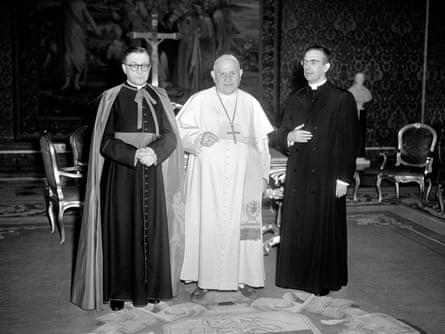
Opus Dei is only 100 years old, and perhaps the reason it’s not treated like other groups of the 20th century that have accused of cultlike behaviour is the seal of religious authority that has been stamped on it by the Vatican. Does the Vatican have real powers to rein in Opus Dei if it chose to?
The Vatican helped to create this monster, not least Pope John Paul II because he saw them as political allies in his conservative crusade. He saw them almost like his personal green berets that he could send off to any part of the world where there was some kind of progressive priest or bishop who was causing trouble. He could send Opus Dei there to do his work or be his eyes and ears. He gave them this special status that has never been granted before or since in the history of the Catholic church.
What is that status?
He made them into this thing called the “personal prelature”, which basically meant that they were answerable to no one but the pope. They could operate anywhere they wanted to in the world and any abuse allegations against [Opus Dei] couldn’t be handled in the normal way through the local bishop or archbishop. Ordinary Catholics welcome this group into their homes, they allow their kids to go to its schools, they attend its meetings because [it has] this stamp of approval from the Vatican.
Pope Francis, to his credit, started to take action [before his death in April 2025]. He issued a papal decree in 2022 where he basically ordered Opus Dei to get its house in order. But there was no effort to speak with any former members, no effort to speak with journalists such as myself who investigated the group.
The point I was trying to make to Pope Leo is that if you’re trying to solve a problem, the first step is to understand exactly what the problem is. Which is why I suggested to him that the next logical step would be to open a full independent investigation into all allegations of abuse [by Opus Dei] – whether they are spiritual, psychological, emotional, physical.
Prosecutors are starting to look into the organization too.
Certainly in Argentina, public prosecutors there have conducted a two-year investigation into the allegations made by 43 or 44 women. And after the investigation, these public prosecutors concluded that there were absolutely grounds to charge the group with human trafficking and serious labour offences. But that’s just the tip of the iceberg. Since the Argentina allegations have come out, we’ve had more women coming forward in places like Ireland, Mexico, France, Spain.
Opus Dei operates about 300 [private Catholic] schools around the world, including in the UK and the US. Not far from my home in south London there are two Opus Dei schools where kids my kids’ age go. The next big step is for governments and for social services to really look into safeguarding practices at these schools and to begin to ask questions about whether this group, which is accused of very serious abuses and crimes, is fit to be looking after young kids and young adults. I would argue that it absolutely is not.
One of the things you’re pushing for is for the canonization of Escrivá to be undone? Would that be terminal for Opus Dei?
Unfortunately people are brainwashed into believing certain things, so whether removing the sainthood of Escrivá would result in this group just dying out, I’m not sure. But it would go a long way to removing this stamp of legitimacy and approval from the Vatican. If all the Vatican does is make a few tweaks around the edges but leaves this guy as a saint, that’s going to send very mixed messages. We have [the founder’s] actual writings in black and white where these practices are not only outlined but mandated and ordered of the membership, which is why this is such an enormous headache for the pope.
People might think that this is an obscure religious group that has little to do with them. Opus Dei says it does not take political positions other than the stances of the Catholic church. But you describe them as having pivotal influence when it comes to the makeup of the supreme court and abortion.
The founder of Opus Dei made it clear that he saw his followers as part of a militia who were going to enter into battle against what he called the “enemies of Christ”. So right from the beginning, this is a political group that uses religion as almost a veneer to hide behind – controlling and manipulating the membership to get them to do things that might benefit Opus Dei politically or financially.
In places like Washington, [Opus Dei has] made a real concerted effort to infiltrate the corridors of power and has been immensely successful. I would argue that today, Opus Dei within the Maga Republican movement is one of the pre-eminent forces. There are several very high-ranking figures inside the White House and the wider Maga ecosystem who are either full-on members of Opus Dei or big supporters. People like Kevin Roberts, the president of the Heritage Foundation [and the force behind Project 2025], is a regular at the Opus Dei centre in central DC and gets his spiritual direction from them. You’ve got Leonard Leo, who helped to orchestrate the conservative takeover of the supreme court and sits on the board of the Opus Dei centre in central Washington. The list goes on.
This is a group that is by invitation only and they target the elites: politicians, judges, business people, journalists, academics.
What’s ironic is that you have the leader of the Catholic church speaking out against war and against the way that immigrants are being treated. That shows this co-option of the Christian identity by Opus Dei to be a complete fallacy; it’s all for political expediency. It’s about these people’s own deeply authoritarian and conservative views about how the world should be run.