.png) 2 months ago
59
2 months ago
59
As they struggled through the decades of cold war gloom and repression, Warsaw’s neon signs became symbols of light, colour and hope of brighter days. What had started as a form of Soviet propaganda sparked a wave of creativity in the Polish capital that even the Communist authorities could not crush.
But after communism ended in the late 1980s, many of the signs lost their purpose and began to disappear, left to rust where they hung or removed and taken to the scrapyard.
Several decades later, neon is enjoying a renaissance in the city. Many historic signs have been restored as new ones are custom-made for bars and restaurants as a nod to the past.
Meanwhile, Warsaw’s Neon Museum, created in 2012 by Ilona Karwińska, a Polish-British photographer, and her partner David Hill, a graphic designer, attracts more than 100,000 visitors a year to see its collection of cold war-era illuminations.
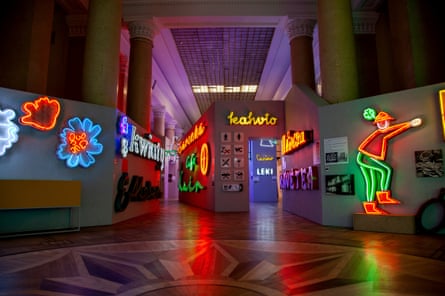
“When we started this, the neon signs were unloved and unwanted. They were ancient and rusting. Many were being taken down and tossed away,” Hill said of the couple’s interest in the signs, which began on a 2006 visit.
“Ilona decided to photograph those that were still up as part of a personal project. We thought it would take a couple of months and we’d get back to our lives. Now it is our lives. We’ve become neon nerds.”
After Karwińska’s photos were exhibited and featured in several bestselling books, people called to offer signs, leading to the museum opening in 2012. “It showed the interest and love people had for them, even though they were thought to have no social or cultural value,” Hill said.
Neon signs emerged in the early 20th century after the 1898 discovery of the noble gas by the British chemists William Ramsay and Morris Travers. The French engineer Georges Claude pioneered the use of high-voltage electricity passed through sealed glass tubes filled with neon and argon gases, with the first commercial neon sign sold to a Paris hairdresser in 1913. A decade later, the “liquid fire” advertisements were introduced in the US.
Warsaw got its first neon sign in 1926, but few of the 70 that followed survived the second world war, when the occupying Nazis razed up to 90% of the city in retaliation for the 1944 Warsaw Uprising by the Polish resistance.
The postwar “neonisation” of Poland began in 1956 when the government of what was now a Soviet satellite state set up the Reklama company to manufacture lights and luminous signs.
For the Communists, it was seen as a way to bring light to cities that were dull and grey, or, in the case of Warsaw, in ruins, and the best graphic designers of the Polish poster school movement, including Jan Mucharski and Tadeusz Rogowski, created many of the signs and symbols.
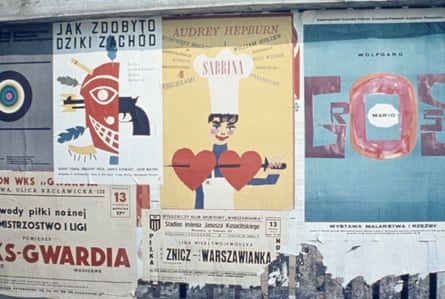
“It was part of a social and political idea associated with modernisation and optimism; something to cheer people up and give them the idea life was improving,” Hill said.
“Obviously, the authorities didn’t want a free-for-all, but there seems to have been a bit of room to navigate. Some stern Soviet bureaucrat would have had to approve the sign, and they were dead against logos that suggested western commercial advertising.
“But a creative design for a neon light would become so popular that it would be replicated, and suddenly it was a logo. Quite a few officials must have found themselves in a bit of a tricky situation.”
The neon signs were also a political tool: when the government introduced martial law between December 1981 and July 1983 in response to the Solidarity protests, the lights were often turned off, plunging Warsaw into darkness.
Some people have questioned whether the signs should be in a museum or repaired in situ. In response, Karwińska and Hill have started renovating neons and returning them to their original sites or nearby, including a 4-metre-tall red cockerel formerly on a folk art warehouse since demolished and replaced by a block of flats, and a Syrenka mermaid, the symbol of the city.
The revival has also inspired a new generation of architects and designers to work with neon. One of the most spectacular new signs, reading “It’s nice to see you” in Polish, was created by the graphic designer Mariusz Lewczyk and installed on the Gdański Bridge across the Vistula River after a competition to design a new symbol for the city.
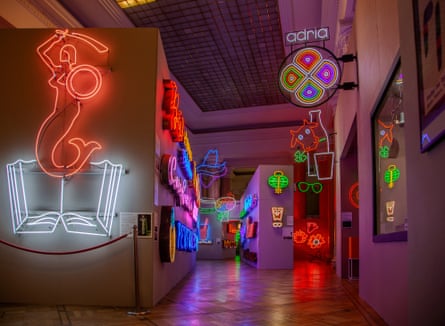
The museum also features neon signs from elsewhere in the former eastern bloc, and Karwińska and Hill now plan to open a second museum in Budapest.
“They are beautiful symbols and people have realised the value of them,” Hill said. “Lots of people from older generations remember them and get quite teary-eyed, because they often represented important places. They say things like: ‘This is where I met your mother.’
“There’s definitely a revival happening. The love affair with neon signs is catching on again.”