.png) 2 months ago
51
2 months ago
51
It’s a brisk November afternoon in the village of South Brent in Devon and, in a daffodil yellow cottage, two women are singing me lullabies. But these aren’t the sort of lullabies that parents sing to their children. They are songs written and sung for terminally ill people, to ease them towards what will hopefully be a peaceful and painless death.
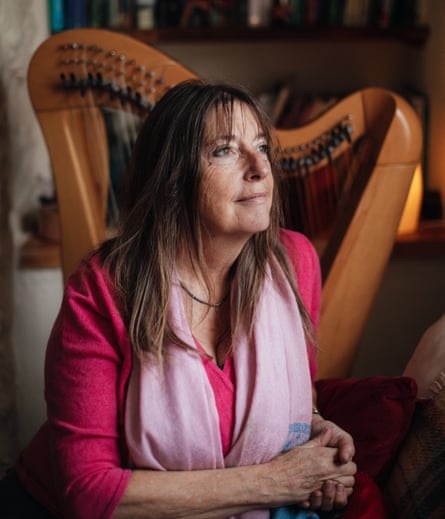
We are at the home of Nickie Aven, singer and leader of a threshold choir. Aven and her friend are giving me a glimpse of what happens when they sing for people receiving end-of-life care. These patients are usually in hospices or in their own homes being supported by relatives, which is why 67-year-old Aven – who is softly spoken and radiates warmth and kindness – has asked me to lie down on the sofa under a rug while they sing. She says I can look at them, or I can close my eyes and allow my mind to drift. In fact, my eyes settle on Lennon, Aven’s large black labrador retriever who squeezes himself between the singers and is as gentle and well-mannered as his owner. The pair sing a cappella and in harmony. Distinct from elegies or laments, the songs are gently meditative, written to provide human connection and foster feelings of love and safety. They are not just for the benefit of the dying but for friends and relatives caring for them or holding vigil. Their singing is simple, intimate and beautiful. It is also utterly calming.
Aven’s choir, who call themselves MoorHeart (a nod to their proximity to Dartmoor), has 10 members. As she explains over tea and biscuits, they are all volunteers, no payment is taken and tips are politely declined. As well as bedsides, the choir sings at funerals, memorial services and sometimes at baby blessings – because birth, like death, is a threshold. Theirs is one in a growing network of choirs founded by an American named Kate Munger. In the early 90s, Munger had sat at the bedside of a friend who was dying of Aids and begun singing to him. The experience was transformative, inspiring her to establish a series of singing groups which she called chapters. There are now about 200 official chapters around the world, most in America and a handful in the UK – in Devon, Cornwall, Sheffield, Scarborough and London . There are further threshold choirs not affiliated with the US organisation, though exactly how many is unclear.
What Aven and her choir do is different from the work of death doulas, who often take on more practical tasks such as setting up food rotas or taking turns with family members to keep vigil. Her choir tends to sing in groups of two, three or at most four, as “it would be overwhelming for somebody who’s very poorly to have 10 of us turn up at their bedside”. The volunteers don’t have to be trained musicians or singers – even though Aven’s choir just happens to include a former member of the Hallé, the celebrated Manchester symphony orchestra. Each choir has its own way of working, but to join this one, candidates must be able to hold a tune and sing in harmony. They also need to be comfortable with death and dying. This isn’t something that comes easily for people but, in Aven’s case, a series of devastating personal losses means she has more experience of death than most.
We are, as a nation, not good at death. Death and grief exist “in the shadows”, Aven says, with many finding it hard to talk about and plan for. I tell her that when my father died 25 years ago, he spent his final weeks in a hospice drifting in and out of consciousness. As I was young and he wasn’t given to displays of emotion, I had no idea what to say near the end. “I think that’s a really common experience and is one of the reasons I do what I do,” Aven says. “I want to get a conversation going. Recently, my beautiful neighbour died at home and there was a sort of open house while she was dying. Many of us would pop round for 10 minutes and be with her and talk with her. She, her husband and family were so generous and gracious. So I want to keep naming it and saying it out loud, so that fewer of us have the experience of not knowing what to say.”
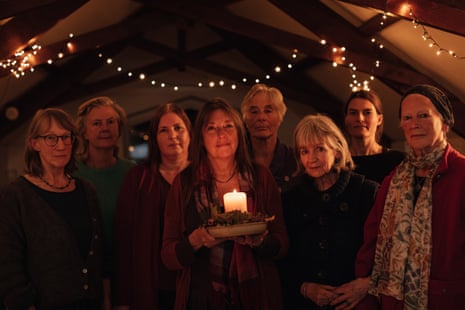
Last month, one of the choir’s own members died: Lindsey Stewart had been diagnosed with breast cancer over a decade ago and had recently been having chemotherapy. Her death was unexpected, meaning Aven and the rest of the choir never got to sing for her when she was alive. So instead they got together in the week after her death, during which they shared memories of her and sang songs.
Though she is officially retired, Aven spends anything between 20 and 30 hours a week working with people who are dying or grieving, whether through singing, spiritual counselling, meditation or what she calls “accompanying”, which can just mean sitting quietly or chatting over a cup of tea. Grief, she says, “isn’t pretty and it isn’t solid. It can be lots of things. It can be trauma, or fury, or self-pity. It can be wanting to die, and that is all right, as that feeling won’t stay for ever.” Aven also runs groups where she helps people manage their grief. Last weekend, she co-hosted one called Clay Stories “where we use clay and creative writing to help them voice what’s going on”. Some people can struggle to talk about how they’re feeling, but she has found “creativity is brilliant at bypassing the brain and our inner critic”. Which, of course, is where music and singing comes in.
She is clear that when the threshold choirs gather around a bedside, what they are doing is not a performance. Once, a nurse at a hospice asked if they would sing Christmas songs: “We said no, we’re not up for that.” The songs are slow in tempo, in the same way that lullabies are, and they are all original, with many composed by choir members. This is important, Aven says, because music is bound up with memory and anything familiar runs the risk of “pulling you back into your life. At the threshold of life, you’re wanting to disentangle yourself.” There are an estimated 600 songs in the repertoire, some recorded versions of which are for sale on the official Threshold Choir’s Bandcamp page as not everyone lives near a choir that can sing to them in person. Song titles include You Are Not Alone, Rest Easy and Sweet, Sweet Dreams. Aven encourages her members to write songs and bring them to practice sessions. This is partly so they don’t get bored singing the same material but also because it makes them “more invested in the choir. It’s not mine, it’s ours, and I much prefer it when we work collaboratively.”
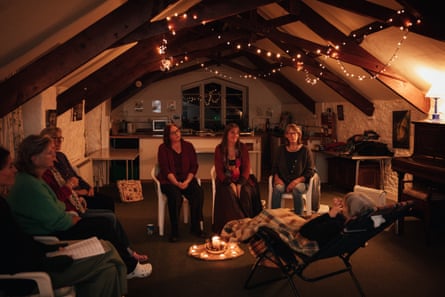
While the choir sings, patients may listen silently or sleep or cry. Once, when they were singing to a patient and her family, the patient “started to cry, and her son started to cry, and the other brother came in and he started to cry. And when we left, they were all hand in hand and I would bet they hadn’t had an intimate moment like that before, because they were usually all chat, chat, chat. It allowed them to weep and be real.” When a new singer joins the choir, Aven suggests they don’t sing at the bedside at first; instead, they practise with volunteers who lie on a couch, much like I am doing. They also do developmental exercises and workshops to get them as relaxed and clear-headed around death as possible. This is because the last thing a dying person needs is a singer bursting into tears.
Aven’s work around death and dying goes back to 2000 when she was living in Bristol and joined a multidisciplinary team at the Rainbow Centre, a non-profit organisation helping people and families dealing with life-threatening illness and bereavement. “It was kids who had cancer, mothers and fathers who had lost children, or children who had lost their mummies.” A month into the job, Aven’s mother, Joan, died. Joan had endured multiple losses as a child. “She was five when her father died in 1933,” Aven says. “Then her grandad caught a cold at the funeral and died a few weeks later. They went to live with her grandmother and found her dead on the kitchen floor from a heart attack.” Joan was never able to properly deal with those losses “because in the 1930s, who’s going to manage grief?”
And so, at the Rainbow Centre, Aven had a revelation. “I realised, oh my God, I am doing this for my mother. This is the exact help she needed as a child.” When Aven’s father died, he was in the middle of having his hair cut. “He had a heart attack in the barber’s chair. The barber had just told him a joke, turned around for his scissors, turned back and he was dead.” That sounds like an excellent way to go, I say. “Yes,” Aven says, adding with a grin, “Shocking for the barber, though. I mean, it’s not good for business, is it?”
In the late 2000s, Aven starting training in interfaith ministry and celebrancy, and began holding funerals; it was while mentoring interfaith students that she met her husband, Neil. In 2012, she moved to Findhorn in Scotland, a spiritual community where she ran a lodge. There, a woman named Chloe Greenwood came to stay. She had been to America and learned about threshold choirs, and was founding one in Scotland. Aven immediately joined up. “What I loved was the sense of love, of kindness. I use the word carefully as it has hippy-dippy connotations, but it felt like a sisterhood.”
In late 2017, Aven and Neil decided to move to Devon, as he had family in the West Country. Keen to keep singing, Aven set up a threshold choir in the village. Two weeks later, Neil was diagnosed with a brain tumour. It was a grade four glioblastoma and it was terminal. A year later, Neil’s health declined and he began having seizures. One, which lasted three hours, left him bedbound “and his memory shot”. Throughout, Aven never stopped singing. In Neil’s final months, the choir would come and sing for him in their front room where he was installed in a hospital bed. Then, one Saturday morning in May 2019, Aven “woke up at half past five and heard him struggling with his breath. I hadn’t realised he was dying but after an hour or two I noticed he was going grey. And then he was gone.” Aven cleaned him, and did some meditation. “And then I sat beside him and I sang.”
During Neil’s illness, another crisis was unfolding for Aven and her family. Sam, her son from a previous relationship (she also has a daughter), had been struggling with heroin addiction for some years, but before Neil’s diagnosis, had seemed to get clean. “To all intents and purposes, he was doing OK,” Aven says. But the last time she saw him, she had a bad feeling. Sam and his sister were visiting for her 60th birthday and, though she didn’t know why, she thought something wasn’t right. Dropping him off at the station, “I gave him a hug and thought: I don’t want to let you go. When I walked away, I very nearly ran back but instead I carried on walking. I didn’t see him again.”
Sam had been living in a dry house in Bristol, was attending meetings at Narcotics Anonymous and was in contact with his sponsor. Aven doesn’t believe he was regularly using again, but she later learned from his journals that he was taking spice, a form of synthetic cannabis that is often called the “zombie drug”. Aven can’t be sure what happened, but she thinks he may have had a drink, then bought some heroin. It was a Saturday when he was last heard in his room by other residents. “It was a hot summer, he was in the room at the top of the house with no window open,” she says. “When he was found on the Monday, his body was already black. I was told, ‘You cannot see him’ which I think was the right call, but it was hard.” Aven is certain he didn’t take his own life, and that it was an accidental overdose. “The way I think of it is that he stood on the edge of the cliff, putting himself in the way of the wind, and one day it was going to blow the other way – and it did.” Sam was 33 when he died.
Aven has witnessed only one death – that of her husband – though she has met scores of people who are close to the end. I ask her what preoccupies them most. “They worry about what their death will look like and about being out of control,” she replies. “They also worry about how their families will manage without them.” Aven has helped people write letters, some of which have addressed regrets in their lives. Shame can be a big thing, she says. “There is such an opportunity, when you know you’re dying, to heal any shame. There’s a real grace in that.”
A good death, Aven notes, comes from “looking it full in the face. To think, ‘Oh, you’re coming, OK’ and working with that. Not thinking death is a bogeyman, or a baddie.” She adds that there are times when death is “a dreadful calamity such as when it’s children, and I’m not belittling it. But very often we die in our time and in our order, and it isn’t a tragedy or a catastrophe. This is what happens: we are born and we die.” Does she think she will be able to maintain a Zen approach when faced with her own death? “What I expect is that first I’ll be in a panic, then I’ll probably ask someone to help me make sure everything I need to do or say is done, even though I try to do that in my life anyway. My daughter knows how much I love her and we talk about death, including my death. It’s not a taboo subject.”
Aven senses I am building up to ask about assisted dying, and heads me off at the pass. “I won’t go there. I have my own views, but they might not be popular and I don’t want to offend people.” Instead, I ask her about the word “threshold”, as it seems to suppose a dying patient is going from one place to another. I wonder if this means those involved in the movement believe there is something else after death? “No, absolutely not,” she replies. “I think, if nothing else, it’s a threshold out of life. It’s not clear to us what’s next, if anything. And I would never dream of asking anybody in the choir, or anyone we sing for, about their beliefs.” Aven declines to say what she thinks happens after death. She will say that after Neil died, she wrote to him every day. Whether he knew that or not wasn’t the point. What mattered was she found comfort in it.
Given all she has endured, Aven’s openness and ability to articulate her feelings around death and dying are remarkable. Much of her work is galvanised by not wanting others to feel alone and disconnected with their fear and grief, and understanding that the more we talk about death – what it looks like, what it’s like for those left behind – the less traumatic and frightening it will be. I had wondered whether our afternoon together would feel heavy and sad, but it turns out conversation with Aven is life-affirming and full of laughter. “When I get to the end of my life,” she says, “I just want to be able to say, ‘Thank you, that was brilliant!’”