.png) 3 months ago
81
3 months ago
81
Last week’s launch of the Artemis II space mission was a stunning spectacle, the 17-storey-high rockets erupting into cacophonous life before wrenching the craft through the Earth’s atmosphere. But the images that have come since hold just as much impact: the tiny Orion craft and its four-person crew drifting silently through space, further and further from home.
In his autobiography, the Apollo astronaut Michael Collins described this feeling perfectly. Left in the command module as Neil Armstrong and Buzz Aldrin touched down on the lunar surface, he wrote: “I am alone now, truly alone, and absolutely isolated from any known life. I am it. If a count were taken, the score would be three billion plus two over on the other side of the moon, and one plus God knows what on this side.”
Although most science-fiction video games are set in distant galaxies or far-off futures where space travel has become routine, a few have attempted to explore this sense of solitude and vulnerability. As a Nasa-obsessed child in the 1980s, I loved the classic space trading game Elite, which rendered an entire lonely universe in monochrome vector visuals. I would play for hours, navigating between silent space stations in a small, single-seater craft, watching the stars pass by through the windows, planets rotating in the darkness far away.
More recently, the original version of space adventure No Man’s Sky, released in 2016, let you explore weird planets all alone – though these desolate places could be deadly, with acid for air or no resources for fuel, so every trip had around it the ominous shadow of death. The game was later patched to be more forgiving, but that sense of deadly peril made those quiet moments of arrival all the more enticing and emotional. Similarly, the surreal, minimalist planetary exploration game Exo One has you piloting a tiny alien craft over weird psychedelic landscapes, surfing thermal updrafts and swooping down impossible mountainsides. When I asked on BlueSky for people’s memories of space games that evoked this sense of beauty, loneliness and mortal danger, game developer Henry Driver wrote of Exo One: “I included it in the programme for a games festival I ran last year, and it captivated audiences like nothing else.”
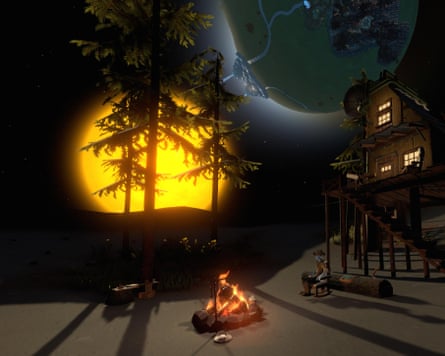
Many other familiar titles came up on that thread. The wonderful puzzle adventure Outer Wilds thrusts players into a time loop in a doomed planetary system, living out the same lonely 22 minutes over and over, while searching for a means of escape. Its worlds are cruel but beautiful, and all the while the clock ticks down to an apocalyptic supernova. Observation and Tacoma set you down in crippled space stations where you must piece together the events that led to disaster. Other games writers and designers, meanwhile, recalled feelings of solitude, awe and fear in titles such as Alien: Isolation, Freelancer, Homeworld and Out There. All of these capture the minimalist elements of space travel – often just isolated noises and details. Games industry adviser Tracey McGarrigan wrote of the Atari 2600 game Solaris: “The sounds of your ship’s engines … the scrolling fuchsia corridors …”
We’ll never fully understand what the crew of the Orion felt in those 40 minutes when they disappeared behind the moon, out of contact with mission control and utterly alone apart from each other. But games have, throughout their history, sought at least to simulate the feeling – to give us a taste of facing the black abyss, protected only by a thin layer of metal and a few tanks of oxygen. There is something in us that needs to know what it is like to loiter at the very edge of existence. That may be through extreme sports, or theme park thrill rides … or through the generated galaxies of thoughtful space games, the ones that concentrate not on generational starships or laser wars, but on small crews in tiny pods, the weight of the universe stacked against them in the dark.
What to play
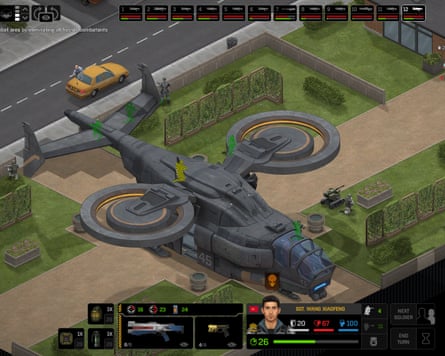
If you’re a veteran of the classic turn-based strategy sim XCOM, then saddle up: you’re needed back on the extraterrestrial battlefields. Xenonauts 2 is the sequel to Goldhawk Interactive’s well-received tribute to the XCOM series, once again putting you in charge of Earth’s defences as humanity squares up against alien invaders. You manage secret bases, develop technologies and then direct your troops to face alien monsters. The graphics are incredibly neat and evocative, and the complex layers of strategy and action make for a ruthlessly immersive challenge. I may be caught up in this desperate cause for many weeks.
Available on: PC
Estimated playtime: 30-plus hours
What to read
-
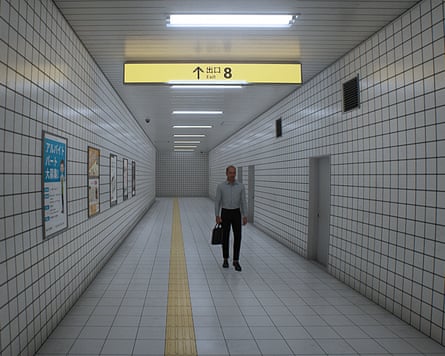
Indie horror games based on the creepypasta phenomenon of the Backrooms have been in vogue for a couple of years via titles such as Exit 8 and The Complex: Found Footage. This recent MIT feature uses these games to analyse the concept of institutional gothic – a sort of modern take on Victorian horror set in office blocks and shopping malls. Fascinating stuff.
-
Despite a tsunami of poor reviews, the Super Mario Galaxy movie made $372.5m in its opening weekend. How did an animated sequel with a Metacritic score of 36 perform so well? “Family movie-going is leading the industry now,” box-office watcher David A Gross told Variety.
-
As an apologetic Sega fan, I was interested to read that the creator of Alone in the Dark is crowdfunding a new Mega Drive game. Frédérick Raynal developed the brick-breaking game PopCorn in 1988, and his rebooted version will come with a dedicated controller. The Kickstarter for the game is halfway to its target.
What to click
Question Block
This week’s question comes from Carl via email:
“Having just read and enjoyed Tomorrow, and Tomorrow, and Tomorrow, I wondered if there are any direct novelisations of video games – and if so, which should I read?”
Yes, there have been lots of video game novelisations over the years – indeed, a lot of 1980s games such as Elite and Lords of Midnight were packaged with novellas that set the scene in an era before cinematic cutscenes. However, like film tie-ins they’re rather hit and miss. My favourite is very difficult to get hold of now: Ico: Castle in the Mist is based on the beautiful PlayStation game, written by Japanese author Miyuki Miyabe and translated into English in 2011. Otherwise, the Halo novels, especially Halo: The Fall of Reach by Eric Nylund, provide pretty good sci-fi fare, while SD Perry’s Resident Evil novels expand on the first games in the series, as well as exploring new stories (but are now considered non-canon, if that matters). If you enjoyed the classic dystopian adventure Bioshock, then John Shirley’s prequel novel Bioshock: Rapture is an intriguing read. Finally, lots of people enjoyed the Metal Gear Solid novels written by Raymond Benson, who also penned a series of James Bond stories. By the way, I would absolutely love to write a Last of Us novel if anyone at Naughty Dog is reading?
If you’ve got a question for Question Block – or anything else to say about the newsletter – email us on [email protected].