.png) 3 months ago
96
3 months ago
96
Hello and welcome to The Long Wave. It’s Morgan here, covering for Nesrine this week. There has been a recent rise in anti-LGBTQ legislation across a number of African countries that already have strict sexuality laws.
I spoke with LGBTQ+ people and activists fighting against the narrative that their identities are an imported “western” creation to better understand the impact of these new laws, why they are happening, and how foreign lobbying groups are pushing for more draconian laws.
An anti-LGBTQ legal onslaught
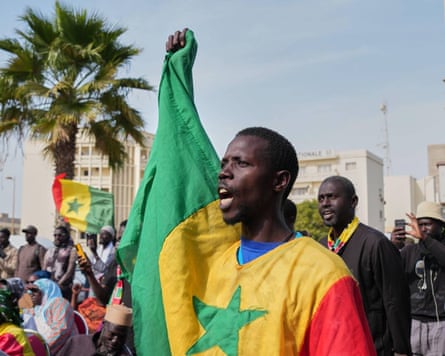
Last month, the president of Senegal, Bassirou Diomaye Faye, signed a new law that doubled the maximum prison sentence for sexual acts by same-sex couples to 10 years. The act also banned financial support for or “promotion” of homosexuality. This came after more than a dozen men, including a popular musician and a journalist, were arrested and charged with “acts against nature” in February. Last September, Burkina Faso’s interim president, Ibrahim Traoré, signed into law a provision that criminalised “homosexual acts”, which would be punished with prison sentences of two to five years and fines of up to 10m CFA francs (£13,300). The Human Dignity Trust labelled it a “deplorable development”. Meanwhile, in 2023, the Ugandan head of state, Yoweri Museveni, ratified perhaps the most globally infamous anti-LGBT legislation, which included the death penalty for “aggravated homosexuality”. The law built on the “Kill the Gays” bill, which came into force in 2014 but carried no risk of execution.
More recently, and perhaps as troubling, plans are in motion for Ghana to resume the legislative process, which began in 2021, for its controversial Human Sexual Rights and Family Values Bill, which is rooted in colonial-era criminalisation of sexuality. Ghana’s parliament first passed a version of the bill in 2024, but it expired without then-President Nana Akufo-Addo’s assent. A new version, received by parliament in February places a legal duty on professionals – such as teachers, journalists, parents and religious leaders – to “protect family values”, creating a mandatory obligation on the part of citizens to enact it.
Ghana’s current president, John Mahama, speaking last month, said the reintroduction of the bill had sparked a “complex and sensitive” national conversation, but that his government would be guided by the country’s 1992 constitution, human rights and dignity, as well as preserving social cohesion. “I explained during my recent engagement with the World Affairs Council [of Philadelphia] that it is not the most important issue we face as a nation,” he said. “We are still grappling with the provisions of basic needs of education, healthcare, jobs, food, clothing and shelter.”
A bitter pill to swallow
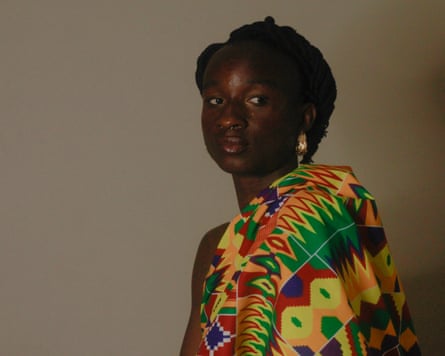
For many Ghanaians, those basic needs remain out of reach, especially for queer people. For awo dufie fofie, an intersex trans woman living in Ghana, that insecurity is compounded by the threat her identity poses to her safety and survival.
An archivist documenting queerness, awo was doxed in 2023, and has faced discrimination after people learned of her identity. “The next apartment I lived in, I lived in for one month, and the owner of the apartment asked me to leave.” Three subsequent landlords would, in quick succession, evict her.
A low point, she tells me, was being attacked by a mob in a car outside her Airbnb accommodation in Accra. “It came with a lot of consequences: psychological, financial … One of the reasons I could not make it to school [university] was because the attack meant I missed my interview for my application to do a PhD.”
Through her work with civil organisations such as Rightify, which documents abuses and violence, awo has seen examples of repression beyond Ghanaian borders and on the continent. “Conversion therapy camps exist. I have been threatened with them twice by my biological family. Frequently, we have gay men being set up on social media apps and getting brutally, brutally beaten.”
Amanda Odoi, a researcher and activist who brought a case against the speaker of parliament and the attorney general, challenging the bill, criticises its outsized impact on allies and their networks. “There are threats to life, threats to careers, threats to security. Sometimes politicians don’t understand how the messages they send create these kinds of challenges for people caught up in these issues.” Odoi adds that the political rhetoric will hurt individuals who are non-conforming in general and lead to material attacks on not just sexual rights but reproductive ones, too.
The colonial gaze
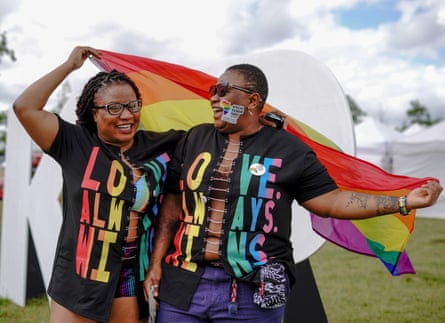
The topic has become a political football as politicians attempt to gain favour with their electorates. Senegal’s recent change was the fulfilment of a campaign promise by Faye, and Akufo-Addo frequently used the topic to maintain his popularity during his presidency.
There is also evidence that rightwing groups outside the continent are trying to influence politics across Africa. The Institute for Journalism and Social Change found that 17 US so-called Christian rights groups known for anti-gender campaigning spent $5.2m in Africa in 2022, up 47% from 2019. This includes the Heritage Foundation, a prominent rightwing thinktank, which reported spending $8,000 in the continent over the four-year period without detailing where or to whom the money was allocated. The analysis also looked at groups such as the Fellowship Foundation, which has funded events attended by Uganda’s Museveni, such as a 2023 speech by US representative Tim Walberg, who urged Uganda to “stand firm” on anti-LGBTQ legislation.
Next month in Accra, Ghana will host the fourth African inter-parliamentary conference on family and sovereignty, a platform with documented links to US-based far-right advocacy groups. Previous editions have featured speakers who promoted Uganda’s anti-homosexuality act as a model for other African legislation.
For now, awo is focused on forging alternative histories and futures that can change the narrative. She recently documented older queer people around west Africa and, despite the repression, attended the wedding of her friend’s two gay children. Ghanaians and other Africans, she says, need to think about figuring out gender, for instance using “Kojo Besia” – an Akan phrase used to describe an effeminate man, who is not always necessarily queer – as a starting point.
“There is,” she tells me, “also an opportunity for a decolonial advocacy that centres on the rights of these indigenous labels. [And] an opportunity for engagement, continuously highlighting queer history and queer experiences.”