.png) 3 hours ago
5
3 hours ago
5
When Matthew Myerscough walks along a beach, he cannot help hunting for fossils. “I think my fossil radar is always on – even if I’m not looking, it’s hard sometimes to not see things,” says the 40-year-old civil engineer, who has discovered thousands of fossils on British beaches.
It was while he was “not looking” on Lavernock beach near Penarth, south Wales, that he recently stumbled across the fossilised bone of an early type of plesiosaur, a marine reptile that roamed the oceans while dinosaurs stalked the land during the early Jurassic period.
Encased in hard limestone bedrock, the 201m-year-old jaw – with its unusual spoon-shaped end – once belonged to “a sea dragon” known as a rhomaleosaur, and was the first of its kind found in Wales.
“That was an amazing discovery; a really, really exciting find, by complete chance,” says Myerscough. He initially strolled past the fossil with two fellow fossil hunters, then decided to return for a closer look.
“There were so many places we could have walked that day. And when I think about the research paper being done at the moment about that fossil, and everything that we will learn, everything that will be understood from finding it – none of that would have been possible if we’d been 3ft to the left.”
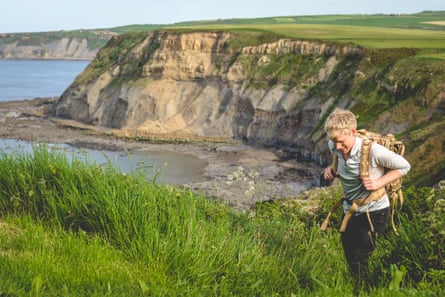
For Myerscough, however, fossil hunting is not just about finding fossils. It is tied to his recovery from a terrifying near-death experience.
In February 2014, he was hiking up Yr Wyddfa (also known as Snowdon) in north Wales when he was thrown off a small cliff during an avalanche. He will never forget the feeling of being airborne, he says, and then being “compressed in the snow” when he came to a halt, unable to tell which way was up. “It was like being cast inside a block of concrete, I couldn’t move any part of my body. I couldn’t move a fingertip.”
He was discovered unconscious, barely breathing, 20 minutes later, buried beneath more than a metre of snow. He had fallen 300 metres.
Badly bruised and shaken but miraculously uninjured, it took him only a few days to recover physically after he was rescued from the mountain. But he found his thoughts returning repeatedly to the accident, the near-misses, the what-ifs.
It was in the aftermath of this experience that he turned to fossil hunting, which he had first enjoyed as a boy during holidays in Whitby on the Yorkshire coast.
It proved to be the distraction he needed to escape his negative thoughts. “There’s this mindful, almost meditative state that I get into because I’m forgetting about all the other stresses and worries in life. I’m so focused on what I’m doing in that moment and what I’m searching for.”
Scanning the rocks for inconspicuous – and often almost imperceptible – signs of fossils takes a lot of concentration.
And there is something he finds particularly soothing about fossil hunting beside the sea. “When I’m there, I feel this connection [to the ocean], imagining this life in the distant past,” he says. “Finding a huge skull full of razor-sharp teeth and an enormous eye from an extinct sea monster from millions of years ago – it’s so exciting.”
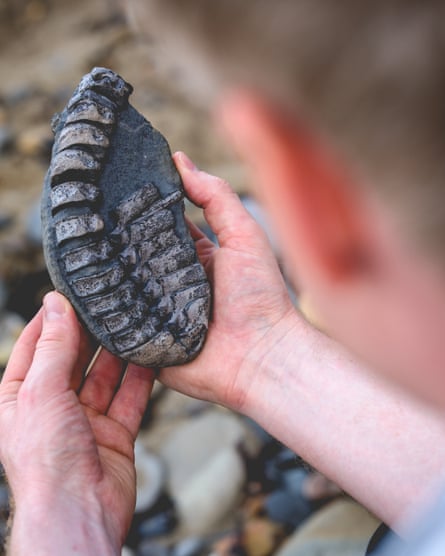
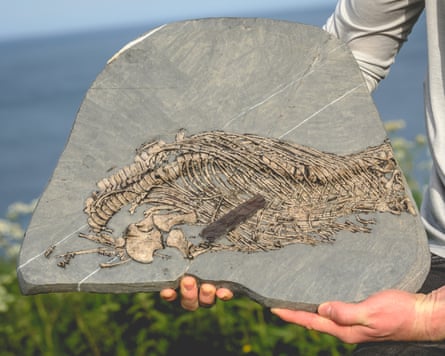
Since he started fossil hunting, he has chanced upon some extraordinarily rare finds, including a plesiosaur flipper, a huge dinosaur footprint and an ichthyosaur forefin and skull.
He details how and where in the UK he discovered each of his “star finds” in his recent book, In Search of Sea Dragons: A Fossil Hunter’s Odyssey.
In doing so, he sheds light on the secretive world of fossil hunting – a world in which most collectors and avocational palaeontologists choose not to reveal the locations of their most exciting and valuable finds, knowing that another important piece of the fossil may one day turn up there after a storm or a cliff fall.
Myerscough, by contrast, wants to share everything he has learned about fossil hunting with the world.
His top tip for those trying out fossil hunting for the first time is to go on a guided tour. “They [experts] can show you [fossils] on the beach,” he says. Once you start seeing fossils, “you start seeing them everywhere.”
But he warns that the pastime can be just as physically demanding as mountaineering. He often carries large rocks or even boulders long distances by foot, as well as different hammers and a chisel. “You can end up with a heavy bag – even if you don’t find many fossils.”
There are also dangers around fossil hunting on beaches, mostly due to unpredictable cliff falls and rising tides. These risks need to be considered and mitigated, he says – for example, by always going fossil hunting on a falling tide.
He also discourages people from going close to the cliffs to pick around in fresh falls, when fossils are more often than not covered in mud. “The best finds are after the sea has cleaned the material, so you can see the sides of the rock.”
Many of the rare fossils he has found were in “well-worn” blocks of rock, he reveals. “Some of them have been on the beach, I’m sure, for decades, rolling around.” He suspects that, after falling from the cliff, they became buried in big banks of shingle or among other rocks, and were exposed as the sea gradually shifted these rocks around.
In this way, he sees fossils as “gifts from nature” and hopes his book will help more people to discover the joy of finding these offerings at the seaside. “The luck of finding these things is just extraordinary,” he says.
“When you think about the events that needed to happen, all those millions of years ago, for something to be fossilised, it seems remarkable. And then for this fossil to be exposed once again on the Earth’s surface, in the cliffs, then on the beach, and then to be found by someone … the odds of all of those things happening seems remarkable, too.”