.png) 3 months ago
85
3 months ago
85
A war engulfing the Middle East has cleared the region’s skies, forcing airlines to make drastic rerouting plans and leaving a massive void in usually busy global airspace.
With Israel and the US bombing Iran day after day – and Tehran responding with waves of missiles and drones attacks – airlines have been forced to divert their passenger jets away from the Gulf or risk a catastrophic accident.
But how did the airspace shut down so quickly and what is the impact on airlines?
How did the airspace close?
The world’s airspace is divided into Flight Information Regions (FIRs), which broadly follow international borders. Governments are usually responsible for the regions above them, providing air traffic services.
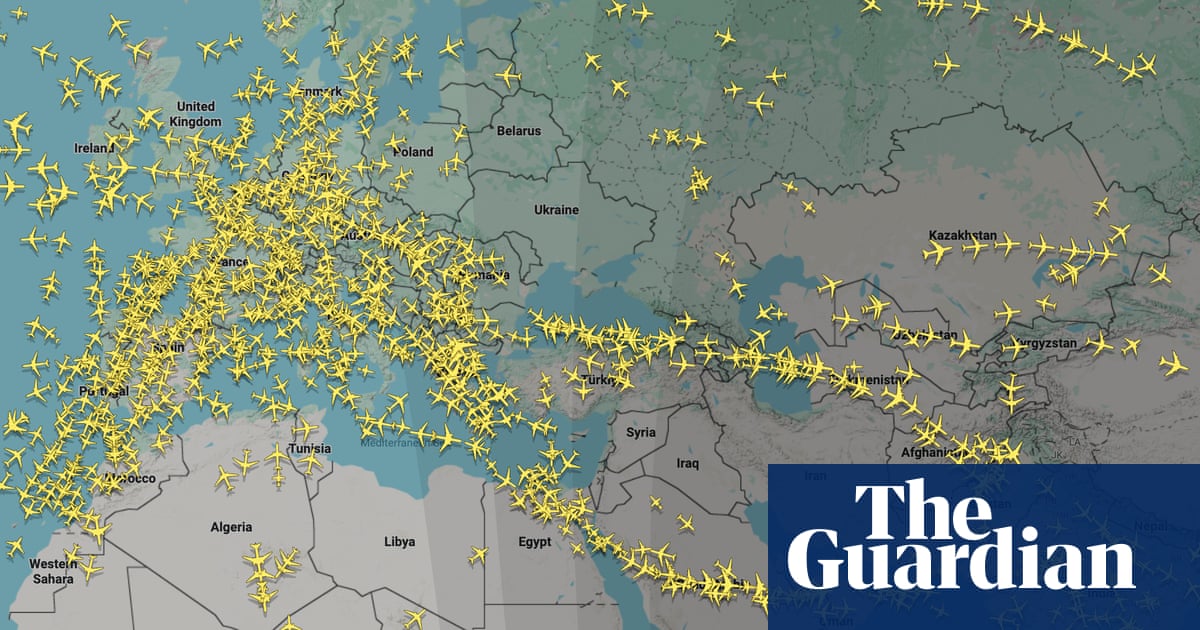
In an extreme situation, like a regional war, authorities will alert aircraft that they are restricting or closing their FIRs by issuing a notification called a Notam, or Notice to Air Missions. Multiple FIRs in the Middle East have been closed since bombing began, creating a 2.8m sq km (1.08m sq mile) gap:
It is not just governments that cause empty skies. Airlines make decisions on where not to fly based on a number of factors, including warnings from the countries where they are registered (such as the UK for British Airways or India for Air India) and whether their insurers will cover a flight over risky areas. Teams of dispatchers constantly monitor events to ensure safe routes.
“In the end, the decision about whether a piece of airspace is safe to fly your passengers through it is that of the airline and the airline’s dispatchers, depending on the level of risk,” says the former British military pilot and aviation expert David Learmount. This explains the situation in the largely empty airspace over Lebanon, which is being pounded with Israeli attacks. While Lebanon’s FIR is not technically closed, most airlines will not risk flying there.
What have airlines done?
The highways in the skies have seen significant changes to major Middle Eastern routes that connect Europe, Africa and Asia.
When bombing began on Saturday, airlines were able to immediately start rerouting, like a flock of birds, as there has been contingency planning for years, in which Middle Eastern routes avoiding certain hotspot countries were already planned out. In many cases, jets would have had these routes pre-programmed into their navigation systems.
Two major rerouting options have emerged for airlines – one that skirts north into the Caucasus but below Ukraine’s closed airspace and the other that funnels air traffic south through Egypt, but also Saudi Arabia and Oman, which are experiencing intermittent attacks.
These corridors are absorbing displaced traffic but it is also creating a chokepoint, which explains why delays and cancellations are building up.
“This problem is not getting better, it’s getting worse,” said Learmount. “You can see the patterns of the way aircraft are going. The northern one is a bottleneck of narrow airspace that routes below southern Russia and Ukraine, and it really entails going through Afghanistan, which is not a very friendly place. Or there is the option of going through southern Saudi Arabia. The airlines don’t really have a choice.”
Why are some flights operating?
Hub airports in the region, including the world’s busiest airport by international transits, Dubai, have been largely shuttered for days. Local carriers Emirates, Qatar Airways and Etihad Airways are deeply affected.
However, limited operations have begun to resume for repatriation and essential transit. This can happen under strict conditions. For example, the Emirates FIR is partially closed, but flights can operate with special permission.
This is why occasional flights can be seen flying in seemingly closed airspace on flight tracking websites. Oman’s airspace is also remaining open, despite several attacks.
What is the impact?
Delays, cancellations and huge financial costs. Here is a graph showing the extent of the impact on major operators in the region:
Steve Fox, the director of operations control at the UK’s leading provider of air traffic control services, Nats, said in a blog post that the “huge black hole” in Middle Eastern airspace is creating a situation in which airlines have “significantly longer routings, flight times and fuel uplifts”. All this costs money and airline stocks have seen a sell-off.
What seems certain, Fox wrote, “is that things will be uncertain for some time to come”.