.png) 3 months ago
76
3 months ago
76
At first glance, Anthony Gordon appears to have little in common with Sir Keir Starmer but, like the prime minister, the Newcastle forward looks infinitely more surefooted on foreign soil than domestic battlegrounds.
In the Champions League, Gordon has scored 10 goals in nine games. In the Premier League, meanwhile, he has managed a modest three in 21 appearances, two of which were penalties. Whether deployed wide on the left or, following a recent positional shift, at centre-forward, Gordon seems emblematic of a wider Newcastle paradox. Just like Eddie Howe’s team, he is irrepressible one match and ineffective the next.
There is a decent chance of Gordon again leading the attack when Newcastle face Qarabag in the second leg of their Champions League playoff at St James’ Park on Tuesday night. Yet although the 24-year-old scored four against the Azerbaijani champions in Baku last week, the blistering pace and remorseless energy of a player ahead of Nick Woltemade and Yoane Wissa in Howe’s attacking thinking camouflages certain weaknesses. Accordingly, Gordon and company may find things less straightforward when Everton visit Tyneside on Saturday.
“I think teams are much more open in the Champions League,” Gordon said recently. “They all try to play proper football, it’s less transitional. The Premier League’s become much more physical than I’ve ever known. It’s so relentless, like basketball. It’s all about running and duels. The Champions League is more of an older style of football; in the Premier League there’s a lot more long throws. It’s a lot more set piece-based now.”
Newcastle are second only to Bournemouth among the Premier League’s most athletic teams. At their ferocious, hard-pressing best they are formidable, but a lack of imagination and incision in possession perhaps explains why they are 11th, level on 36 points with 12th-placed Sunderland. Qarabag walked into Howe’s trap by attempting to play out from the back, but more streetwise domestic rivals often cede possession to Newcastle, sit back and watch them do very little with the ball.
“We’re better out of possession,” Howe has admitted. “Ultimately our preferred way of play is to go for the throat and try to control games with relentless pressing and really good physical performances.”
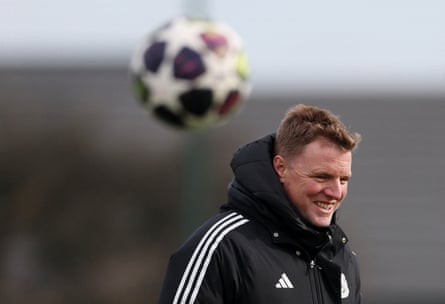
The problem with tactics based on out-of-possession intensity, non-stop running and a general creation of chaos is that the resultant exhaustion leaves Newcastle at risk of burnout. It is also no match for the best manipulators of the ball, which may explain why Barcelona’s Pedri ended up pulling the strings as Hansi Flick’s side won 2-1 at St James’ Park in September.
Howe has certainly evolved from the coach who once regarded Arsène Wenger’s post-Invincibles Arsenal as his ideal template. In more recent times he has instead fallen under the spell cast by two high priests of hard pressing; Bournemouth’s Andoni Iraola and Atlético Madrid’s Diego Simeone. Between leaving Bournemouth and taking charge on Tyneside, Howe visited Spain, shadowing Iraola, then at Rayo Vallecano, and Simeone before deciding imitation really is the sincerest form of flattery.
The 48-year-old was at it again after Atlético visited for a friendly last summer and he noted that, straight from kick-off, they directed the ball long and deliberately into touch near a corner flag. The idea was to concede an opposition throw in an area where they could easily regain possession and create a scoring chance.
When Sandro Tonali duly booted the ball out for a throw during Newcastle’s first Premier League game of the season at Aston Villa, visiting fans gasped in shock; how had a midfielder who invariably places the ball precisely where he wants it miscued so badly? Tonali was under manager’s orders but the practice was abandoned after the Italian and certain teammates argued it was “anti-football.”
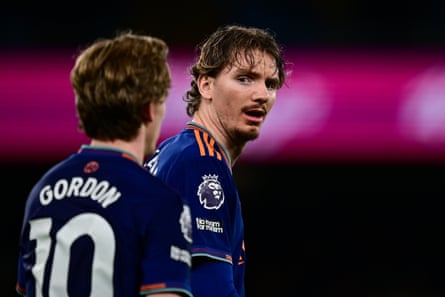
Woltemade is another purist presence in Newcastle’s dressing room. The German’s sure touch, adhesive control and improvisational link play is a joy to watch, but unlike Newcastle’s other forwards he lacks pace and is not too hot at pressing. After scoring five goals in his first eight games after arriving from Stuttgart, Woltemade has only one in his past 17 appearances and has been shifted from No 9 to No 10, and most recently to a left-sided No 8 brief. “Nick plays better between the lines than stretching the lines,” according to Howe, who referred, significantly, to the 24-year-old as a midfielder in his preferred 4-3-3 formation.
Woltemade could yet prove integral to a more considered, tempo-controlling style that might leave Newcastle less fatigued and less injury-prone. Implementing that sort of philosophical switch would be tricky, yet if they are to challenge for the game’s glittering prizes it appears imperative. Whether or not Howe can pull off such a reinvention remains one of football’s most intriguing questions.