.png) 3 months ago
56
3 months ago
56
Hundreds more flights were cancelled on Monday, extending the turmoil in global air travel caused by the US-Israel war on Iran, with hundreds of thousands of passengers already stranded.
Leading airline stocks came under pressure after days of disruption, with Donald Trump indicating that the US military action could last another four weeks.
Major Middle Eastern airports, including Dubai – the world’s busiest international hub – closed for a third consecutive day amid the most acute aviation shock since the Covid-19 pandemic paralysed the industry.
Flights across the Middle East have been cancelled, disrupting thousands of services so far, as international carriers continued to suspend their services.
Early on Monday, 1,239 flights had already been cancelled. Emirates Airlines, based in Dubai; Etihad Airways, based in Abu Dhabi; and Qatar Airways, based in Doha; have collectively cancelled hundreds of flights.
Other carriers cancelled services across the region. Air India cancelled flights on Sunday departing from Delhi, Mumbai and Amritsar for major cities in Europe and North America.
Almost 2,800 flights were cancelled on Saturday, and 3,156 cancelled on Sunday, according to the tracking platform FlightAware.
“For travellers, there’s no way to sugarcoat this,” said Henry Harteveldt, an airline industry analyst and the president of Atmosphere Research Group. “You should prepare for delays or cancellations for the next few days as these attacks evolve and hopefully end.”
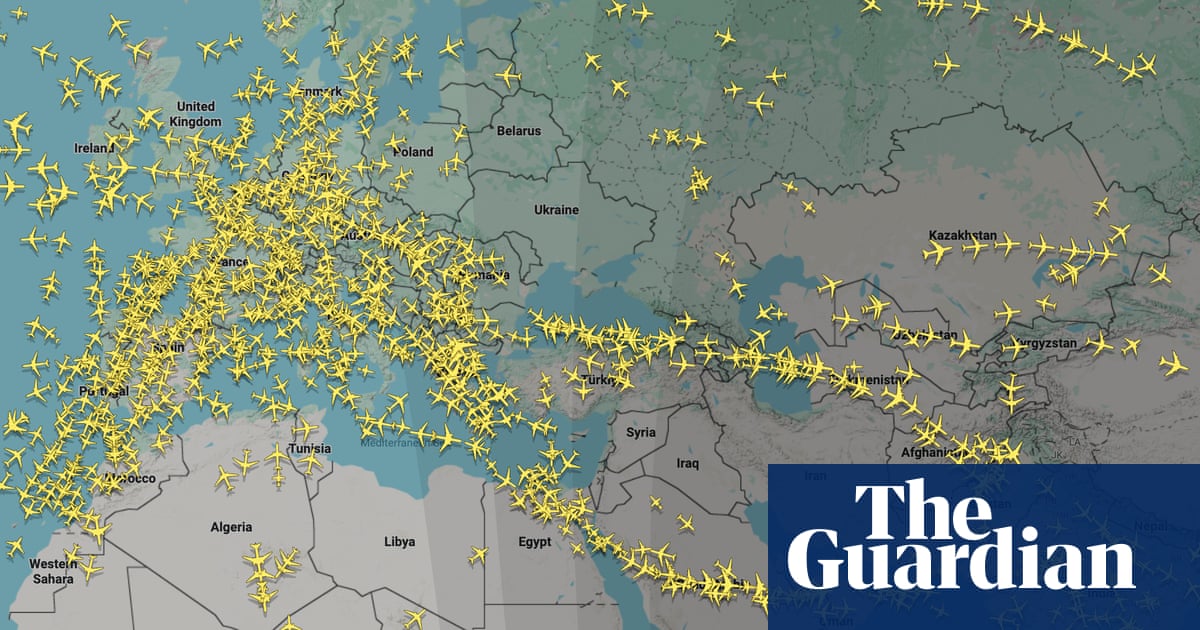
Airspace over Iran, Iraq, Kuwait, Israel, Bahrain, the UAE and Qatar was still virtually empty as of Monday, according to the flight tracking website Flightradar24.
The impact spread far beyond the Middle East, with passengers stranded from Bali to Frankfurt.
Among the most disrupted airlines were:
-
Emirates Airlines, the world’s largest international carrier, which suspended all planned services to and from Dubai until 3pm UAE time (10pm AEDT, 11am GMT and 6am EST) on Monday.
-
Etihad Airways, which suspended all flights to and from Abu Dhabi until 2pm UAE time (9pm AEDT, 10am GMT and 5am EST) on Monday.
-
Qatar Airways, which suspended flight operations because of the closure of Qatari airspace.
As the conflict spread to Lebanon – with Israel carrying out airstrikes on the southern suburbs of Beirut after Iran-aligned Hezbollah launched rockets at Israel – much of the region’s airspace remained closed. Key airports, including Abu Dhabi in the UAE and Doha in Qatar, were shut or severely restricted.
Crew and pilots are now scattered across the world, complicating the process of resuming flights whenever airspace reopens.
As many passengers struggled to find information on the status of planned journeys, gathering at some of the world’s busiest commercial airports amid widespread delays and cancellations, the uber-wealthy found an alternative route out of the Middle East.
“Saudi Arabia is the only real option for people who want to get out of the region right now,” Ameerh Naran, the chief executive of the private jet brokerage Vimana Private, told Semafor, putting the cost of private jets from Riyadh to Europe at up to $350,000.
The region and its airlines have become used to travel disruption over the past few years, but such a prolonged closure of the skies – more than 24 hours – and the shutdown of all three major Gulf transit hubs is unprecedented, analysts said.
The Gulf is also a major intersection for air cargo, putting further pressure on trade lanes on top of disruption at sea.
Shares in Japan Airlines tumbled 5.6%, Singapore Airlines dropped 4.5%, Qantas Airlines fell 5.4% and Cathay Pacific slipped 2.9% as investors contemplated the impact of the Iran war on aerospace industry.
Carriers around the world also face higher oil prices after Brent crude jumped by as much as 13% to hit $80 per barrel, with analysts predicting they could climb as high as $100.
“For everyone the main impact will come through oil prices, which will obviously take a bump upwards,” said aviation adviser Bertrand Grabowski.
Some flights that have run have been rerouted, to avoid closed or restricted airspace. Iranian and Iraqi overflight routes, had grown more important since the Russia-Ukraine war forced airlines to avoid both countries’ airspace.
Middle East airspace closures are now squeezing airlines into narrower corridors, with fighting between Pakistan and Afghanistan adding a further risk, noted Ian Petchenik, the communications director at Flightradar24. “The risk of protracted disruption is the main concern from a commercial aviation perspective,” he said.
AP and Reuters contributed to this report