.png) 1 month ago
58
1 month ago
58
Most people who closely follow British politics probably know the basics about Jaywick, an enclave of Clacton, on the Essex coast. A sprawling tangle of tracks, paths and old holiday shacks repurposed as permanent homes, it has been ranked as England’s poorest area several times since 2011, most recently in October last year.
I first visited in 2014, during the byelection campaign that would see the former Tory Douglas Carswell – remember him? – chosen as the UK Independence party’s first MP. “Look at us,” one man told me. “We’re a backwater no one gives a shit about.” He was one of many Nigel Farage fans I spoke to; in 2024, when local people elected the Reform leader as Clacton’s new MP, many presumably did so with hopes of Jaywick’s neglect coming to an end. I suspect, unfortunately, that Farage’s extra-parliamentary earnings and international gallivanting have rather been giving them the impression that Jaywick remains a backwater no one gives a shit about.
But no more. When Farage addressed the public on Tuesday via a Reform UK-operated video feed, after 15 minutes of self-defensive rambling, he had big news: in the wake of the circus-like Makerfield byelection, the people of Jaywick – along with those resident in such seaside communities as Frinton, Walton-on-the-Naze and Clacton itself – are to be given the honour of voting in a bizarre, equally circus-like contest triggered by Farage’s decision to resign as an MP and seek a new mandate.
I am not quite sure how to summarise the logic at work here: a phrase like “self-serving tomfoolery” probably suffices. But the Reform UK leader seems to envisage the people of his constituency being, as much as electors, jurors – who will somehow be adjudicating on the mounting pile of investigations and allegations that have put Farage and his party in a position they are really not used to: on the back foot, having to answer questions that they clearly find very uncomfortable.
From the top, then. The standards watchdog is still investigating the £5m personal “gift” given to Farage by the Thailand-based cryptocurrency investor Christopher Harborne, which Farage first said was to cover his personal security costs and therefore did not need to be declared to the parliamentary authorities, before then claiming it was a “reward” for campaigning for Brexit. Thanks to an exhaustive investigation by the Sunday Times, there are now serious questions about Farage’s longstanding – and very close – ties to the convicted wire fraudster and digital-currency betting entrepreneur George Cottrell, who he reportedly recruited and who paid three staff to work on Farage’s social media output before the last general election; Cottrell also offered Farage the use of a five-storey Georgian townhouse he rented near Buckingham Palace, and has acted as his loyal aide and adviser for well over a decade.
There are other very serious allegations that may soon join these two stories. The Labour MP Phil Brickell has referred Farage to the standards watchdog over a meeting he had last September with the governor of the Bank of England during which, Farage has freely admitted (or rather boasted), he fiercely argued against that institution’s apparent plans for a BofE digital currency already known as Britcoin. “I’m prepared to go to prison to stop us having [it] administered under digital ID,” he told the crowd at a huge cryptocurrency convention in London. “That is how committed I am.” Brickell, whose professional background lies in monitoring dirty money and corruption for UK banks, argues that this might be interpreted as lobbying on behalf of Harborne, who owns a sizable stake in the huge digital currency Tether, and would presumably not take kindly to such a powerful competitor.
All this, Farage either directly says or heavily implies, is simply the work of a decayed elite who cannot beat him politically, so have reverted to “foul means”. Into his stew of outraged victimhood – and I may miss a few gripes here – he has also added complaints about public spending on his security, fury about the Times’s publication of a photo of the house where his daughter lives and Sky News’s alleged harassment of his family (which it firmly and strongly denies), and grievances over death threats that he claims the police have repeatedly ignored. In his incandescent ire, he has thus arrived at a simple formula: “a people v the establishment byelection”.
What will ensue? At the time of writing, the Lib Dem leader Ed Davey had called for all parties to join him in boycotting what he says is a “vanity project”, and there were also strong rumours that the Labour party will not take part, so the whole scheme may be rendered borderline meaningless. Whatever happens, thousands of people agreeing with his outrage and voting for him once more? I dare say that is probably the most likely outcome: his majority in 2024, after all, was 8,405. But especially in the context of Farage’s lucrative outside jobs and insatiable appetite for luxury and international travel, it would be nice to imagine at least some of his opponents convincing the Clacton electorate that Farage has a number of very grave cases to answer, and that they ought to understand the world in which he moves.
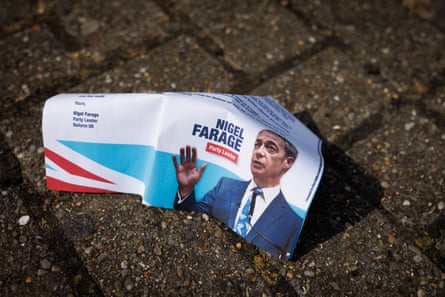
To do so is to peer into a milieu that is a long way from Clacton’s shabby seafront, Jaywick’s former chalets and the dire neglect they embody. It revolves around huge amounts of money in the form of cryptocurrencies, firms registered in the usual tax havens and constant lobbying for governments to roll over and let digital anarcho-capitalism run riot. Cottrell is the embodiment of a new political stereotype: mini-Musks, jostling for status and recognition from older, more powerful men (they are always men), and in the process, doing some entry-level empire building themselves. And the understanding of politics among everyone involved is not about deep values or beliefs – or, for that matter, anybody but themselves.
after newsletter promotion
Yet Farage knows he and his friends face an increasingly hostile environment. This week, the government announced a milquetoast £100,000 limit on donations from anyone who moves to the UK from abroad for a year after they have done so (why not just make that cap universal?), as well as new checks on companies making political donations: looking at their profit as well as revenue, which should prevent corporate donors registering in the UK in order to meet the demands of electoral law while channeling their profits abroad. In March, a moratorium on crypto donations was announced. Farage, unsurprisingly, says all this is part of an authoritarian, woke dystopia akin to “a communist country”.
And so we arrive at a truly surreal prospect: the Reform UK leader – whose pitch, judging from what he said, now seems have shifted from his old raw populism to “vote for me, I know how to make loads of money” – seeking re-election and absolution from a lot of people who barely have a thing. Whether he wins or loses, those standards investigations will continue and possibly expand. But if he does triumph a question will remain, which may fascinate the proverbial future historians: how did such politicians get away with styling themselves as tribunes of the people while living lives and keeping company that embodied the complete opposite?
In Jaywick, life goes on. When it was last declared the poorest area of England, a Guardian report described it as “an exemplar of economic neglect, austerity and social breakdown, compounded by geographic isolation”. Farage, for what it was worth, offered the somewhat trite observation that it was “obviously sad that things aren’t improving more quickly”. According to a BBC report, he said he felt he had helped with investment and tourism in the area, but continued: “There’s a limit to what one person can do.” If he was honest, he would put those words on his election literature, accompanied by some others: “Particularly when they seem to be much more interested in backing the interests of people rich beyond the dreams of avarice.”
-
John Harris is a Guardian columnist
-
Do you have an opinion on the issues raised in this article? If you would like to submit a response of up to 300 words by email to be considered for publication in our letters section, please click here.