.png) 1 hour ago
5
1 hour ago
5
“The mystery of time,” muses William Shatner, and for a moment we are back on the bridge of the Starship Enterprise listening to one of Captain Kirk’s philosophical tag-line speeches. “Not just the passage of time and our perception of it, but what is time? What does 60 years mean? It really is meaningless, isn’t it, 60 years, in terms of what time is? On the other hand, Dolly Parton just died. It brings up the whole concept of the passage of time and what that means.”
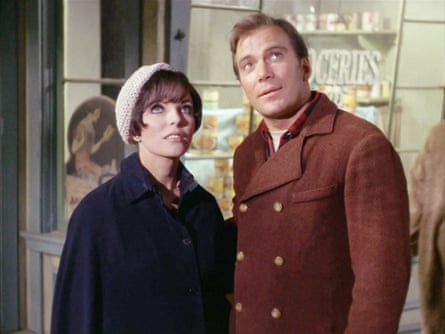
In an episode called The City on the Edge of Forever, Shatner’s Kirk travelled back in time and fell in love with a pacifist (Joan Collins) only to discover that she must die to prevent Nazi Germany winning the second world war. Such ethical quandaries help explain why Star Trek will celebrate its 60th anniversary on 8 September not just as a force in US culture but a mirror held up to the country’s politics.
Born in the idealism of the 1960s, the show offered a utopian vision of the future in which humanity sought to explore rather than conquer. Diversity, empathy and reason had triumphed over tribalism, superstition and greed. Big government and big tech were liberators from scarcity and inequality. Star Trek’s fans included Martin Luther King and his wife, Coretta, who said it was the only programme they allowed their little children to stay up and watch.
But six decades on, the Enterprise is encountering some cosmic turbulence. Donald Trump’s America is convulsed by polarisation, culture wars and the retreat of liberal democracy, along with anxiety over artificial intelligence and climate catastrophe. Paramount, merged with Skydance Media for $8bn, promptly cancelled the latest Star Trek series amid claims that it was too “woke”.
The rightwing complainers yearn for a return to the days of Iowa-born Captain Kirk, who fits their conceit of an all-American hero, even though Shatner is Canadian. When he was hired in 1965 after NBC rejected Jeffrey Hunter’s dour pilot performance as Captain Pike, he brought an athletic, theatrical charisma that lifted the cerebral storytelling.
“I saw the film and I thought it was really interesting, a little ponderous,” Shatner, a sprightly 95, recalls of the original pilot via Zoom from his home in Los Angeles, with his dogs sleeping nearby. “So I suggested maybe a lighter touch, and we made another pilot and it sold.”
That lighter touch did not prevent Shatner from making history. In 1968, he and Nichelle Nichols, who played Lt Nyota Uhura, shared television’s first high-profile scripted interracial kiss in the episode Plato’s Stepchildren. Was he aware of its groundbreaking importance?
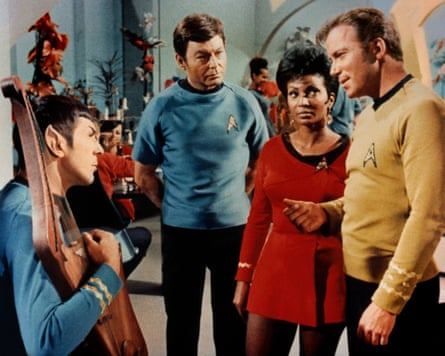
“I was told,” he says, sounding reluctant to be cast as a civil rights activist. Shatner muses about “infrequent hates” that are “dramatised by documentary filming” to shock audiences and contends: “The vast majority of us just want to live and have your barbecue and live in peace and quiet and go do what you want to. You believe what you wanna believe and, if you don’t bother me, I won’t bother you. I think most people want to do that and if we could elevate those people to express themselves more, we’d discover that humanity really just wants to be human.”
Star Trek is still pushing boundaries, much to the chagrin of unlikely fan Stephen Miller, the deputy White House chief of staff and driver of Trump’s extremist immigration policy. In January Miller cited a social media account called End Wokeness that mocked the newest Star Trek series, Starfleet Academy, as “Beyond parody”. Miller himself wrote: “Tragic. But it’s not too late for @paramountplus to save the franchise. Step 1: Reconcile with @WilliamShatner and give him total creative control.”
Shatner laughs at the idea of White House aides spending their days picking holes in Star Trek. “Can you imagine they’re watching TV, criticising TV. I mean, it’s bizarre! I don’t understand it. I don’t know why they don’t – I don’t want to be political. I’m Canadian in America but it’s enthralling.”
He rejects Miller’s notion that Star Trek’s inclusiveness has gone too far. “I don’t know what going too far is. Where’s the demarcation line? Who drew that line? ‘Now you’ve gone too far.’ Excuse me, I didn’t realise that. Where should I have stopped? And by the way, what is ‘woke’?”
In creator Gene Roddenberry’s 23rd-century vision, nation-states no longer exist and planets have banded together to form a sort of United Nations in space. Poverty, disease and hunger have been eradicated, currency has largely disappeared from Federation life and citizens pursue self-improvement rather than private accumulation. To some, it might sound like John Lennon’s Imagine. But others would rather not imagine it.
In 2017 the billionaire investor Peter Thiel told Maureen Dowd of the New York Times: “I like Star Wars way better. I’m a capitalist. Star Wars is the capitalist show. Star Trek is the communist one. There is no money in Star Trek because you just have the transporter machine that can make anything you need. The whole plot of Star Wars starts with Han Solo having this debt that he owes and so the plot in Star Wars is driven by money.”
Shatner, who travelled into space for real aged 90, sounds wryly amused. “Peter Thiel must be a very bright, creative man, full of opinions and he’s made a lot of money which should indicate he’s very self-sufficient and has ideas. He talked about money. Well, that’s one aspect. You need money to live. But you need other things as well and the other things are represented by Star Trek. I’d love to talk to him. I’d love to get into a discourse on the differences between Star Trek and Star Wars.”
One difference has been articulated by Shatner’s friend, the astrophysicist Neil deGrasse Tyson, who argues that Star Trek adheres more closely to real science. Another can be traced to the franchises’ origins: whereas Star Wars draws on the classic hero myth outlined by scholar Joseph Campbell, Star Trek was forged in the horrors of the mid-20th century.
Roddenberry was a decorated second world war bomber pilot who later survived a harrowing commercial plane crash in the Syrian desert. His writing partner Gene Coon had served in the marines and received training as a war reporter during the Korean war era.
Mark Altman, co-author of The Fifty-Year Mission and director of a new documentary, The 60-Year Mission, says via Zoom from Los Angeles: “Their approach to Star Trek was they had lost a lot of friends and had seen war up close and they didn’t romanticise it. They knew the cost of war. They weren’t changing the name of the Department of Defense to the Department of War. They loathed war.
“That’s something I find shocking, these deeply conservative fans like Stephen Miller say, ‘I’m a huge fan of Star Trek.’ How is that possible? Did they miss the memo that in reality, Star Trek abhorred war, and it always said that talking is the way to resolve conflict?”
Nowhere was that clearer than in the 1967 episode Arena, in which Kirk refuses to execute the monstrous Gorn that has obliterated a Federation outpost. “Kirk makes this decision not to kill this alien creature that has annihilated our base and killed his friends,” Altman notes. “Some people look at it and say, ‘Oh, it’s this goofy monster in a suit.’ But there’s a reason an episode like that becomes so iconic: it’s the message as well as the visuals.”
Viewers in the late 1960s were accustomed to all-white TV westerns. On Star Trek, they encountered a meritocracy: an African American woman, Nichols’s Uhura, answering communications with unflappable authority (she was poised to quit after one season but King persuaded her to stay); George Takei’s Sulu piloting the flagship barely two decades after Japanese Americans had been interned; and an alien second-in-command, Leonard Nimoy’s Mr Spock, acting as what Altman calls “the ultimate immigrant”.
Altman points out that this integration extended beyond the main bridge crew: “What about the diversity in the guest characters? In one episode you have Captain Kirk answering to his superior, Commodore Stone, played by the late Percy Rodriguez. Many years before Colin Powell, Kirk is answering to an African American who’s his boss. That stuff resonates too.”
The original series ran from 1966 to 1969, crashing headlong into the Vietnam war, racial violence and the assassinations of John F Kennedy, King and Robert F Kennedy. Animated series and films followed. Then came The Next Generation (1987–1994), starring the Shakespearean actor Patrick Stewart as Captain Jean-Luc Picard, Deep Space Nine (1993–1999), Voyager (1995–2001) and several subsequent iterations.
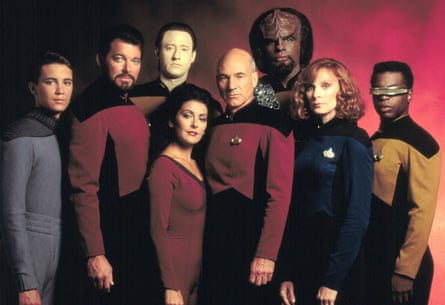
Altman regards Kirk as an analogue for John F Kennedy, the young president who had pledged to reach the moon before the decade was out. “The final frontier is the New Frontier. Kirk is very much a Kennedy-esque liberal. He’s liberal on social issues but more hard-nosed on defence. It’s more of a traditional moderate than what we see with democratic socialists today. It’s a meritocracy; it believes everybody needs to start from the same starting line but then it’s about your gifts and you have ability.
“But if you look at The Next Generation, it’s a very George HW Bush vision: consensus-building, a thousand points of light. Kirk has a line: ‘When this becomes a democracy, I’ll let you know.’ Picard was more of a consensus builder who had a lot of meetings to get a lot of input from people. It was more of an HW Bush thing.
“You can extend that to a lot of Star Trek shows which were clearly influenced, if not necessarily by the president, by the tenor of the times. Deep Space Nine was heavily rewritten in the aftermath of the Los Angeles riots and the beating of Rodney King. It was all about rebuilding and asking, can’t we all just get along? It has one of the great Star Trek quotes: ‘It’s easy to be a saint in paradise.’ When you’re on a starship and everything’s great, it’s easy to be a saint in paradise. But on a station, there’s more of a struggle and more conflict.”
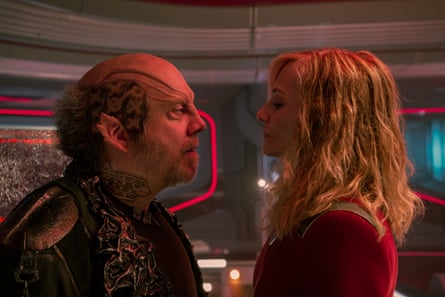
The latest series, Starfleet Academy, starred Oscar-winner Holly Hunter as the captain and a chancellor alongside Paul Giamatti as its central antagonist. The show boasted the largest and most expensive physical set in the franchise’s history. Set in a distant future where young cadets rebuild the Federation following an apocalyptic event, it was designed as an allegory for institutional renewal.
But following Paramount’s merger with Skydance, which is led by David Ellison, who is the son of Trump ally Larry Ellison, Starfleet Academy was cancelled, with its forthcoming second season set to be its last. Miller had been joined by tech billionaire Elon Musk in a Maga pile-on denouncing the show’s alleged wokeness.
Altman is scathing of the rightwing crusade. “How can you criticise Starfleet Academy on the ground that it’s too diverse? It’s absolutely ridiculous, and particularly if you’re someone who’s claiming to be a Star Trek fan who needs to understand that diversity is in the DNA of Star Trek.
“Diversity as a strength is something that’s celebrated as a through-line in all the Star Trek series. The series can be very different but one thing that has never changed from 8 September 1966 is the value of diversity in making these crews stronger. If they were all homogeneous, they would not be able to as effectively deal with the challenges they face in the cosmos.”
That sentiment is shared by the veteran actor Robert Picardo, who spent seven seasons playing Voyager’s Emergency Medical Hologram and reprised his role in Starfleet Academy. Speaking by phone, the 72-year-old does not mince words: “Let’s face it: when someone that high up in the administration and also Elon Musk piled on the same day, do I think it’s a coincidence that the new owners of Paramount cancelled our show the first moment they could have? We did not get a fair shake. We were killed in the cradle.”
Picardo adds: “Yes, there was the fact that we had a gay Klingon. Did a lot of people get over-exercised about that? My feeling is, get over yourself! There seems to be a movement to drive us back to the 1950s. Star Trek is all about the future, not about returning.
“In that climate the core values of Star Trek – science and also diversity and inclusion – are going to get lumped in with what is under attack. Some people say, do you feel that it was at all current politics that had to do with your cancellation? If we caught the same flu that Stephen Colbert and the editorial freedom of CBS 60 minutes caught then we’re in excellent company.”
If Star Trek’s social politics were prescient, its engagement with science and technology was frequently uncanny. Decades before smartphones, tablets, automated doors and voice-activated digital assistants, the Enterprise was operating with personal access display devices, communicators and talking mainframes. But it also interrogated the ethics of innovation.
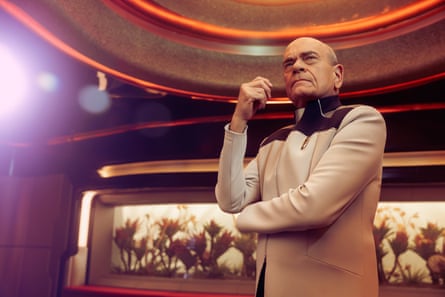
For Picardo, who spent seven years embodying a holographic doctor wrestling with sentience and civil rights on Voyager, current debates around Silicon Valley’s generative AI boom feel oddly familiar. “The explosion of the technology and the pace at which it is happening is something nobody could have predicted.
“It’s a useful tool but it’s raised all sorts of issues. We actually did episodes on Star Trek where my character wrote a book and then there was the question of whether an artificial intelligence could have intellectual property rights. We did the whole issue of whether an artificial intelligence can have an original idea or if it can only slice and dice human ideas scraped from the internet, from everything ever written.”
Sixty years on, Star Trek’s faith in a United Federation of Planets that has outgrown bigotry, racism and nationalism feels perversely quaint in an era that has seen Trump champion “America first”, deride the UN and denigrate the very concept of empathy. The show, whose future is uncertain as Paramount’s new owners focus on a proposed $110bn acquisition of Warner Bros, offers utopia in a time of dystopia.
Picardo observes: “Post-9/11, a lot of science fiction has become very apocalyptic. It’s in some hellscape future with a few straggler survivors and Star Trek is the opposite of that. But to me, the biggest damage that’s been done in current politics is the destruction the idea of truth or that there is such a thing as a fact and our word does matter. I worry about Star Trek’s survival in a post-truth, post-literate world.”