.png) 3 months ago
77
3 months ago
77
It is the image that will forever define the 2026 Winter Olympics: a Ukrainian skeleton racer, stoic and unbowed, holding a helmet bearing the faces of 24 athletes killed by Russia. Behind him, the icy track serves as a reminder of the dreams he sacrificed for a greater purpose.
It was an extraordinary act of bravery and defiance, which carried the tremors of Tommie Smith and John Carlos’s civil rights protest in 1968. But in his first in-depth interview since being disqualified from the Milano Cortina Games, Vladyslav Heraskevych makes one thing clear: he has unfinished business with the Olympics.
He doesn’t just intend to race when the Games return in the French Alps in 2030. He also plans to win a gold medal wearing the same “helmet of memory” that got him banned this month.
“I deeply love the sport of skeleton,” he says. “And I want to come back and compete in the Olympics. First of all, we need to appeal in another court which is not under control of the International Olympic Committee. Our goal is to win this case. Then I want to come in Olympic competitions with the same helmet. And, of course, to win a gold medal.”
Heraskevych is now back in Kyiv after a tumultuous fortnight during which he made global headlines, was awarded the order of freedom by Ukraine’s president, Volodymyr Zelenskyy, and was gifted $200,000 by Rinat Akhmetov, the Shakhtar Donetsk president – equivalent to the amount given to Ukrainian gold medallists at an Olympics.
Many also praised his heroism, but Heraskevych is quick to dismiss the idea that he deserves special praise. “I’m not a hero. I don’t believe I did something heroic. Of course, I’m very thankful for all of the support. But I believe the people on the helmet are the heroes. There are kids there who were not able to have an adult life. But it’s because of them the whole world is talking about Ukraine, not me.”
The $200,000, he stresses, will be put into a charity foundation to help Ukrainians. And he isn’t seeking fame either, despite becoming an overnight cause célèbre. “It was a strange experience. But I was in such a tornado that I didn’t really have time to pay attention. I really only felt it when we were driving from Milan to Munich. We were at a petrol station, and people started to recognise me.”
Now he has had time to draw breath, Heraskevych also wants to set the record straight. In particular, over the idea that he was helped by a global PR firm – a rumour that was circulated in Olympic circles. The reality, he says, was very different and it was the intransigence of the IOC that turned an act of remembrance into a global news story.
“I’m not a worldwide superstar. I’m not in a PR world. And when all this started, you couldn’t predict that the IOC would disqualify me with no real reason from the Olympics.”
As Heraskevych explains, he decided to honour 24 Ukrainians who had died in the war only three or four weeks before the Games. “Many of them I knew personally. So it was important to bring them with me, because at some point of their lives, it was their goal to be at the Olympics too.”
As he points out, he had paid similar tribute during the 2024-25 skeleton season. After the Ukrainian activist Pavlo Petrychenko died on the frontline, Heraskevych honoured him by putting one of his quotes – “all beautiful people remain optimistic” – on his sled.
Heraskevych also says that he had just signed a contract with Visa, one of the IOC’s main sponsors, and believes he would have faced “crazy court cases” if he deliberately caused trouble. “If the IOC want to blame anyone for this scandal, they should blame themselves. If I had a PR campaign, it was the IOC who were my PR company.”
Heraskevych also bristles when reminded that the IOC partly justified his disqualification by saying that there were 130 conflicts going on during in the Olympics during the actual competition and it couldn’t allow them to be featured on the field of play.
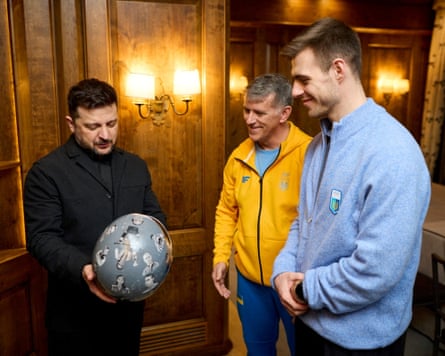
“My helmet wasn’t showing any violence, just drawings of athletes” he says. “There was no Ukrainian flag. There were no Ukrainian symbols.
“Certainly, we have many conflicts in the world and many hard situations. But at the same time, conflict can be measured by victims and destructions. And sometimes in Ukraine we have more victims in one day than other conflicts altogether.”
With that Heraskevych takes me back to his dramatic last‑ditch meeting with the IOC president, Kirsty Coventry, in Cortina just minutes before he was disqualified from the Games. She left the meeting in tears. Heraskevych departed with his Olympic medal hopes crushed.
So what happened when they met face to face? “We talked in a pretty respectful manner, both of us,” he says. “But when we prepared for my court case at the court of arbitration for sport we found out the decision about my disqualification was made the night before.”
At that meeting, Heraskevych expressed his frustration that another athlete at the Games had competed wearing a Russian flag from the Sochi Games – one of several from different Olympics visible around his neck – while many Russian fans in the stands did not have their flags confiscated.
“It seems like the IOC plays alongside with Russia and I told her that I believe it’s not right,” Heraskevych says. “They have actions with no consequences. So why do you have some special treatment on me?”
The IOC had allowed him to practise in his “helmet of memory” and allowed him to wear a black armband in competition. So what would have persuaded him to compete? “I asked Coventry to allow me to use this helmet,” Heraskevych says. “And then, if you need to, you can change the rules afterwards. Because I didn’t violate any rules.”
There was another request he made, which he believes would have painted the IOC in a good light. “If you don’t want to look like an organisation who plays alongside with Russia please provide some support,” he says he told Coventry. “In Ukraine we have a pretty bad situation with electricity. So give some electric generators, and then I think it’s a win-win situation, because you show solidarity with people. Don’t give it to the government – but people, athletes or sports facilities.
“It plays alongside with Olympic values, because it’s about peace and about friendship. It would provide support in a tough situation. And you will have a better image as an organisation. But then I was disqualified.”
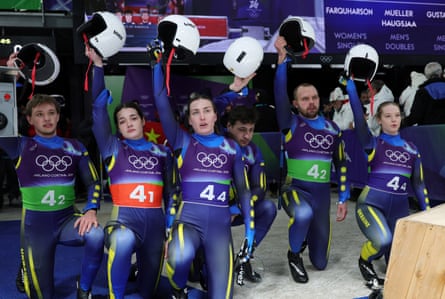
A few weeks ago when I interviewed Heraskevych for a preview of the Games, he told me the Ukrainians had been warned by the IOC not to protest at Milano Cortina. He didn’t want to elaborate further. Now, though, he is willing to share more details. “I was told that if we had some protest or something similar, then the whole Ukrainian team could face disqualification. It wasn’t said straight to me. But another organisation in between us.”
Our latest interview is conducted on the eve of the four-year anniversary of Russia’s invasion of Ukraine and Heraskevych still vividly remembers being woken up around 5am by explosions and the chaos that followed.
“The first days were so scary. We didn’t have a stable or consistent source of news. It was just chaotic. You’re sitting there and you don’t understand what’s going on. Are Russian troops here already or not? When you hear this explosion, and then you see rockets and rocket attacks. It was a really terrible feeling. You realise that your life and everything you have achieved, it means nothing.”
Days before the 2022 invasion, Heraskevych held a sign while competing at the Beijing Games that said: “No war in Ukraine.” Soon afterwards he was urging governing bodies to ban Russia. It is a message he still emphasises, just over a week away from the start of the Winter Paralympics in Milano Cortina.
It will be the first Games where Russian athletes will be allowed to compete under their own flag and anthem since Sochi 2014. The decision, which was taken by the International Paralympic Committee last September, clearly horrifies him.
“It’s a big mistake,” he says. “Pavel Rozhkov, head of the Russian Paralympic Committee, has stated that there are 300 Russian Paralympic athletes who were former soldiers in this full‑scale war in Ukraine. So we may have a situation where former soldiers are competing in Italy under their own flag. Basically, they were killing Ukrainians on the frontlines and now they will kill them as a propaganda instrument.”
So what should be done? “At a time when we have so many victims, it’s just such a wrong thing to do. So I believe the international community should create a coalition and boycott the Games if Russia and Belarus athletes are able to compete.”
Before Heraskevych was barred from the Games I was texting him regularly and it was clear that he was utterly determined to do the right thing. But with the benefit of hindsight, does he have any regrets?
“Of course, I’m sad that I couldn’t compete. I was in the best shape of my life. But I couldn’t betray these athletes. If I did, I would regret it for my whole life. And I believe the whole world understands that it was an unfair disqualification. I think I did the right thing. I don’t have any regrets.”
Before I say goodbye, Heraskevych wants to impart one more message of wisdom: it is the simple things, not money or medals, that we should care most about. “War is a great reminder about what really matters. Sometimes in the modern world of social media, people chase the wrong things. Expensive cars. A fancy life. The things that really don’t matter.
“After the war started, the happiest thing was just to see your friends in a good health, to hug each other, and to know your family members were OK.” He pauses. “This is what is really important, not material things.”