.png) 4 hours ago
6
4 hours ago
6
On 4 October 2024, Justin Broadrick felt a pop. The singer and guitarist of pioneering industrial metal duo Godflesh had felt pain in his groin for several years. After a coughing fit following a show in Sofia, Bulgaria, he knew he had a hernia. “It was a small knob in my groin,” says Broadrick. “I got back home and told my partner, and she was like, ‘Let’s watch how it goes.’” He continued to perform live for another year, wearing up to two hernia belts at a time. By the time he got it surgically treated in February this year, it was 13cm long.
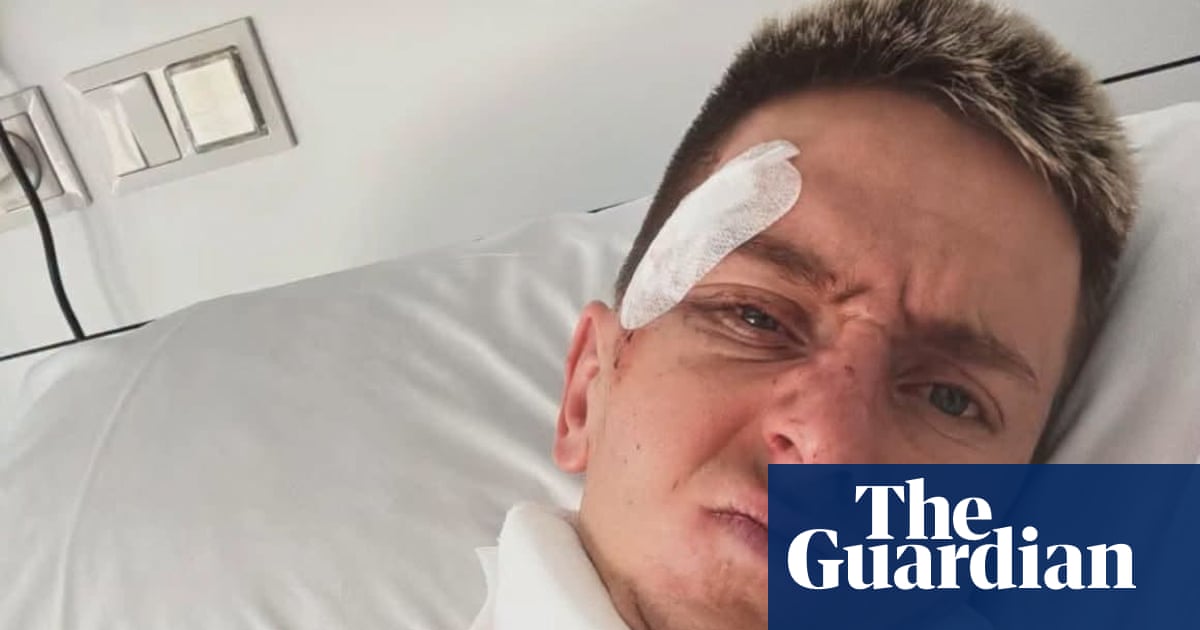
The next month, Broadrick shared a picture of himself in hospital and announced that Godflesh’s near-four-decade career will soon end. His condition had been caused by the physicality of shouting over their music since he was 18; he just turned 57. If he were to do so again, he would risk blowing out his abdominal wall entirely. There will be two more studio albums – starting with this autumn’s reliably crushing Decay, recorded pre-surgery – and possibly some archival releases and remixes. But beyond that? Nothing.
“I’m still in a lot of discomfort, even now,” says Broadrick, talking to me by phone in mid-August. “I’m not the toughest guy in the world, I’m very sensitive to pain, so it’s going to be nine to 12 months [after surgery] before potentially feeling no negative sensations whatsoever.”
Broadrick received support from all over the heavy metal world, including current or former members of Megadeth, Slipknot, Fear Factory, Neurosis, Sunn O))) and Killing Joke. It was just a small glimpse of the impact Godflesh have made. When Broadrick and bassist Ben “GC” Green formed the band in 1988, their cacophonous beats, programmed on a £500 drum machine, were unprecedented in the genre. Broadrick’s riffs were immediate, dense and unsettling. From top to bottom, they were the heaviest band ever.
Metallica were fans: guitarist Kirk Hammett got Andres Serrano to design their Load and Reload album covers after Broadrick showed him a Godflesh video directed by the provocative artist. Mike Patton praised them as “ridiculously heavy” and invited Broadrick to audition for Faith No More in 1993. He turned the offer down. “There’s no way I can join someone else’s band,” he reasons today. And many of nu metal’s frontrunners idolised Godflesh. Founding Slipknot drummer Joey Jordison once blared their music during an interview at his house; when Broadrick first heard Korn’s debut single Blind, he thought: “I quite like it, but it sounds like Godflesh meets Faith No More.”
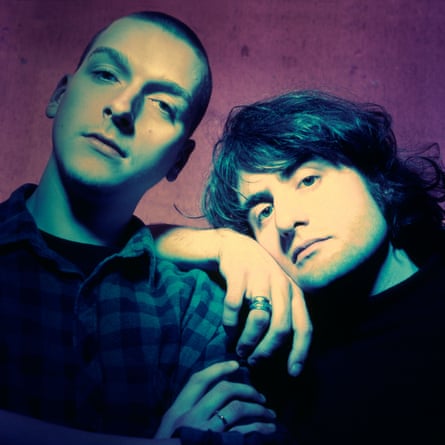
Despite his widespread influence, Broadrick eschews the limelight. Born in Birmingham, he now lives with his partner, 15-year-old son and many, many pets in a north Wales village so remote that it doesn’t have as much as a pub. He avoids social situations, rarely granting interviews, but gives long, sometimes meandering answers. He says that these are symptoms of his autism, which went undiagnosed until 2022, when he was in his early 50s.
“I’m generalising, but the psychiatrist pretty much said to me that there are two types of autistic people,” he explains in his undiluted Brummie accent. “A lot of people who used to get diagnosed with Asperger’s generally have the cold, don’t speak, sit-in-a-corner type of autism. My autism is the other one, where, they said, people can get hyperemotional and hypersensitive and talk all the time, trying to get themselves understood.”
Broadrick’s hypersensitivity shaped Godflesh’s music. Their beats echo the clanging he heard from nearby factories while growing up on a council estate, and his anguished shouts and misanthropic lyrics are rooted in childhood trauma. His mum and stepdad were punk musicians who hosted wild parties with drugs and alcohol while he was home. “I was exposed to all manner of shit,” he says, “but at school, I was totally isolated. I couldn’t communicate with kids. I was virtually mute. Two very different, polarising existences there. As soon as I became obsessive about music at the age of eight, that’s all I could communicate about.”
He began making music under the pseudonym Final when he was 13. At 15, he walked out of his first exam and never went back to school. After meeting Nicholas Bullen of West Midlands grindcore agitators Napalm Death at a market, he joined the band and wrote “90%” of the music on side A of their debut album, Scum. It became a cult classic, inspiring a legion of copycats. The 1.3-second track You Suffer holds the Guinness world record for the shortest song ever recorded.
Come the release of Scum in 1987, however, Broadrick had already grown bored and left. “I love what we created, but I felt restricted. We said, ‘Let’s play as fast as we can.’ I remember saying to [drummer] Mick Harris, ‘Faster! Faster!’, and he was laughing, and we just got faster and faster. It was very momentary – very temporary, almost.”
In 1988, Broadrick and Green, who grew up on the same estate, started Godflesh. They were both signing on at the time, and talked Green’s mum into taking out a bank loan to cover that £500 drum machine. Their formula of playing distorted guitar over huge beats was inspired by Run-DMC’s single King of Rock, which Broadrick heard on The Old Grey Whistle Test. The angular riffs were pulled from Killing Joke, while the discordance and rhythmic vocal patterns evoked early Swans. That unique blend resonated widely, getting the pair off the dole “relatively quickly”. Their 1989 debut album, Streetcleaner, was released by popular death metal label Earache (then also home to Napalm). After initially only reaching No 19 on the UK indie chart, it became a sleeper hit and seminal release.
Godflesh proved especially popular in the US, where they scored their breakthrough by supporting Napalm in 1991. However, the tour triggered Broadrick’s hypersensitivity. From his first gig, he had used drink or substances to cope with the sensory overload of performing. Still, he had to play. Music is the only job he’s ever had, and, “among the distress and the feeling of wanting to fucking kill everyone, there is transcendence”, he says.
“I hated the overwhelm, everything about it. Two-and-a-half months, that fucking tour! I spent two-and-a-half months trying to get off,” he admits. “But here’s the thing: you could tell we were being exposed to a metal audience that had never experienced anything like us.”
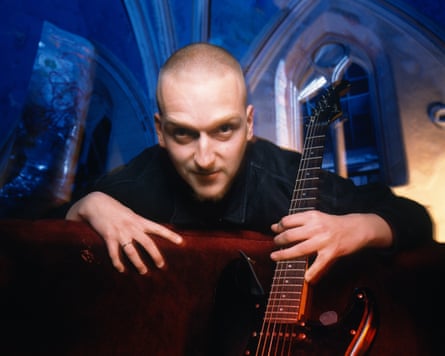
Thanks to a deal by Earache, Sony-backed juggernaut Columbia Records agreed to distribute Godflesh’s 1994 album Selfless in the US. But then MTV banned the Serrano-directed Crush My Soul video – not only did it contain religious imagery and end with red liquid being poured on to Broadrick, but the artist had previously flared tempers with his 1987 photograph Piss Christ, which depicted a crucifix submerged in urine. Broadrick believes that the rise of nu metal not long after Selfless “buried” Godflesh: “Labels that wanted to sign Godflesh two years before were not interested any more. They just wanted anyone who sounded like Korn or Slipknot.”
He also expresses his frustration over certain high-profile artists not acknowledging him. He claimed in a 90s interview that Metallica’s Hammett never publicly gave him the credit for introducing him to Serrano’s work. “Kirk promptly fell out with me and got friends of his to write me nasty letters and shit,” he alleges today. “That was the end of that.”
Were you ever able to mend that relationship? “Eventually, he admitted that it was taken from the influence of Godflesh. It’s now public knowledge that it was inspired by a Godflesh video, but he didn’t say that for many, many years. And I got made the bad guy for daring to suggest that that concept was taken from the band. I’m pretty upset now, to be honest, that people turned on me about it.”
after newsletter promotion
Godflesh suffered another, ultimately fatal blow when Green left in 2001, two weeks before a tour. After rushing to replace his longtime partner and once again hitting the road, Broadrick collapsed. He ended Godflesh in April 2002, ahead of a scheduled North American run, and put together a new shoegaze project, Jesu.
More ambient and melodic than Godflesh, Jesu broadened Broadrick’s influence. He remixed Julien Baker’s song Favor in 2021. Baker’s Boygenius bandmate Phoebe Bridgers did backing vocals. Recently, Bridgers emailed Broadrick about doing some “Jesu-style stuff” on her chart-topping new album, Lost Weekend. “I thought I was being scammed,” he admits, but he played guitar on the tracks Bobby and Best Dressed.
Was it intimidating, collaborating with a pop star? “The fact that she was so personable and we were immediate friends was brilliant for me, but I was overwhelmed by how big she is. I was literally sending music to Taylor Swift’s personal engineer! I’m catapulted into this huge, mainstream world, and I’m like, ‘How the fuck am I here?!’” They’re still working together, as recently as three weeks before we speak. “She wanted me to play guitar and bass on a song for a film. She said to me a few months ago, ‘I’m just going to keep hitting you up.’”
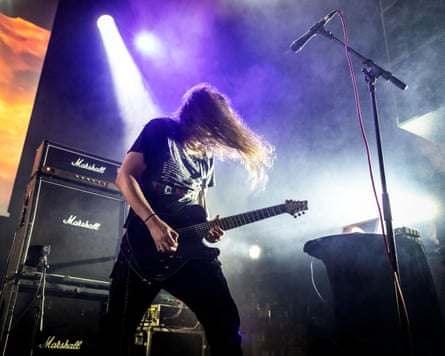
After performing across Europe and North America as Jesu in 2007, Broadrick quit drink and drugs and gave up touring. “I ended up drinking a bottle of Jack Daniel’s every night,” he says. “Total self-destruction. I was killing myself, so I had to address it. I had to stop touring.”
Two years later, craving a heavier counterpart to Jesu, he restarted Godflesh with Green. They’ve experimented plenty since the early days: they’ve done dub remixes, some of their later beats took from hip-hop and breakbeat, and new album Decay contains two of their longest, most claustrophobic compositions in Master and Slave and Consume Me.
But Broadrick feels trapped by the band’s framework. His hernia didn’t cause their impending split as much as confirm it.
“The Godflesh template has become dated to me,” he says. “It’s very 80s and 90s, like a noise rock band. For want of a better analogy, it’s very meat and potatoes. I always wanted to go much further than that. You can step outside the template, but it won’t be Godflesh any more.”
He hopes to record Godflesh’s final album, aptly entitled The End, in November and December and release it as soon as possible. It’ll feature vocals, but they’ll be higher-pitched screams and spoken-word sections that he can handle safely. He reveals that the music will mark a “sideways step” for the band, as he plans to use a guitar with a tremolo arm: something Godflesh haven’t touched since their debut album.
After Godflesh are put to bed, Broadrick, as well as continuing with Jesu and his electronic solo project JK Flesh, will form a new “brutal, industrial, heavy” solo band called White Light District. There’ll be sampled percussion and electronic textures. Live, he’ll be joined by a session drummer.
“I wouldn’t dare call it a Godflesh replacement,” he says. “Because it’s heavy, ugly music, people may venture that it is, but it will be less rock based. It’s not confined by that instrumentation. It will sound like Glenn Branca with metal guitars, except it’s not metal: 15 layers of guitar that create this ultra-cluster of fucking hallucinatory dissonance, which could not be created by a band.”
As he readies The End and this new pursuit, Broadrick admits that Godflesh’s retirement hasn’t sunk in yet. He believes, in a way, that the band will live for ever. “I’m not saying this arrogantly, but I think it will always be a beacon. It was a vehicle for my alien way of writing things, and I will still be writing shit like that. It’s outsider music. It doesn’t belong, and I don’t belong, and I’m happy to not belong. I don’t want to belong.”