.png) 3 months ago
76
3 months ago
76
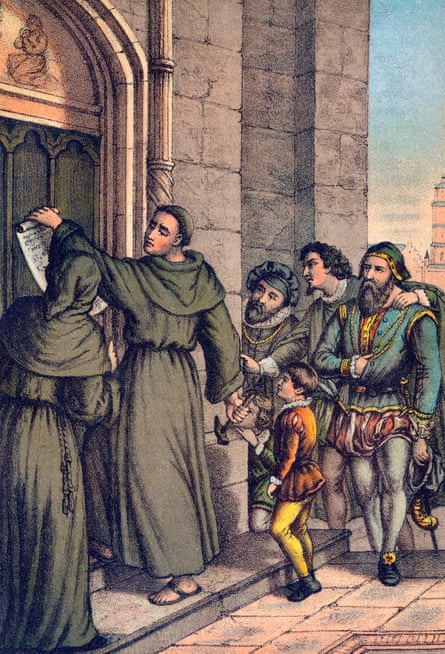
It is All Hallows’ Eve – Hallowe’en to you and me – in 1517. Martin Luther, a 33-year-old German priest and scholar, marches up to the church in Wittenberg and nails a document to the door. On the document, in Latin, are 95 statements, or theses, protesting against corruption in the church. Luther is particularly exercised by the practice of indulgences: whereby the rich can buy their way to heaven by lining the pockets of priests and the papacy here on earth. Much more fundamentally, he’s suggesting that everybody can have a direct and personal relationship with God without the mediation of the rituals and hierarchy of the church. The rebel priest is excommunicated for his trouble, and then summoned to a Diet (a church assembly) in the city of Worms. He’s declared a heretic and faces death by burning at the stake. There’s a dramatic escape involving disguise and a fake abduction – and the Reformation begins.
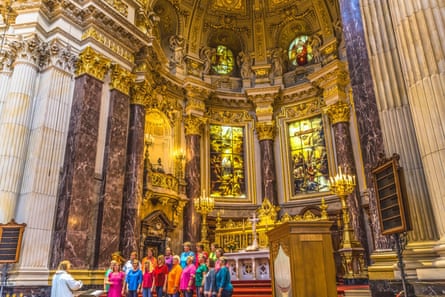
What has all this got to do with music? In Radio 3’s new series Key Changes, we’re looking at pivotal events over a thousand years of history which have changed the course of music. Luther’s Reformation was, for sure, one of these events. Luther was a musician himself. He knew music theory, he played the lute and the flute and he saw music as a divine gift “next to theology”. But some of his more fundamentalist adherents would like to have seen music off altogether: away with elaborate polyphony, mass settings and anthems – the unadorned word of scripture is enough!
If Luther hadn’t been a musician, the course of music history might have been very different. But he realised how powerful music could be in spreading his new doctrine, that it could “incite people to do good and to teach them”. He’s one of several figures to whom the phrase: “Why should the devil have all the best tunes?” has been credited. He almost certainly didn’t say it, but he should have.
Some reports say that Luther and his followers were defiantly singing hymns as they rode into Worms for the trial. And Lutheran hymns were a new kind of music to match the new theology: simple, memorable tunes, some adapted from popular melodies, repeated verse to verse. Crucially, the words were not in Latin, but in everyday German. And, in place of complex counterpoint, the hymn tunes were harmonised with simple, block chords so that the all-important religious words were easily understood. This is music that anybody could sing at home, in the street, in school. Church music was no longer an elaborate art form performed at people by monks and scholars. Everybody – even the majority of Germans who were illiterate – could join in and raise their voices in worship.
If, like me, you grew up singing hymns in church (and a lifetime later can’t get them out of your head), this is where it all began. One of the most famous of Luther’s hymns, dating from around the time of the Diet of Worms, is Ein feste Burg ist unser Gott – A Safe Stronghold Our God is Still – sung to this day in churches around the world, its tune as craggy and imposing as the words.
Luther’s hymns were known as chorales in the German-speaking world and were soon gathered into books and widely distributed, taking advantage of the relatively new technology of the movable type printing press, invented in Mainz by Johannes Gutenberg some 60 years earlier. And, as Luther intended, the printed chorales spread the new doctrine like wildfire. In 1524 in Magdeburg, before Luther could visit to preach the new ideas, crowds gathered to sing his chorales in protest against the selling of indulgences in the city. Luther himself composed many of the chorales, as did his followers including some women. Elisabeth Cruciger, a nun from Pomerania in what is now Poland, abandoned her holy orders and travelled 250 miles to follow Luther’s reformation. She wrote poems and hymns, and her only surviving chorale, the affecting Lord Christ, the only son of God was published in one of the first Lutheran hymnals.
Composers being composers, it wasn’t long before the urge to elaborate on the austere, direct and democratic music of the Reformation became too strong. Lutheran chorales were an ideal framework for all sorts of music, inside and beyond the church – an irresistible source material for musical flights of imagination. Early the next century, Heinrich Schütz, a good Lutheran, went to the Basilica of St Mark’s in Venice and came back intoxicated by the white-hot theatricality of Gabrieli and Monteverdi. This soon found its way into his compositions around Lutheran psalm settings and chorales. Johann Sebastian Bach, a lifelong church musician living 200 years after Luther, composed many new chorales himself and clothed literally hundreds of existing ones in the richest, crunchiest harmonies imaginable.
But Bach also wove those chorales into elaborate musical structures. A favourite is the chorale prelude, usually written for organ, where an elaborate, totally new and always arresting melodic line unfolds until the chorale tune emerges out of the music like an old friend. Because his congregation knew these tunes and words well, Bach’s complicated counterpoint connected directly with them.
This music lived on down the centuries in new versions; think of the essential 1960s sound of the Swingle Singers’ doobeeboo version of the Wachet Auf Chorale Prelude over louche jazz bass and drums; or the British pianist Myra Hess’s arrangement of the Chorale Prelude Jesu Joy of Man’s Desiring with its irresistible flowing triplets over the serene chorale melody. This became a source of strength and spiritual solace in wartime Britain when she played it regularly as part of her morale-boosting National Gallery concerts. And Jesu Joy has even had a life in 70s pop, providing a one-hit wonder, Joy, for the band Apollo and the material for The Beach Boy’s Lady Lynda.
In the 19th century, Felix Mendelssohn wrote a symphony to commemorate 300 years since the Reformation. The symphony’s finale is given over to a musical exploration of Luther’s Ein Feste Burg, with the chorale stated triumphantly at the end. Mendelssohn – born into a prominent Jewish family – was a convert to Lutheranism. But the protestant Reformation had also reshaped old prejudices: I wonder if Mendelssohn took into account that Luther wrote virulently antisemitic texts which were a reference point for negative attitudes towards Jews in Germany for centuries.
Lutheran chorales turn up in even more unexpected places in the 20th century. In the loft culture of 1970s Manhattan the black, gay activist composer and pianist (and one-time church choirboy) Julius Eastman hammered out Ein Feste Burg at the climax of his pounding minimalist work Gay Guerilla. And Bertolt Brecht, who cited Luther’s German Bible as his most important influence and perhaps also envied Luther’s effectiveness in spreading a message far and wide, was a great devotee of the Lutheran chorale. Chorales appear throughout his operas written with Kurt Weill. At the end of his 1928 Threepenny Opera the cast all sings a unison chorale about the futility of fighting injustice. The bleak nihilism of the words are of their time and place; but they are elevated by a tune which Luther, or Bach, or Elisabeth Cruciger could have written.