.png) 2 months ago
60
2 months ago
60
It should be uncontroversial to state that what we want to be called – or do not want to be called – should be respected. This simple enough principle is what defined the grievance between NHS co-workers Ilda Esteves and her colleague Charles Oppong.
Last week, an employment tribunal ruled in Esteves’ favour, agreeing she was subjected to harassment from Oppong for his repeated references to her as “auntie”. The healthcare assistant was awarded £1,425 in compensation.
The tribunal heard that Oppong defended his actions by claiming “auntie” was, in his Ghanaian culture, a term of respect for older women. But Esteves, 61, had asked him to stop. He did not.
It went further than the unwanted name. Oppong also suggested, the tribunal heard, that an older colleague would be a “good match” for Esteves: this was clearly a case of inappropriate over-familiarity.
The dispute is perhaps especially charged because the workplace sharpens the gulf between what is learned behaviour from home and what is appropriate in our shared spaces, such as school or work. Habits we have been raised to see as harmless – be that a jokey manner, the liberal use of expletives in our sentences or, as in this case, the title used to address our colleagues – can be read very differently.
This is why, despite Oppong’s clear transgression, the story – shared on a parent group chat and duly forwarded by me (as any self-respecting “auntie” would) to family and black and brown friends – struck a note of discomfort.

For many west African, Caribbean and South Asian people, “auntie” and “uncle” are, indeed, used as honorifics. In fact, last year DKMS UK, a charity fighting against blood cancer and blood disorders, launched the campaign Listen to your Aunties! to encourage Black and South Asian communities to join the stem cell donor register – a clear signal that this is a title conveying authority.
It is so ingrained in many of us that it can come out like a reflex: in childhood, referring to an elder person by their first name could earn you a rebuke from your parents for being disrespectful. You are older than me, those terms say, and that carries weight.
In these contexts, using auntie and uncle signals good manners. It shows, too, that we are part of a culture that values age, viewing it as imbued with the twin wealth of experience and wisdom. Of course, members of the diaspora can invert the premise of these terms to emphasise how out of touch an elder person is. Describing a person as an auntie or uncle can be used to challenge their authority or understanding. Its migration across continents means that it can impart dignity in one culture while being quietly embarrassing in another.
So when auntie lands in the British workplace, in a culture where age hierarchies are flattened, it arrives laden with implications. Rather than as a sign of respect, it can be interpreted as an attempt to undermine a colleague, or even push them out. For this is a society in which older women feel compelled to hide their age due to ageism and misogyny: our age becomes something to ignore, rather than to be celebrated.
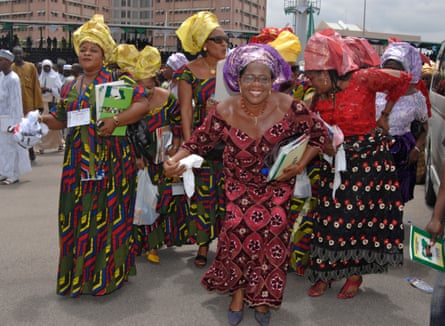
Despite this, I personally do not share this western discomfort with ageing. I am unmistakably now middle-aged, and when I relay that to colleagues or new acquaintances, it is met with a peculiar response. People behave as though being frank about your age amounts to self-deprecation. “You don’t look it,” they might say. Meant kindly, without a doubt, but odd given that I do. The cultural framework goes: she is older and therefore wishes to be younger. But as my brother, who lives in Nigeria, astutely puts it: “I have earned my grey hairs.” Every single one.
This is what comes from belonging to multiple cultural identities: one set of assumptions is brought into sharp relief because you have been shaped by another. What is the problem with looking my age and visibly carrying signs of the years I have lived? Likewise, why must I consider it taboo or even rude to be asked how old I am and thereby respond with hedging or the sense that I have been offended? Why should my 45 years on this planet be borne as a source of shame?
What can’t be denied is that a corollary of not “seeing” a person’s age is the awful fact of turning them invisible. How liberating to step beyond those limitations. To acknowledge getting old with pride rather than regret. It explains why the word “auntie” lands so differently for me. This is not to say I necessarily want to be called it in every context or by everyone, but I also recognise what the moniker is trying to do. By not denying age and instead valorising it, it makes clear its worth.
To age like a fine wine shouldn’t, then, be a special compliment for those of us who are deemed to be doing it correctly – not least because at its heart sits the premise that ageing is, inherently, the process of becoming sullied. Here’s to growing old proudly and disentangling ourselves from the worship of youth.
Still, persisting with a title someone has rejected is not a sign of respect. Take the statement as it is intended: free (and perhaps unsolicited) advice from an ageing auntie.
-
Lola Okolosie is an English teacher and writer