.png) 2 months ago
60
2 months ago
60
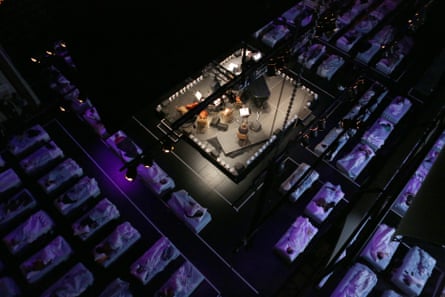
One of the most familiar topics of our time is the trouble many of us have in winding down at the end of the day. Insomnia is rife: crossing the threshold between day and night has become a challenge for many of us. Music is often recommended as a way to help us relax, and there are countless sleep music playlists on streaming sites to lull us into unconsciousness and bear us towards morning on a current of soothing sounds. Max Richter’s Sleep, “an eight-hour lullaby”, a set of musical episodes that mirror what’s happening in our brains during the various phases of sleep, is, 11 years after its release, currently No 2 in the official classical artist albums chart. It’s been performed all over the world, with audience members provided with camp beds, blankets and pillows and gently serenaded through the night by live musicians playing Richter’s meditative score.
Musing over photos of slumbering audiences, I started to wonder about the history of music being used as an aid to sleep. The lullaby must be as old as humanity, but lullabies are essentially vocal. Their words often work against the grain of the music, sometimes conjuring up some very non-soothing images: “When the bough breaks, the baby will fall / Down will come cradle, baby and all.” Lullabies are a strange hybrid, musically comforting yet often expressing a vein of underlying anguish. Sleep music, on the other hand, tends to be purely instrumental. The absence of a voice makes it more abstract; without words, the meaning of the music remains open and listeners are free to connect however their imagination suggests.
Where did this genre of instrumental sleep music begin? Concertos and symphonies certainly contain slow and gentle movements you could think of as nocturnal, but they are not labelled as such. There is also music describing the ghosts and terrors of night (try Schubert’s terrifying song Der Erlkönig or the Dream of a Witches Sabbath from Berlioz’s Symphonie Fantastique), but it is not designed to promote relaxation.
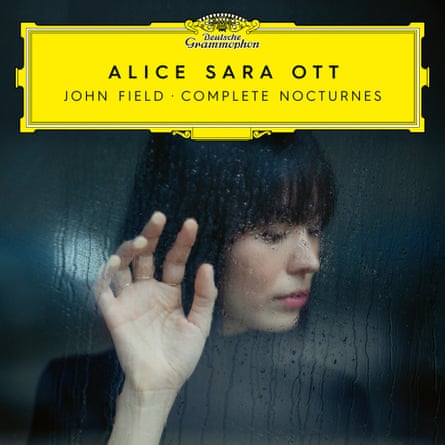
John Field (1782-1837) seems to have been the first to use the term “nocturne” as the title of short stand-alone piano pieces. “Notturni” had previously meant entertainment pieces for the evening, but Field’s Nocturnes are specifically designed to evoke a tranquil evening mood.
Field was born in Ireland and, as a young man, was apprenticed to the composer Muzio Clementi, who ran a piano manufacturing business and employed him to demonstrate the instruments to prospective customers. One of their trips took them to Russia, and when Clementi returned to London, Field elected to stay in St Petersburg. There, he was soon in demand as a pianist, renowned for his gentle, delicate, lucid style of playing. Field began composing and playing Nocturnes around 1812. They tended to feature a slow and lyrical melody in the right hand with a rippling accompaniment in the bass. The fact that these works extolling twilight were written in St Petersburg was not accidental: the city has long been famous for the pearly light of its long summer nights, and Field liked to compose at night with the curtains open.
A few years later, Chopin expanded the form to include stormy, passionate moods and religious and patriotic episodes, as well as meltingly beautiful pieces more like Field’s Nocturnes. Chopin’s own style of playing, often compared with Field’s, was subtle, sensitive and imaginative. He could give the impression of great power and variety of tone, but was said never to play loudly. Sir Charles Hallé, who heard Chopin play in 1836, wrote that the experience left him “filled with wonderment, and if the room had suddenly been peopled with fairies, I should not have been astonished”.
Field’s vision of the piano as “a poet of the evening hours” inspired many other composers, and it remained the pre-eminent instrument for nocturnes. The 13 Nocturnes by Gabriel Fauré span practically his whole composing career and map out a journey from the gorgeous lyricism of his early works to the austere, tightly controlled passion of the later ones. Another notable “nocturnist” was Erik Satie, whose Nocturnes are mosaics of enigmatic small phrases. His impassive and radically restrained piano music turned out to be a great influence on the minimalist and ambient composers of our own day.
Nocturnes found a life beyond music when James McNeill Whistler gave the name to some of his paintings from the 1860s onwards. He acknowledged the inspiration of abstract music, and it is notable that his Nocturnes are usually unpeopled or contain the merest hints of human figures. They in their turn inspired twilit scenes from artists such as Van Gogh, Winslow Homer, Edvard Munch, John Lavery and Charles Rollo Peters. Nocturnes also flowed into the world of literature, permeating the collective unconscious of poets. Oscar Wilde, Conrad Aiken, Rubén Darío, Sylvia Plath, Gabriela Mistral and Louise Glück all wrote Nocturne poems. Kazuo Ishiguro’s first short story collection, Nocturnes: Five Stories of Music and Nightfall, presents melancholy tales of musicians grappling with regret.
And today, there are nocturne perfumes, liqueurs, silks, inks, blueberries, peppers, teas, and flavours of tobacco and vapes. The word alone has come to symbolise dreamlike, peaceful night.
But nocturnes are subtly different from sleep music, which is deliberately intended to be soporific. Nocturnes are tiny three-minute narratives, asking us to follow as the story unfolds. They stand on the threshold between “day mind” and “night mind”, looking both ways – into the light and into the dark. They are, perhaps, a form of “dusking”, the old Dutch custom of pausing to savour the quiet passage to evening. In this twilit realm, we are uniquely open to music’s enchantment.