.png) 3 months ago
75
3 months ago
75
Far-right members of Israel’s governing coalition on Sunday rejected a US-backed plan for postwar governance in Gaza, criticising their prime minster, Benjamin Netanyahu, for failing to annex the Palestinian territory and establish new Israeli settlements in the territory.
After the announcement of the White House’s pick of world leaders who will join the so-called Gaza “board of peace”, which includes Turkey and Qatar, both of which have been critical of Israel’s war in the Strip, Israeli far-right finance minister, Bezalel Smotrich, described ‘‘Netanyahu’s unwillingness to take responsibility for Gaza’’ as ‘‘the original sin’’.
According to Smotrich, himself a settler in the Israeli-occupied West Bank, the Israeli prime minister should have instead ‘‘establish a military government there, to encourage immigration and settlement, and in this way to ensure Israel’s security for many years.’’
The White House announced this week the setting up of the “Gaza executive board,” which would operate under a broader “board of peace” to be chaired by US President Donald Trump as part of his 20-point plan to end the war.
The executive board, described as having an advisory role, includes Turkish foreign minister, Hakan Fidan, and Qatari diplomat Ali Al-Thawadi, alongside other regional and international officials.
Presumably referring to Qatar and Turkey, Smotrich said on X: ‘‘The countries that inspired Hamas cannot be the ones that replace it. Those who support it and continue to host it even now will not be granted a foothold in Gaza. Period.
‘‘The prime minister,” the Israeli finance minister added, “must stand firm on this, even if it requires managing a dispute with our great friend and President Trump’s emissaries.’’
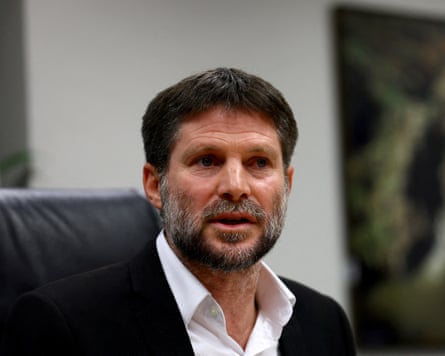
On Sunday, in an apparent attempt to calm tensions and assess his next move, Netanyahu convened a meeting with coalition partners.
The prime minister’s central challenge is containing his far-right allies, whose continued participation in the government is existential to his political survival and who never agreed to a US-brokered ceasefire struck last October.
Netanyahu himself has also objected to the plan on Saturday, citing how some of the appointments were “not coordinated with Israel and were contrary to its policy”, without specifying who it objected to. The Israeli prime minister also told the Israeli foreign minister to contact the US secretary of state, Marco Rubio.
Israel has previously objected strongly to any Turkish role in postwar Gaza, with relations between the two countries deteriorating sharply since the war began in October 2023.
In addition to naming Turkey’s foreign minister to the executive board, Trump has also invited Turkish resident, Recep Tayyip Erdoğan, to join the overarching board of peace, Abdel Fatah al-Sisi, former UK prime minister Tony Blair and the president of Argentina, Javier Milei.
The White House said Trump’s plan would include three bodies: the board of peace, chaired by Trump; a Palestinian committee of technocrats tasked with governing Gaza; and the Gaza executive board, which would play an advisory role.
The Palestinian technocratic committee held its first meeting in Cairo on Saturday.
A draft charter sent to about 60 countries by the US administration calls for members to contribute $1bn in cash if they want their membership to last more than three years, according to the document seen by Reuters.
“Each Member State shall serve a term of no more than three years from this Charter’s entry into force, subject to renewal by the Chairman,” the document, first reported by Bloomberg News, shows.
“The three-year membership term shall not apply to Member States that contribute more than USD $1,000,000,000 in cash funds to the Board of Peace within the first year of the Charter’s entry into force.”
The diplomatic developments came as the United States said this week that the Gaza truce plan had entered a second phase, shifting from implementing a ceasefire to the disarmament of Hamas, whose 7 October, 2023 attack on Israel triggered the Israeli offensive in Gaza.
The focus of the second phase has shifted from simply stopping the fighting to establishing transitional governance, demilitarisation, and reconstruction in the territory – a dramatic escalation of diplomatic ambition amid persistent violence from the Israeli military.
At least 451 Palestinians have been reportedly killed since the ceasefire took effect in October last year.
Life in the enclave remains precarious. While airstrikes and gunfire have slowed, they have not ceased. At the same time, recent storms have compounded the crisis, causing deaths and flooding in displacement camps already stretched beyond their limits.
Strong winter winds caused walls to collapse on to flimsy tents housing displaced Palestinians on Tuesday, killing at least four people.
On Saturday, a 27-day-old baby died in Gaza from severe cold, bringing the number of children in the region who have died of hypothermia since the start of the current winter season to eight, according to the Palestinian health ministry.
AFP contributed to this report