.png) 2 months ago
68
2 months ago
68
There were 68 goals in the last 16 of the Champions League, which is not only a lot but goes against the trend of the previous four seasons. What’s going on? Has football suddenly become more attacking again? This surely can’t all be down to Premier League sides struggling to defend against teams who don’t just rely on corners but actually attack from open play, can it?
An average of 4.25 goals a game is highly unusual, particularly given the recent context. Before 2008-09 there was only one season when the knockout phase of the Champions League yielded more than three goals a game; between 2008-09 and 2019-20 there was only one season when goals per game dipped below three. There then followed four campaigns in which the average did not climb above 2.72 (and in 2022-23, it was as low as 2.34), before bouncing back to 3.29 last season (including the playoff round). The playoff round this season produced 3.94 goals per game – and there were no Premier League teams involved; this is not purely an English issue.
The sample size is limited, but 32 games yielding an average of more than four goals a game is a marked uptick. There had been a theory that the abolition of the away goals rule in 2021 lay behind the drop in the number of goals – although that didn’t explain why the decline began the previous season – but if that did have an impact, it seems to have been temporary.
Goals per game in the Premier League, to offer some context, has remained fairly consistent at about 2.7-2.8 over the past decade. It’s probably to be expected that two-leg knockout ties would produce more goals than league games. If a team is two, even more, goals behind, there’s little to be gained in accepting it: a side may as well keep attacking however unlikely a comeback may be; there is no goal difference to be protected. And there is the possibility of extra time: one game in both the playoff round and the last 16 had 30 minutes added, in each case yielding two additional goals. But that still doesn’t explain the explosion of goals over the past nine days.
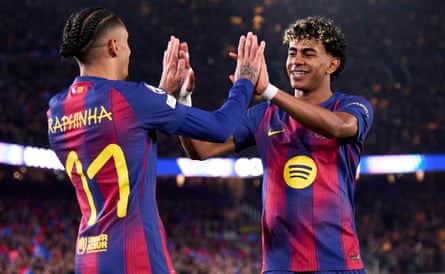
There are always individual circumstances. There were a couple of obvious mismatches – and that such imbalances can occur at this stage should worry all of European football. Atalanta and Galatasaray were a little fortunate to get through their playoff games, and found themselves up against, respectively, a rampant Bayern and a Liverpool side who, despite their uncertain form, proved far too good back at Anfield. Three of the goals were conceded by Tottenham in the first 15 minutes of their game at Atlético, and had their origins not in some deeper movement but in the very specific crisis caused by the selection of Antonin Kinsky, itself a reflection of Spurs’ broader crisis.
Newcastle in their second leg against Barcelona and Chelsea in their first against Paris Saint-Germain were both probably victims of chasing a game that was getting away from them, conceding goals on the break that increased the margin of victory beyond the magnitude of the difference in ability between the sides. There’s a strange nexus of results there that should make everybody cautious about drawing overly broad conclusions: Chelsea overpowered Barcelona in the league phase, when Newcastle drew away to Paris Saint-Germain. In the Premier League this season, Newcastle drew at home to Chelsea then beat them 1-0 at Stamford Bridge. Yet Chelsea lost 8-2 on aggregate to PSG and Newcastle 8-3 on aggregate to Barça.
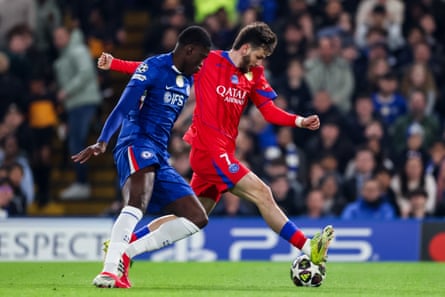
But perhaps simply to say they were carved apart on the counter is insufficient. Why should that be a greater issue this season than in previous years? The answer to that perhaps implicates all Premier League clubs. There seems to be a consensus, so general that it even apparently includes Pep Guardiola, that orthodox Guardiola-style football is over: juego de posición is no longer pre-eminent. But there is no agreement on what should come next.
This could be an opportunity for managers to experiment and set off on their own voyages of discovery. Instead, there seems general confusion with everybody awkwardly following the one manager who does have a clear plan: Mikel Arteta. And so Premier League football, nearly two decades on from the shit-on-a-stick era, has entered what James Horncastle has memorably described as the shit-at-the-back-stick era: all long throws and corners, caution and control.
Can it really be the case that Premier League sides, used to the congested midfields and complex pressing schema of their domestic game, heads full of theories on how to combat inswingers and protect their goalkeeper, have forgotten how to deal with teams whose response to winning the ball back is not to set up to counter a counter but simply to counter? Have they lost the knack of dealing with opponents who run with the ball, who are capable of slicing through opposing midfields? Could it be that the widespread acceptance of the Arteta principles – drop back into shape, don’t overcommit, attack through set plays as necessary – has left Premier League sides unable to deal with anything different?
Certainly the feel over the past couple of weeks has been the return of the old paradigm that English sides could physically overpower some European sides but not the most gifted. Perhaps the reversion to a more physical style is not so inevitable as this season’s Premier League has made it seem.